

When you play live casino games online, you’ll see every table comes with its own betting limits. Betting limits mean the smallest and largest amounts you can put on a single bet at any live casino table. These numbers decide which tables you can join and how you’ll manage your money while playing.
Knowing the limits helps you avoid tables that could wipe out your bankroll too quickly. If you’re jumping into blackjack, roulette, poker, or baccarat with a live dealer, always check these numbers before you take a seat.
Some tables let you bet just $1, but others—especially for high rollers—might demand $100 or even more per hand. Don’t let your excitement land you at a table that’s out of your league.
I’ll break down how these limits work, why casinos set them, and how they can impact your experience. You’ll get the details on different types of betting limits and how to spot tables that actually fit your style and budget.
Key Takeaways
-
Betting limits tell you the minimum and maximum you can put down at each live casino table
-
Games and platforms offer different ranges to suit both casual players and high rollers
-
Picking tables with limits that fit your budget helps you play responsibly and protect your bankroll
Understanding Live Casino Betting Limits

Live casino betting limits set the floor and ceiling for each bet you make. Every table has these boundaries, and they shift depending on the game, the provider, and whether the table’s for casuals or high rollers.
What Are Live Casino Betting Limits?
Think of betting limits as the rails that keep your wagers in check. The minimum bet is the least you’re allowed to risk, and the max is the most you can put on a single round.
Whenever I enter a live casino lobby, I check the game tiles or table placards for these limits. For example, a blackjack table might read $5-$500, so I know I can’t bet less than $5 or more than $500 per hand.
Operators work with providers like Evolution or Ezugi to decide these ranges. Some tables are super affordable, starting at $0.50 or $1, while VIP tables might let you go as high as $10,000 or more. The exact numbers depend on the game variant and how much risk the casino’s willing to take.
How Table Limits Work in Live Games
Table limits don’t change mid-session. Before you join, just check the info panel or the little sign on the screen near the dealer for the current min and max bets.
Watch out—each bet type can have its own limits. In roulette, inside bets and outside bets often have different maximums. You might get $500 on red/black but only $100 on a single number. Casinos use this to control their risk, especially on long-shot bets.
The dealer, or rather the casino’s system, won’t let you bet outside these boundaries. If you try to go above or below, your bet just won’t be accepted. Some tables also set win caps, which limit how much you can win in one round, no matter how much you wager.
Purpose and Importance of Betting Limits
Betting limits are there for a reason—they protect both you and the casino. Minimum bets make sure the casino covers its costs and keeps the table running profitably. Maximum bets stop anyone from placing a wild wager that could do serious financial damage to the house.
From a player’s side, these limits are a tool for managing your bankroll. When I pick a table with a low enough minimum, I can stretch my playtime and avoid blowing through my funds in a flash. If you’re using progressive betting systems, you’ll need tables with higher maximums to make your strategy work.
Limits also encourage responsible gambling. They set boundaries that help you avoid betting more than you can afford. A good live casino will offer a mix of tables with different limits, so you can find the right fit for your experience and budget level.
Types of Live Casino Betting Limits
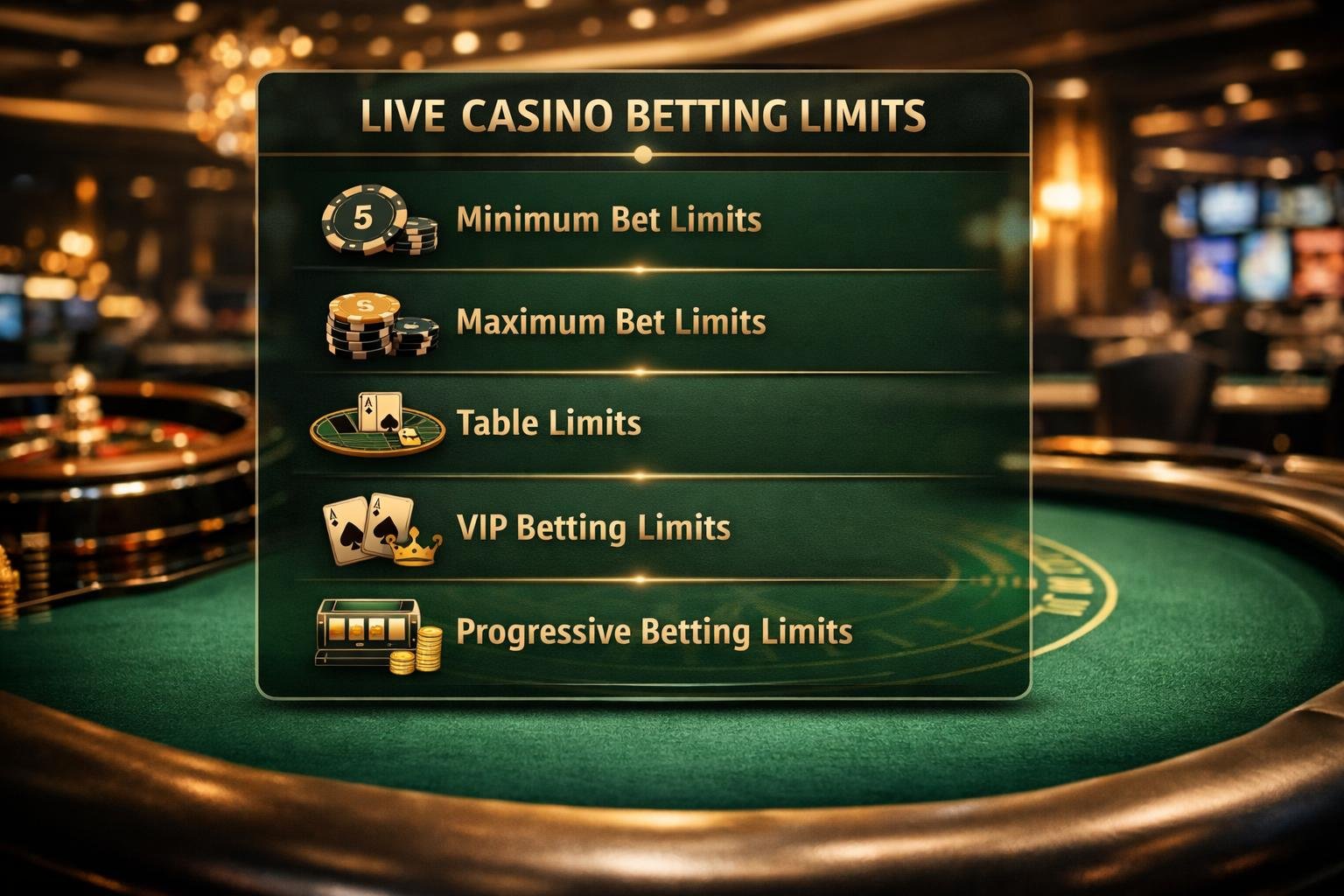
Betting limits in live casinos can swing wildly depending on your game and table. Some roulette tables let you start at just $0.10, while high-limit baccarat tables might let you go up to $150,000 per hand. That’s a huge range, and it’s up to you to find your comfort zone.
Minimum and Maximum Bets for Popular Games
Every live casino game comes with its own betting range. Live blackjack and poker usually start with minimum bets between $1 and $10, while the maximums can stretch from $2,500 to $100,000, based on the casino’s policy.
Roulette is where you’ll see the biggest spread. Some sites let you bet as little as $0.10, but others let you chase a $75,000 max. Remember, these are total table limits, not always for a single bet like a straight-up number.
Baccarat tends to start higher. Most standard baccarat tables have minimums from $1 to $10, but max bets can climb to $150,000 at elite casinos. Side bets usually have lower minimums than the main game.
Differences Between Low-Limit and High-Limit Tables
Low-limit tables are perfect for casual players or anyone testing the waters. These usually have minimums between $0.10 and $5, with maximums around $1,000 to $5,000.
If you’re a serious player with a bigger bankroll, high-limit tables are your playground. Here, minimums often start at $25 or $100, and max bets can blast past $10,000—sometimes hitting six figures.
It’s not just about the cash. High-limit rooms often come with perks like faster dealers, fewer players, and better service. Low-limit tables? They’re busier, a bit rowdier, and full of recreational players just looking for some fun.
How Online Casinos Set Their Table Limits
Casinos set limits to keep their financial risk in check while making sure games stay accessible. They look at the house edge, expected player numbers, and their overall bankroll when deciding these numbers.
Games with a low house edge like blackjack usually get stricter maximums. Side bets and higher-edge games can afford to offer bigger max bets. Speed matters too—faster games mean more hands per hour, which increases risk for the casino.
Some casinos even tweak their minimums during busy hours. If you notice limits creeping up in the evening, that’s not your imagination—it’s just supply and demand at work.
Standard vs. VIP and High Roller Tables
Most players end up at standard tables, where the betting limits strike a balance between accessibility and the casino’s bottom line. You’ll often see blackjack minimums around $5 and maximums between $5,000 and $10,000 here.
VIP tables raise the stakes. You might face a $100 minimum but get a $50,000 maximum, while a standard table could be $1 to $5,000. These are for folks who want a bit more privacy and a lot more action.
High roller tables take it up another notch. Casinos sometimes keep these limits under wraps, only revealing them to VIPs. If you’re in that club, you might negotiate a $200,000 max for baccarat or $100,000 for blackjack through your account manager.
These tables usually live in separate rooms with private dealers and service that regular players don’t get. If you’re there, you’re probably not worried about the minimums anymore.
How Live Casino Betting Limits Affect Your Experience
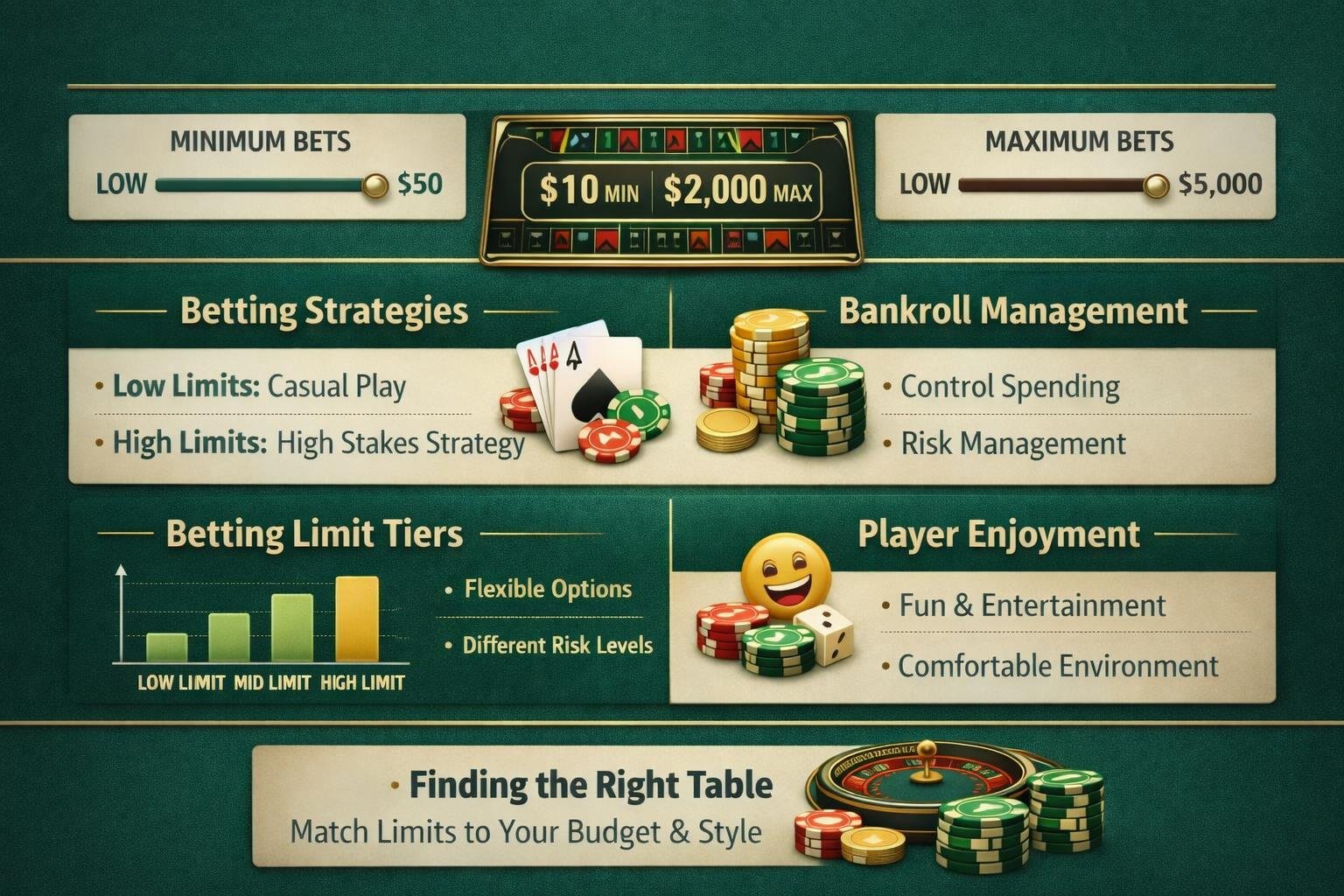
Betting limits shape every move you make at a live casino table. If you don’t pay attention, you could end up overspending or missing out on the right table for your style.
Choosing the Right Table for Your Budget
I always scan table limits before sitting down. The minimum tells you the lowest you can risk, and the maximum is your ceiling.
Say you’ve got $100 and pick a table with a $25 minimum—you’re down to just four rounds. That’s not much chance to ride out bad luck or enjoy the game. I recommend keeping your minimum bet at 2-5% of your total bankroll.
High rollers need a different approach. VIP tables might let you go up to $10,000 or more, while standard tables often cap out at $500. Good platforms show these limits right on the game tiles, so you can avoid nasty surprises.
The Role of Betting Limits in Bankroll Management
Limits directly control how long your bankroll lasts. I use them to make sure I’m not burning through my funds in five minutes.
The minimum bet decides how many shots you get. With $200 and a $5 minimum, you have 40 rounds. Drop to a $1 minimum, and suddenly you’ve got 200 chances.
Maximum bets protect you from chasing losses. If I’m on tilt, the max limit stops me from making a reckless bet that could empty my account. It’s a built-in safety net, especially when emotions run hot.
When I’m planning withdrawals or chasing a specific goal, I check if the table’s max payout will even let me get there. Quick, hassle-free withdrawals often depend on smart session management and picking the right limits.
Impact on Betting Strategies
Some betting strategies just don’t work if the table limits are too tight. The Martingale system, for example, needs low minimums and high maximums because you double your bet after each loss.
Here’s how Martingale can trip you up:
-
You start with $5 and lose
-
Next bet is $10, then $20, then $40
-
After six straight losses, you need to bet $320
-
If the max is $200, you’re stuck—strategy busted
Progressive systems just can’t function with low maximums. I’ve seen tables with $5 minimums and $100 maximums—that only gives you four doubles before you hit a wall.
If you stick with flat betting, the minimum matters most. I can play for hours at a $1 minimum table without sweating the max. That’s the safer route for most players.
Don’t forget—some bonuses limit your max bet during wagering. Even if the table lets you go higher, the bonus terms might cap you at $5 per round until you clear the requirements. Always read the fine print, or you could lose your bonus winnings over a technicality.
Responsible Gambling and Maximum Payouts
Maximum bets play a huge role in keeping gambling responsible. These limits help protect you from making a disastrous wager that could wipe out your finances in an instant.
I've found it smart to set personal deposit limits that work hand in hand with table limits. For example, if my weekly deposit cap is $200 and the minimum bet sits at $50, I can't play more than a few sessions before I have to pause and reassess.
Maximum payouts often tie directly to the maximum bet. Take roulette: a 35:1 payout on a single number with a $100 max bet means you can't win more than $3,500 on that spin. Knowing this, I always check if a table aligns with my goals before I play.
Warning signs to watch:
-
Frequently bumping into maximum bet limits
-
Sitting at tables where the minimum is more than 10% of your bankroll
-
Skipping low-limit tables because they seem "boring"
Betting limits aren't obstacles—they're guardrails. They keep your play in check, letting you have fun and use your strategy without putting your well-being at risk.
Understanding Table Limits Across Different Platforms

When you look at live casinos, table limits can swing wildly depending on the software provider and your location. Studio operations, casino policies, VIP perks, and features like bet behind all play a part in shaping those ranges.
Live Dealer Studios and Software Providers
Most online casinos don't run their own live games. Instead, they license software from giants like Evolution Gaming, who stream tables from their studios to dozens of casino sites all over the world.
It's wild, but you and I could be playing at different casinos and still end up at the same blackjack table, facing the same dealer. The studio sets the base limits, but each casino tweaks those numbers to fit their own risk appetite.
Evolution Gaming often runs tables with minimums as low as $1 and maximums soaring to $10,000 or more for high rollers. Other providers set their own structures. Some studios broadcast from real land-based casino floors, while others use purpose-built streaming rooms.
Some casinos even splash out on exclusive branded tables with custom limits for their members. These private tables sometimes offer unique betting ranges you won't find anywhere else.
Betting Limit Variations by Casino and Location
Every online casino sets its own minimum and maximum bets, but only within the boundaries their software provider allows. One conservative operator might cap blackjack at $1,000 per hand, while a site that courts high rollers could go up to $25,000 or more on the same game.
Roulette betting works a bit differently. The minimum and maximum often apply to your total table coverage, not just a single spot. So, you can spread your chips around as long as you don't bust the table limit.
Baccarat usually lists separate limits for banker and player bets. Side and tie bets nearly always have lower maximums than the main bets.
Where the casino is licensed makes a difference. Some jurisdictions slap regulatory caps on maximum payouts, which forces casinos to set lower table limits.
Special Features: Bet Behind, Auto Spin, and Customer Support
Bet behind is a handy feature when all blackjack seats are full. You can still wager on another player's hand, though you have to follow their decisions, and the limits for bet behind are usually lower than for seated bets.
Auto spin roulette tables—those speedy, automated ones—often have different, sometimes lower, limits than standard tables. Casinos use this to manage risk since these games cycle so fast.
If you ever get confused about limits or have a bet rejected, don't hesitate to hit up customer support. Decent support teams will explain the rules, help you find tables that fit your budget, and clarify any weird edge cases you run into.
The Role of Loyalty Programs and VIP Perks
Loyalty programs can open the door to exclusive tables with higher limits for regular players. As you move up the VIP ladder, casinos might invite you into special high-limit rooms that aren't visible to most players.
VIP managers sometimes negotiate custom limits for serious high rollers. If you're betting $50,000 a hand, you might get your own table with handpicked limits tailored to your play style.
Even with these perks, all bets still have to fit within the casino's max payout rules and liability caps. VIPs get higher ceilings, but nobody gets a blank check.
Some loyalty schemes blend perks from live games and sports betting, so you can build status across different activities and unlock better access all around.