


Sign up at any online casino and you'll smack right into deposit limits. These controls dictate how much cash you can pump into your account. They're not just there for show—casinos use them to stop you from torching your wallet and to keep regulators off their backs.
Get a handle on how these limits work and you'll save yourself a lot of headaches, not to mention some money. Trust me, knowing the rules means you won't be blindsided when you want to play and suddenly can't top up your balance.
Deposit limits cap how much you can stuff into your casino account over a set period—daily, weekly, or monthly—and, yes, most regulated markets force casinos to set them. But don't think everyone's limits look the same. Where you live, how long you've been around, whether you've actually verified your ID, even your betting history—they all play a part.
Plenty of casinos let you set your own, lower limits if you want to stay in the driver's seat. And honestly, that's a smart move if you don't trust yourself to stop at "just one more deposit."
Here's the truth: I'm about to break down everything that matters about casino deposit limits. Why they exist, how the rule-makers enforce them, what tweaks your personal numbers, and how you can use these limits to keep your gambling fun—not stressful.
Key Takeaways
-
Deposit limits put a ceiling on how much you can add to your casino account per day, week, or month—mainly to keep you from blowing your budget and so casinos can check the legal boxes.
-
Your actual numbers depend on stuff like account verification, payment method, where you live, and whatever hoops the casino's regulators make them jump through.
-
You can almost always set your own deposit limits lower than the casino's max—perfect for building a gambling budget that won't wreck your bank account.
What Are Casino Deposit Limits?
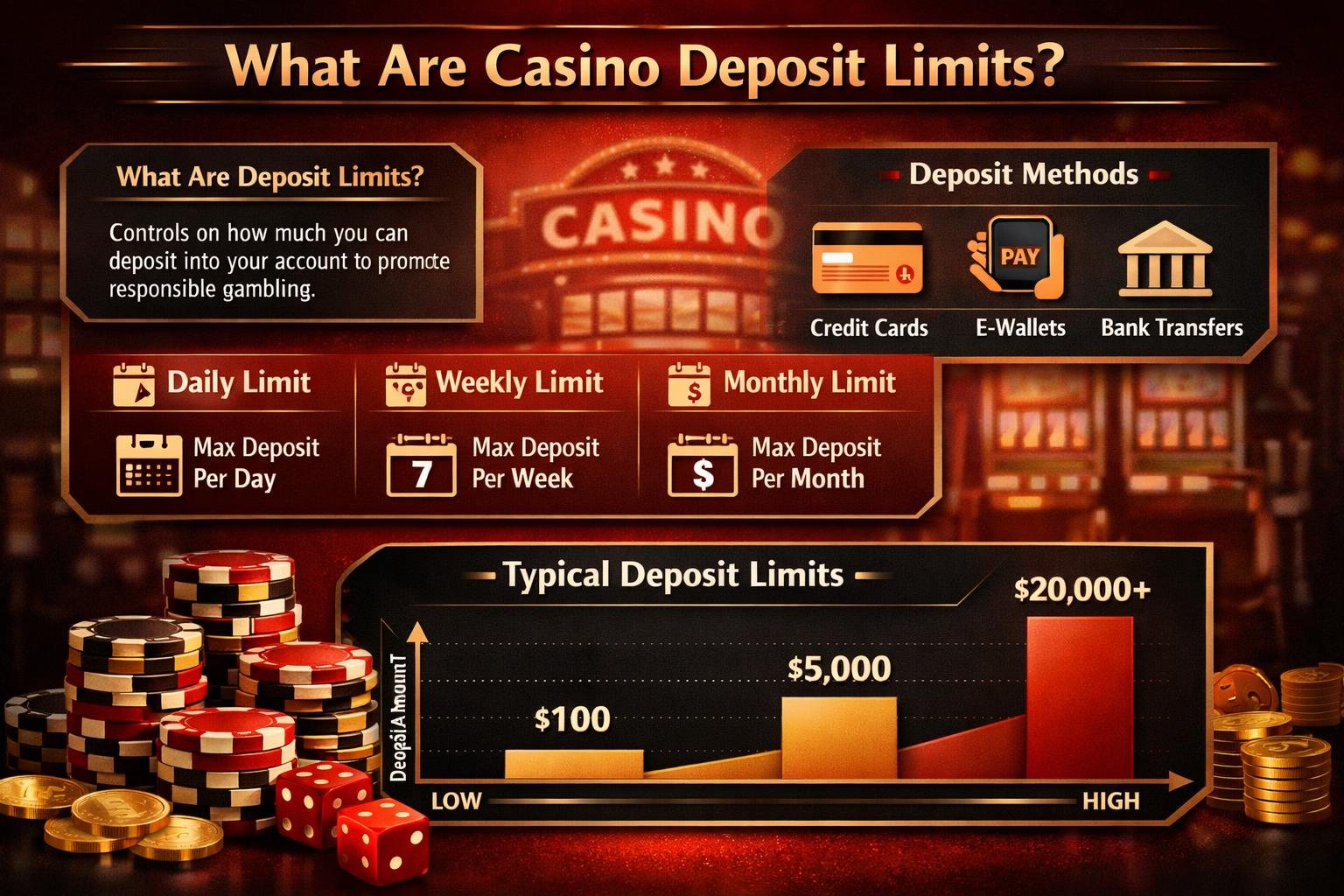
Deposit limits are basically your built-in spending brakes. They stop you from dumping more money than you should into your gambling account over set timeframes. Casinos set them up to work across different payment methods and periods, so you can actually stick to your budget—assuming you want to.
Types of Deposit Limits
Online casinos usually hand you three main types of time-based limits. Daily limits put a stop to how much you can deposit in 24 hours. Weekly limits stretch that cap across seven days. Monthly limits? You guessed it—30 or 31 days, depending on the month.
Most sites let you stack these limits. Maybe a daily $50, weekly $200, monthly $500. Whichever is strictest, that's the one that rules. No loopholes.
Some casinos get fancy and let you set different limits for different payment methods. Maybe you want to go easy on your credit card but don't care about e-wallets. A few even let you split limits by game, but honestly, that's rare and usually more confusing than helpful.
Once you hit your cap, the casino slams the door shut. No more deposits until the clock resets. Your transaction gets shot down, no exceptions.
Deposit vs. Withdrawal Limits
Let's clear up a common mix-up. Deposit limits are about what goes in to your account. Withdrawal limits are about what comes out.
If you max out your deposit limit, you can still cash out your winnings. No one stops you from taking your money back. But withdrawal caps can be a pain—they might block you from pulling out more than, say, $5,000 a month even if you've got double that sitting there.
Casinos usually set withdrawal limits for their own security and to keep regulators happy. Deposit limits, though, are more about you staying in control. Or at least pretending to.
Key Terms Explained
Maximum deposit amount is just the highest chunk of cash you can throw in during one transaction or over a set period. Cooling-off period means you have to wait (usually 24 hours to a week) before a higher limit kicks in. Lowering your limit? That happens instantly.
Payment method limits tie restrictions to specific deposit types—maybe your bank card gets a lower cap than your e-wallet. Regulatory limits come from the top: gambling authorities in certain regions force casinos to set hard caps.
Withdrawal cap is the most you can cash out in a time frame. Don't confuse it with your actual balance or total winnings—it's just another hoop to jump through.
Regulatory Compliance and Industry Standards

Deposit limits aren't just some feel-good feature. They're tangled up in a web of laws that shift wildly depending on where the casino parks its license. Some places force casinos to set strict limits, others just want the option for players to self-exclude. It's a regulatory circus, honestly.
Mandatory Limits and Jurisdictional Differences
The rules change dramatically depending on who's in charge. In the UK, the Gambling Commission makes every licensed casino hand players the tools to set daily, weekly, or monthly deposit limits. You can tweak these downward whenever you want, no hassle.
Some European countries crank it up a notch. I've seen places slap a €1,000 monthly cap on everyone unless you cough up extra paperwork. New accounts? Sometimes stuck with a measly €500 weekly limit or less. Not exactly high-roller territory.
Meanwhile, in the US, it's a state-by-state free-for-all. New Jersey and Pennsylvania force casinos to offer responsible gaming tools but don't set specific dollar limits. They care more about making sure casinos play by anti-money laundering rules and offer enough player protection. The dollar cap? That's on you.
Role of Regulatory Authorities
State gaming boards and commissions run the show. They hand out licenses, audit casinos, and dig into complaints. The UK Gambling Commission? They're notorious for cracking down on anyone who ignores deposit limit rules—lose your license and it's game over.
Regulators make casinos write out compliance programs and prove they're actually following their own deposit limit policies. Licensed casinos have to show how they protect vulnerable players and stop reckless spending. Most regulators also force casinos to offer self-exclusion options and educational resources—because apparently, reading about risks is supposed to help.
Offshore Casinos vs. Regulated Casinos
Offshore casinos play by their own rules. Usually, that's code for "no real deposit limits and zero player protection." If you blow your paycheck there, don't expect sympathy or safeguards.
Regulated casinos, on the other hand, have to follow all the rules. They verify your ID, set clear deposit limits, and spell out their policies. My advice? Stick with licensed operators. They're accountable, and if they mess up, regulators actually care.
Responsible Gambling Tools and Player Safeguards
Modern casinos have finally caught on—deposit limits aren't enough. Now you get a toolbox full of extras: time-based controls, loss caps, and self-exclusion programs. All designed to stop you from going off the rails.
Setting and Modifying Deposit Limits
Setting deposit limits is usually dead simple. Head to your account settings or hit up customer support. Pick daily, weekly, or monthly—whatever fits your style. Personally, I find a weekly limit keeps me from getting carried away on a Friday night.
Want to lower your limit? Happens instantly. Want to raise it? Get ready to wait—there's always a cooling-off period, usually at least 24 hours, sometimes up to a week. It's there to stop you from making a dumb, spur-of-the-moment decision you'll regret.
Some casinos let you set limits per payment method. Others keep it simple and slap one limit across everything. Double-check your casino's setup so you don't accidentally dodge your own rules. If you try to bust through your cap, your deposit gets blocked and you'll get a not-so-friendly reminder.
Cooling-Off and Time-Based Restrictions
Need a break but don't want to nuke your account? Cooling-off periods are your friend. You can take a breather for a day, a week, or even longer—no drama.
During this time, you can't log in, deposit, or bet. The casino locks you out until your chosen break ends. It's not the same as self-exclusion, since your account reopens automatically when the timer runs out.
Session limits are great if you lose track of time. Set an alert or force a logout after a certain number of hours. Time limits can track your overall play across multiple sessions—handy if you tend to binge.
Loss Limits and Reality Checks
Loss limits are the real MVP for those who want to avoid disaster. You pick how much you're willing to lose in a day, week, or month. Hit that number? The system shuts you down until the next period starts.
Casinos calculate your net losses by subtracting your winnings from your wagers. Once you cross your line, that's it—no more bets until the next cycle. No loopholes, no sweet-talking support into an exception.
Reality checks are those pop-ups that remind you how long you've been playing and how much you've spent. Set them for every half hour, hour, or whenever you want. It's a nudge to take a breath and, maybe, rethink your life choices for a second.
Self-Exclusion Options
Self-exclusion is the nuclear option. If you need a serious break, you can block yourself from gambling for six months, a year, several years, or forever. It's the strongest tool for people who need real protection.
When you self-exclude, your account gets closed and you can't open new ones. No deposits, no bets, no bonuses—nothing. Many regions share exclusion lists across all their licensed casinos, so you can't just hop to the next site.
You can request self-exclusion through your account, customer support, or even the regulator. Some places let you ban yourself from every licensed casino in one shot. Once you're on the list, getting back in isn't easy—you'll have to apply and prove you're ready to return.
Factors Influencing Deposit and Withdrawal Limits

So, what actually decides how much you can deposit or withdraw? Several things, honestly. The payment method you pick can come with its own restrictions. Your account profile—how long you've been around, what info you've provided—affects your limits too.
And if you're a high-roller? Casinos might bend the rules for you. But for the average player, expect the usual caps and hoops to jump through.
Payment Methods and Transaction Caps
Let’s be real—payment methods all come with their own quirks and caps. E-wallets like PayPal and Skrill let you drop in anywhere from $10 to $5,000 per deposit. But if you’re going the old-school bank transfer route, expect higher maximums and a wait that can stretch three to five business days. Not exactly instant gratification.
Credit and debit cards? They usually tap out between $1,000 and $2,500 per hit. And here’s a pain: some card issuers flat-out block gambling deposits. When that happens, you’re off to hunt for another way to fund your fun.
Now, if you’re crypto-curious, you’ll find the highest ceilings. Bitcoin deposits can swing from $20 up to a wild $50,000 or more, but don’t get too excited—your real limit is whichever is lower: the casino’s policy or your payment provider’s restriction. It’s a tug of war, and you’re stuck in the middle.
|
Payment Method |
Typical Deposit Range |
Processing Speed |
|---|---|---|
|
E-wallets |
$10-$5,000 |
Instant |
|
Bank Transfers |
$50-$10,000 |
3-5 days |
|
Credit/Debit Cards |
$10-$2,500 |
Instant |
|
Cryptocurrency |
$20-$50,000+ |
10-60 minutes |
Account Settings and Player Profiles
Your verification status isn’t just a boring box to tick—it totally changes your limits. Unverified? You’ll probably get stuck with a $100-$500 daily cap. But once you cough up your ID and proof of address, those limits usually jump to $1,000-$5,000 a day. Not bad for a few minutes of paperwork.
How long you’ve been around matters too. Casinos treat new accounts with kid gloves, starting you off with tight limits that slowly climb after a month or two of activity. Your transaction history and play style also tip the scales on what the casino thinks you can handle.
Most sites let you set your own deposit limits in the account settings. These self-imposed rules are actually pretty useful for budget control. Don’t expect to raise them on a whim, though—a 24-72 hour cooling-off period usually stands in your way if you want to up your limit.
Limit Increases for High Rollers
If you’re dropping $1,000 or more each month, congrats—you’re in high roller territory. You get to request custom limits, and the casino will often assign you a dedicated manager to negotiate your personal deposit and withdrawal thresholds. Perks, perks, perks.
VIP programs crank up withdrawal ceilings, sometimes boosting your daily max from a modest $2,000-$5,000 all the way to $10,000, $50,000, or even more. The ultra-elite might even see those pesky monthly caps vanish completely. Sounds dreamy, right?
But don’t fall for the myth that it’s all automatic. To get those higher limits, you’ll need to show extra documentation and keep a consistent play record. The casino’s going to scrutinize your deposit habits, account standing, and how much action you bring before they give you the green light for bigger thresholds.