

Whenever you grab a casino bonus or promo, you’ll almost always run into something called wagering requirements. Technically speaking, these rules tell you exactly how much you need to bet before you can actually withdraw any winnings tied to your bonus.
Casinos express wagering requirements as a multiple—think 10x or 30x—of your bonus amount, and, as of January 2026, UK regulations cap these at 10x. That’s meant to keep things fairer for players. If you’re not clear on these requirements, you might get a nasty surprise when you try to cash out and realize your funds are still locked up.
I put this guide together to break down how wagering requirements really work under the hood. Here’s how it works: you’ll see how to calculate requirements, what sneaky terms to watch for, and how different games chip in toward clearing your playthrough. Knowing this stuff helps you pick smarter bonuses and actually get value from them.
Getting your head around wagering requirements is crucial if you want to make the most of casino bonuses and avoid headaches. Plenty of players have lost out just because they missed a detail in the fine print. Learn the basics now, and you’ll avoid those rookie mistakes.
Key Takeaways
-
Wagering requirements tell you how many times you have to bet your bonus before withdrawing winnings; UK sites now cap this at 10x.
-
Game types contribute differently—slots usually count 100%, but table games often only count 10% or less.
-
Always read the bonus terms and stick with fair requirements to avoid losing out and to keep your experience smooth.
What Are Wagering Requirements?
Online casinos set wagering requirements on bonuses. In simple terms, these rules outline how many times you need to bet your bonus money before you can cash out any winnings.
Definition and Core Concepts
When I claim a bonus, I can’t just withdraw it or any winnings right away. The casino makes me bet a certain amount first, and that’s what the wagering requirement controls.
You’ll see the requirement shown as something like 30x or 40x. That number means you need to wager the bonus amount that many times. For example, if you get a $100 bonus with a 30x requirement, you’ll need to make $3,000 in bets before a withdrawal is allowed.
Casinos use these rules to prevent bonus abuse. If they didn’t, people would just grab bonuses and cash out without ever playing.
Playthrough and Rollover Explained
You might see “playthrough” or “rollover”—these are just different names for wagering requirements. All three mean the same thing: the total you need to bet before you can touch your winnings.
To figure out playthrough, multiply your bonus by the requirement. So, a $50 bonus at 25x means $1,250 in bets. Some casinos apply the requirement to both your deposit and bonus, which really ramps up the total needed.
Game choice matters. Slots usually count 100% for playthrough, but games like blackjack might only count 10%—or sometimes not at all. That’s a big deal if you prefer table games.
Wagering Requirement Multiples and How They Work
Most casino bonuses come with requirements anywhere from 20x to 50x. Lower is obviously better—20x is a lot easier to clear than 50x.
Some casinos only count the bonus (bonus-only), while others count your deposit plus bonus (deposit + bonus). If you deposit $100 and get a $100 bonus with 30x wagering on deposit + bonus, you’re looking at $6,000 in bets, not $3,000.
Your casino account usually tracks your progress. Most sites also set time limits (often 30 days) and max bet sizes while you work through wagering.
Calculating and Meeting Wagering Requirements
Clearing a wagering requirement isn’t just about spinning slots blindly. The way you deposit, the games you pick, and the time you have all impact your real chances of cashing out. Here’s how to break down the calculations and plan your play.
Bonus Amounts and Deposit Contributions
There are two main ways casinos calculate requirements, and knowing which one applies makes a huge difference. Bonus-only wagering multiplies just your bonus by the requirement. For a $100 bonus at 30x, you need $3,000 in bets.
Bonus plus deposit wagering is tougher. That same $100 bonus with a $100 deposit at 30x means $200 x 30, or $6,000 in bets. Always check if the terms say “bonus and deposit” or “B+D”—that’s the stricter version. Sometimes casinos even mix it up, using different rules for different games.
Free Spins and Their Specific Terms
Free spins are a different beast. When you win, say, $25 from free spins with a 40x wagering requirement, you’ll need to bet $1,000 before you can withdraw. The value of each spin doesn’t matter—only your winnings count.
Most free spins come with a max win cap. If there’s a $100 cap, you can only cash out $100 even if you win $500. That’s something to keep in mind before you get too excited about “unlimited” free spins.
Free spins usually expire faster than deposit bonuses. Often, you get just 24-48 hours to use the spins and maybe a week or two to finish the wagering on any winnings.
Game Type Contributions and RTP Impact
Every game doesn’t pull its weight equally. Slots almost always contribute 100%—so a $10 spin counts as $10 toward your requirement. Table games like blackjack? Usually just 10-20%, so that same $10 bet only moves you $1 or $2 closer.
To figure out how much you really need to bet, divide the requirement by the game’s contribution rate. A $3,000 requirement with 10% blackjack contribution means $30,000 in real bets. So, even though blackjack has better odds, it’s not efficient for clearing bonuses.
RTP (Return to Player) is another big factor. For a 96% RTP slot, the house edge is 4%. That means if you bet $3,000, you can expect to lose about $120 while clearing the requirement. I always look for slots with at least 96% RTP when I’m working through a bonus.
Understanding Time Limits and Expiry
Wagering requirements always come with a clock. Usually, you get 7-30 days from when you activate the bonus. I figure out my daily target by dividing the total requirement by the number of days. For example, $3,500 over 7 days is $500 per day.
If you miss the deadline, you lose both the bonus and any winnings. I’ve seen people lose everything when they’re almost done. I set reminders every couple of days to check my progress.
Some casinos pause the timer during verification, but most don’t. I always finish the wagering before I even think about withdrawing, just to avoid timing messes.
Risks, Player Education, and Responsible Gambling
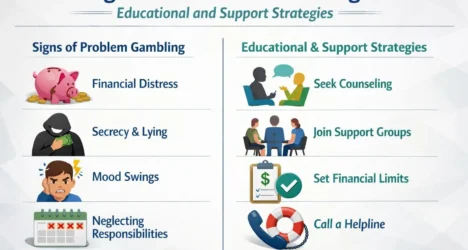
Sports betting isn’t just about fun and games—it comes with real risks, both for bettors and for the sports world in general. These days, educational programs focus on spotting problem gambling and teaching safer habits.
Risks of Sports Betting and Problem Gambling
Problem gambling, especially among young bettors, is a growing concern. Surveys show that 58% of people aged 18 to 22 have tried sports betting. Even more worrying, 16% have taken risky bets, and 6% lost over $500 in a single day.
The damage goes beyond just losing money. Gambling problems can hurt mental health, tank grades, and even mess up future careers. Plus, the rise in betting has led to more harassment of athletes online.
Young adults are especially at risk. Their brains are still figuring out decision-making, and constant betting ads don’t help. A lot of people don’t spot the warning signs until things get really bad.
Role of Sports Wagering Education Programs
From what I’ve seen, the best education programs use peer-to-peer teaching. The NCAA’s e-learning module, for example, reaches over 500,000 student-athletes by featuring former college players who’ve been there. NFL linebacker Zaire Franklin and other ex-athletes share what it’s really like.
These programs cover a range of topics:
-
How betting rules and violations work
-
Spotting the signs of problem gambling
-
Keeping your personal info safe online
-
Handling social media pressure
Groups like EPIC Risk Management and the National Council of Problem Gambling offer expert advice. They’ve already trained over 20,000 student-athletes, coaches, and administrators with targeted programs.
NCAA Sports Wagering Rules and Best Practices
The NCAA keeps a tight lid on sports betting for student-athletes. They ban all betting on NCAA sports, no matter the school or division. That’s how they protect game integrity and avoid conflicts of interest.
NCAA President Charlie Baker wanted to know more about betting on campus, so he ordered research into student habits. Turns out, education works best when it comes from people who’ve lived it. The NCAA now has free interactive tools, scenarios, and Q&A sessions for students.
Best practices? Regular training, clear reporting channels, and working with law enforcement. The NCAA is also pushing to update state laws to crack down on athlete harassment linked to betting losses.