

Let’s be real: how you move your money at an online casino changes everything. The payment method you pick determines how fast you get your cash and how much of your business stays your business. Bank transfers and e-wallets dominate the scene, but they’re nothing alike. E-wallets are lightning-fast and keep your gambling off your bank records, while bank transfers let you move big bucks and grab every bonus in sight.
Choosing between the two? It comes down to your priorities. Do you care more about fees, speed, or just plain convenience? E-wallets like PayPal, Skrill, and Neteller make deposits instant and get your winnings back in a few hours—no waiting, no drama.
Bank transfers drag their feet but let you move serious cash and always count for casino promos. If you don’t know the fees, you could be burning money every time you play.
I’ve put both to the test at a slew of casinos. Here’s the truth: you’re better off using both, depending on the situation. Knowing the real differences—speed, fees, privacy, and limits—means you’ll always pick the right tool for the job.
Key Takeaways
-
E-wallets pay out in hours. Bank transfers? Expect 3-7 days and a different set of security hoops.
-
E-wallets keep your gambling invisible on bank statements. Bank transfers put everything on display.
-
Bank transfers let you move more money, qualify for every bonus, and make meeting wagering requirements easier.
Understanding Bank Transfers and E-Wallets in Online Casinos
Bank transfers move your money straight from your bank to the casino. E-wallets, on the other hand, act as digital middlemen—storing your cash and handling payments. Both let you deposit and withdraw, but the similarities end there. Speed, setup, and available options are wildly different.
What Are Bank Transfers?
Bank transfers link your personal account directly to your casino account. When I deposit with online banking, I pick the bank transfer option, punch in my details, choose my amount, and approve the transaction in my banking app or website.
Every bank has its own way of verifying you. Some want your fingerprint or face. Others text you a code or ask for passwords. A few still hand out those old-school code cards or tokens for extra security. It’s a bit of a circus, honestly.
For withdrawals, I hit “withdraw” at the casino and the money heads to my bank. The first time, you’ll probably need to upload a driver’s license or utility bill—casinos love paperwork. They usually approve it within 24 hours, but the actual transfer? That can take anywhere from one to seven business days, depending on how quick (or slow) your bank is.
Weekdays are your friend—weekends and holidays, not so much. The speed also depends on your bank’s tech and how solid your internet connection is. Don’t expect miracles if your bank still looks like it was designed in 2005.
How Do E-Wallets Work?
E-wallets are digital accounts that hold your money and let you pay casinos without handing over your bank info every time. To get started, I create an account, toss in some basics like my name and birthday, and wait for approval.
Once I’m in, I load up the e-wallet from my bank or credit card. E-wallets are all about making things easy—less time fiddling, more time playing.
Big names? PayPal, Skrill, Neteller, and Wise. Apple Pay sneaks in at a few casinos too.
When I’m ready to deposit, I log in, pick my e-wallet, and breeze through a secure gateway. The money lands in my casino account in seconds. My bank info stays hidden with the e-wallet provider—casinos never see it.
Withdrawals are just as simple. I ask for a payout to my e-wallet, the casino sends the cash, and I can either keep it there or move it to my bank. Super handy if you want to bounce between casinos or just keep your winnings separate.
Popular Providers and Payment Processors
Depending on where you live and which casino you pick, you’ll see different payment processors. Here’s what I run into most:
E-Wallet Providers:
-
PayPal
-
Skrill
-
Neteller
-
Wise
-
Apple Pay
Bank Transfer Methods:
-
Direct online banking
-
Interac (Canada loves it)
-
Wire transfers
-
ACH transfers
Card-Based Options:
-
Visa debit and credit
-
Mastercard debit and credit
-
Prepaid cards
-
Play+ prepaid (casino-only)
-
VIP Preferred (ACH-style)
Some casinos even let you deposit or withdraw cash at their physical cage. What’s available depends on your country and which banking partners the casino has. Not every casino supports every method, so I always check their banking page before signing up. Don’t get caught out.
Key Differences: Bank Transfers vs E-Wallets
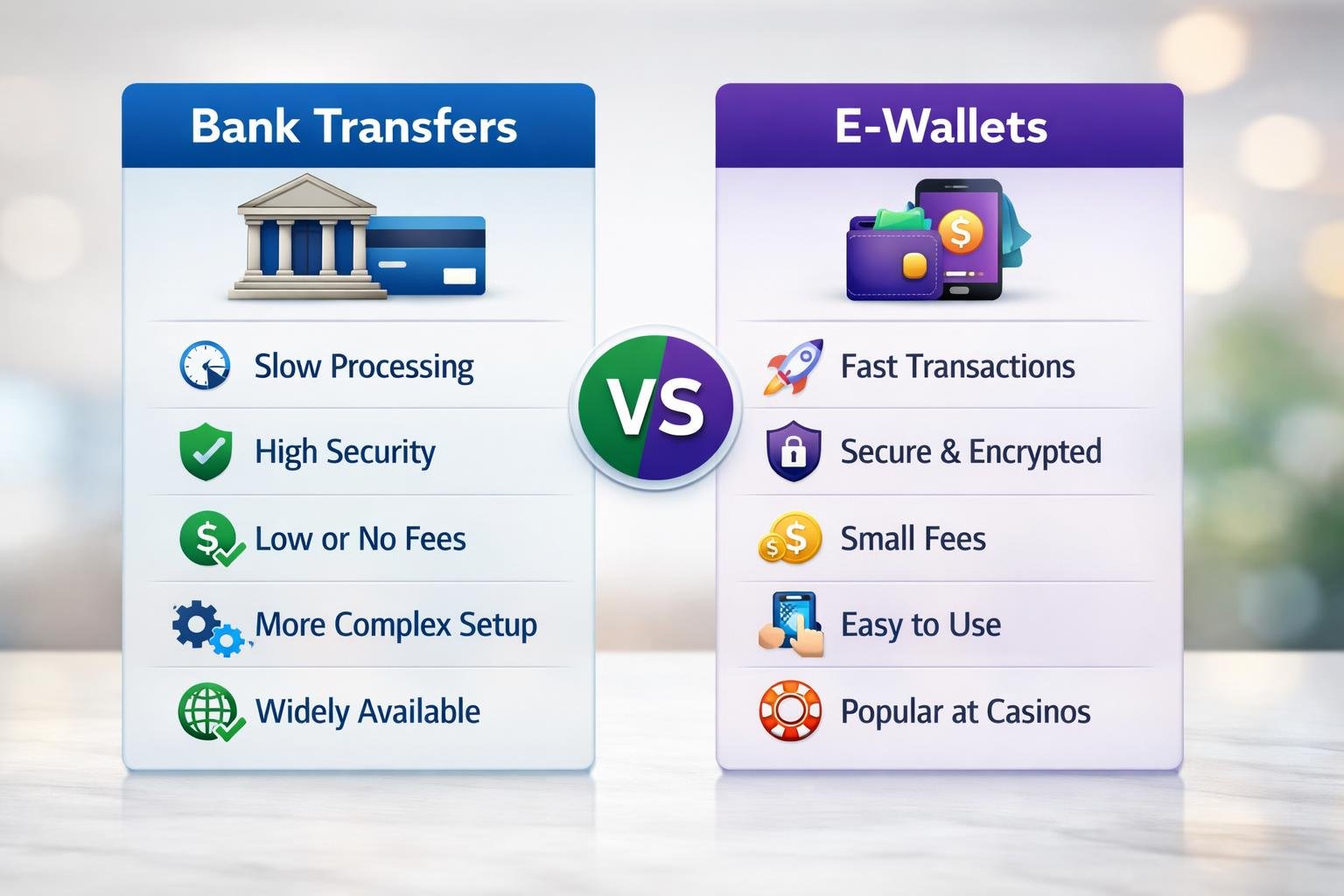
If you want fast money, e-wallets are king. They process deposits and withdrawals in minutes. Bank transfers? You could be waiting days. Fees jump all over the place depending on where you are and who you bank with. Whether you want instant access or massive limits will tip the scales.
Transaction Speed and Processing Times
E-wallets are the Usain Bolt of casino payments. When I deposit, the money’s there instantly. Withdrawals? Usually under 24 hours, sometimes even less. That’s why so many players swear by them—nobody likes waiting for their own money.
Bank transfers are a different beast. Some casinos now offer instant bank transfers, but most old-school options still take 1-3 business days to show up. Withdrawing is where it really slows down—expect 3-7 business days, and that’s if your bank isn’t napping.
ACH (in the US) and SEPA (in Europe) shave off some time, but they’re still no match for e-wallets. SEPA is solid and regulated, but you’re not getting instant gratification here.
Timing depends on your bank’s rules and whether you’re unlucky enough to hit a weekend or holiday. I’ve had bank withdrawals sit for a week during the holidays. Not fun.
|
Method |
Deposit Speed |
Withdrawal Speed |
|---|---|---|
|
E-Wallets |
Instant |
24-48 hours |
|
Bank Transfers |
1-3 days |
3-7 days |
|
Instant Bank Transfer |
Instant |
3-5 days |
Fees and Cost Structure
Let’s talk money. E-wallets can hit you with fees—sometimes 1-3% per transaction. Some let you deposit for free, but charge when you want to move your winnings back to your bank. Read the fine print or risk a nasty surprise.
Banks play their own game. Domestic transfers are often free, but international ones? You could pay $15 to $50 a pop. Some banks sneak in hidden fees, so check before you send. If you’re dealing with another currency, tack on another 2-4% for conversion. Ouch.
Most casino e-wallet deposits are free, but withdrawals might come with a 2-5% processing fee. I always, always check the payment page before picking a deposit method. Don’t fall for “free” claims without proof.
Ease of Use and Accessibility
E-wallets ask you to set up an account and verify your ID before you can play. It takes maybe 10-15 minutes, tops. Once you’re in, though, making deposits is a breeze—just a few taps and you’re done.
Bank transfers are more old-school. You enter your bank info straight into the casino, no extra accounts needed. As long as you’re okay sharing those details, it’s pretty painless.
Most people already have a bank account, so it’s the obvious choice for many. But e-wallets win on convenience after setup—you never have to type your details again. You’ll need a smartphone app or web access, and you have to fund the wallet first. Still, I find e-wallets way less hassle once you’re rolling.
Deposit and Withdrawal Limits
Bank transfers are the heavy lifters here. Deposits start at $500 and can hit $50,000 or more in one go. Withdrawals are just as generous—perfect for high rollers who don’t mess around.
E-wallets cap you lower. Deposits usually top out at $5,000-10,000. Withdrawals? $5,000-15,000 per transaction, if you’re lucky. Land a big win and you’ll be cashing out in batches.
Here’s what I see most often:
-
E-wallet deposit limits: $10 minimum, $5,000-10,000 max
-
E-wallet withdrawal limits: $20 minimum, $5,000-15,000 max
-
Bank transfer deposit limits: $25 minimum, $50,000+ max
-
Bank transfer withdrawal limits: $100 minimum, $100,000+ max
Some casinos slap on weekly or monthly withdrawal caps, no matter which method you use. Always check the rules so you’re not stuck waiting for your own money.
Security and Privacy Considerations
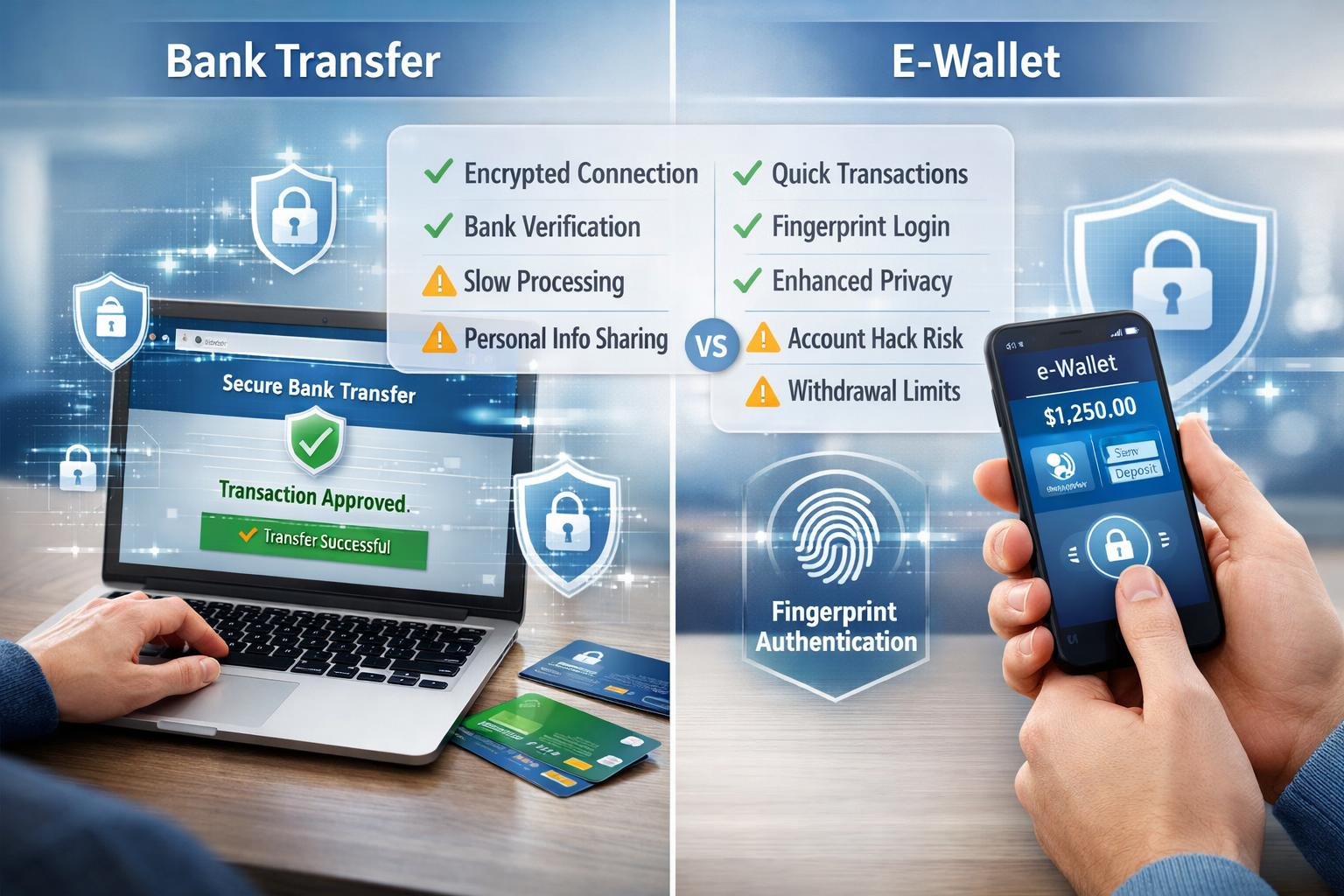
Bank transfers and e-wallets guard your money and info in totally different ways. Each one uses its own bag of tricks to keep your data safe. Both follow strict rules and layer on security to stop fraud and keep out snoops.
Authentication and Verification Processes
Banks make you jump through a few hoops before moving your cash. Most use two-factor authentication—a password plus a code sent to your phone. Some want your fingerprint or face, just to be sure it’s really you.
E-wallets are quicker but don’t skimp on security. PayPal, Skrill, and Neteller use biometrics as a first line of defense. Their apps run in a kind of digital bubble to keep out malware and hackers.
Setting up either method means you’ll have to prove who you are. Get ready to upload your ID or a utility bill to satisfy the Know Your Customer (KYC) rules. It’s a pain, but it keeps things legit.
Encryption and Anti-Fraud Measures
Let’s be real—if you’re worried about your payment details ending up in the wrong hands, e-wallets have your back. They use tokenization to scramble your info so the casino never actually sees your real account details. Instead, the casino just gets a secure token—no peeking at your real numbers. That multi-layered encryption? It’s a serious headache for hackers hoping to swipe your data.
Banks, on the other hand, lean on SSL and TLS encryption protocols. Online casinos slap on SSL to keep your financial info private and out of reach from snooping third parties. Your bank details get scrambled in transit, making them useless to anyone trying to intercept them. Casinos that accept bank transfers have to jump through some hoops: secure payment gateways, PCI DSS compliance, firewalls—the works. Nobody’s getting in unless they’re invited.
Both e-wallets and banks keep fraud detection systems humming in the background. If something looks fishy, banks and e-wallets flag it and might freeze your account for a quick security check. It’s not always convenient, but it sure beats getting ripped off.
Regulatory Compliance and KYC
E-wallet providers must answer to financial authorities in their home countries. The FCA, for example, keeps a tight leash on major e-wallets and isn’t shy about enforcing anti-fraud rules. Digital wallets roll out AML protocols to keep shady money out, and honestly, that’s just standard practice in finance these days.
Banks face even more red tape in the online gambling world. They work with compliance processors to make sure every transaction checks the right legal boxes. It’s a pain, but it helps keep money laundering at bay.
Here’s the truth: all payment methods demand ID checks. Before I can cash out, I have to upload documents and prove I’m really me. No way around it.
Player Privacy and Data Protection
If privacy is your thing, e-wallets win hands down. You never hand your bank details to the casino—your digital wallet steps in as a buffer. If the casino gets hacked, your real banking info stays safe and sound.
Bank transfers? Not so private. You have to give up your banking details to the casino, and while encryption helps, some folks just aren’t comfortable with that. The best casinos claim they store your info securely and follow data protection laws, but you’re still taking a leap of faith.
One thing both options get right: supporting responsible gambling. Casinos monitor deposit patterns, and payment authorities can track transactions to make sure sites aren’t taking advantage of vulnerable players. If you care about control, pick a method that lets you keep an eye on your own spending.
User Experience, Casino Perks, and Method Suitability
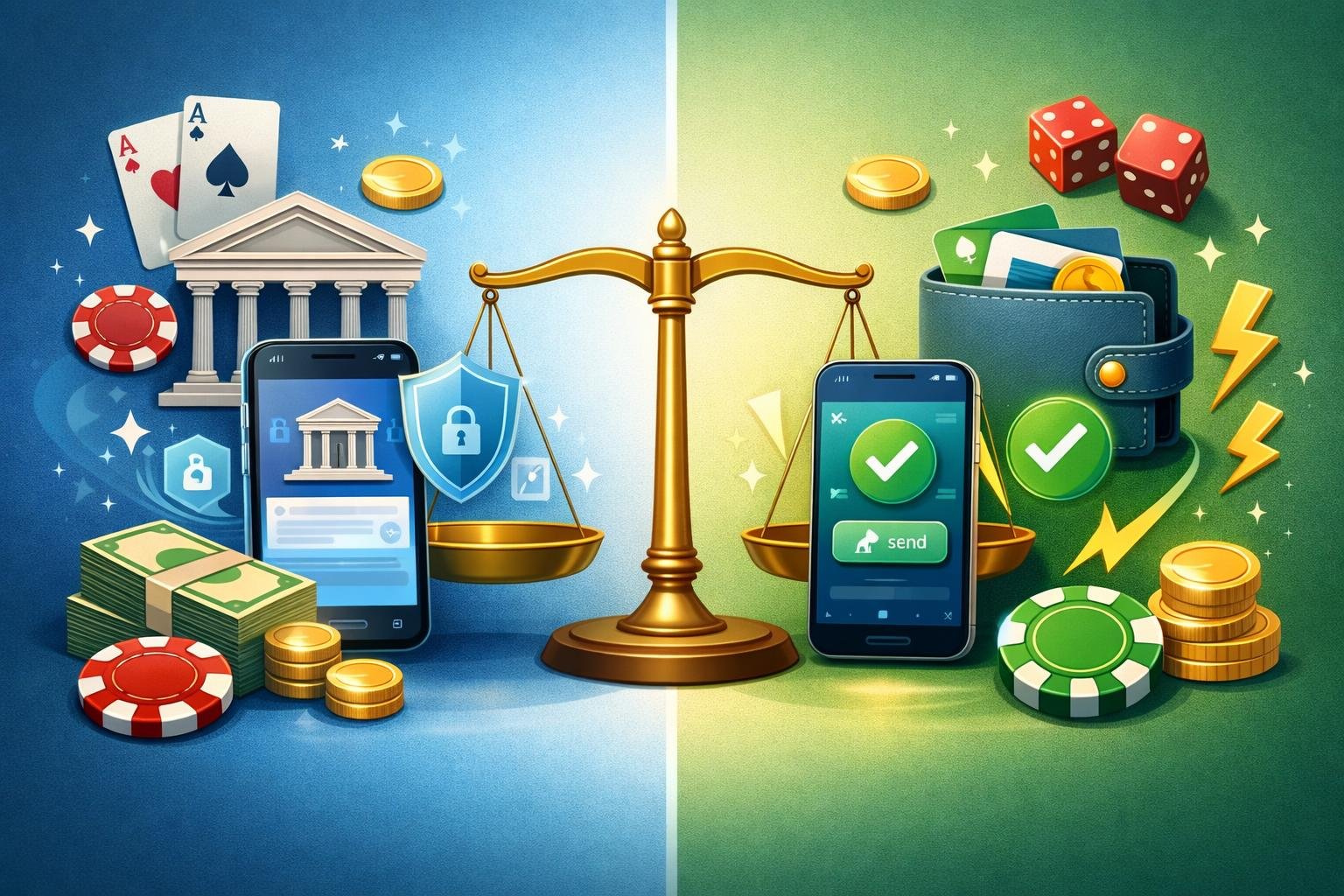
Picking your payment and withdrawal method isn’t just about convenience—it can mess with your bonus eligibility and even whether you can use the method in your area. These details decide which casino perks you can actually grab and if your favorite method works where you live. Sometimes, the devil really is in the details.
Bonus Eligibility and Promotions
Bank transfers usually unlock the full buffet of deposit bonuses at top casinos. If I use a bank transfer, I’m in for welcome offers, free spins, and loyalty points—no weird restrictions. Most legal US casinos are happy to include bank transfers in their bonus terms.
E-wallets? It’s a different story. Don’t fall for the hype—PayPal, Skrill, Neteller, and friends often get excluded from deposit bonus offers. I’ve seen plenty of casinos refuse to match e-wallet deposits for bonuses or free spins, mostly thanks to anti-fraud rules and regulatory headaches.
Key differences in bonus access:
-
Bank transfers: You get the works—welcome bonuses, reloads, loyalty rewards.
-
E-wallets: Often left out in the cold when it comes to matched deposit bonuses and promos.
Wagering requirements don’t care how you deposit. But if your e-wallet doesn’t qualify for bonuses, a bank transfer might be your only shot at chasing those wagering goals. Always, always read the fine print before you commit your cash.
Visa and Mastercard usually get a green light for offers, but double-check the rules for e-wallets. Occasionally, casinos toss out exclusive promos just for digital wallet users—but don’t count on it.
Geographical and Legal Considerations
Bank transfers work nearly everywhere online gambling is legit. I can use them at most US and international casinos, as long as my bank is cool with it. The real gatekeeper here is your bank, not the casino.
E-wallets, though, run into more roadblocks. PayPal casinos only show up in certain regions, thanks to tricky licensing. Some e-wallets flat-out refuse gambling transactions in certain countries or states. Before you sign up, check if your e-wallet actually plays nice with casinos in your area.
Feeling boxed in? Bitcoin and other cryptocurrencies can slip past some regional restrictions, but they come with their own set of legal headaches. Every gambling jurisdiction treats payment methods differently, so don’t assume you’re in the clear just because you found a workaround.
Customer Support and Reliability
If you hit a snag with a bank transfer, brace yourself. You’ll have to bounce between your bank and the casino’s support team, and neither side can fix the other’s mess. That means longer wait times—sometimes days—before you see your money or get an answer.
E-wallet issues? Usually less painful. The casino’s support can often solve problems directly, or the payment processor steps in fast. I’ve sorted out e-wallet hiccups in hours instead of days—huge difference if you’re itching to play or withdraw cash.
Both methods work reliably at reputable casinos. Banks offer old-school security and dispute resolution, while e-wallets bring specialized support for gambling payments. Honestly, the casino’s reputation matters more than your payment method when it comes to reliability.