

The UK Gambling Commission’s February 2026 updates mark a clear shift in regulatory strategy for Great Britain. These announcements outline how betting and gaming companies will need to operate under new oversight.
Key updates include Andrew Rhodes stepping down as Chief Executive on April 30, 2026, a wave of industry resistance to new affordability checks, and ongoing reviews of slot limits and financial verification rules introduced under the Gambling Act review.
These changes arrive as the gambling industry faces tighter scrutiny. Operators now deal with stricter compliance requirements, while regulators try to balance consumer protection with business viability.
The Commission reported updates on enforcement actions. Several companies received penalties for social responsibility and anti-money laundering failures.
Here’s a breakdown of the most important developments from the UK Gambling Commission’s February 2026 updates. This summary focuses on what matters for operators and stakeholders.
Key Takeaways
-
Andrew Rhodes will step down as Gambling Commission Chief Executive on April 30, 2026.
-
The gambling industry is contesting new affordability checks as the Commission reviews Gambling Act policies.
-
Multiple operators faced enforcement actions and financial penalties for compliance failures in late 2025 and early 2026.
Key Gambling Commission Policy Updates in February 2026

The UKGC released updates in February 2026 on its ongoing evaluation of Gambling Act Review measures. These updates focus on consumer protection, including stake limits and vulnerability checks.
They track how reforms affect both online gambling operators and people who gamble. The Commission’s approach relies on data and direct feedback from stakeholders.
Online Slots Stake Limits and Implementation
The Gambling Commission made online slots stake limits a core focus in its evaluation work with the National Centre for Social Research. These limits cap the amount people can bet per spin on online slot games.
The evaluation examines how operators have put these limits into practice since they became mandatory. The Commission gathers both qualitative data from interviews and quantitative operator data to measure the impact.
The evaluation team surveyed operators and ran semi-structured interviews to understand the practical challenges of enforcing stake limits. They also analyze operator data to track changes in gambling behavior and consumer outcomes.
These findings will help shape future decisions on gambling regulation. The Commission expects to use this evidence to inform policy adjustments going forward.
Financial Vulnerability and Affordability Checks
Financial vulnerability checks emerged as another key policy under review in the February 2026 update. These checks require operators to assess if customers can afford their gambling activity without risking financial harm.
The Commission, working with DCMS, evaluates whether these checks protect consumers while supporting responsible gambling. The research includes consumer surveys, focus groups, and operator interviews for a full picture.
Operators must share data on how they run affordability checks and identify financially vulnerable customers. The evaluation looks at both consumer and commercial impacts. Evidence gathering continues through early 2026, with findings due by year-end.
New Rules for Non-Compliant Gaming Machines
The February update also covered enforcement efforts beyond online gambling. While details about gaming machine rules were limited, the evaluation framework includes several Gambling Act Review policies.
The Commission described this evaluation as one phase of ongoing monitoring. Policies affecting sports betting, lottery operations, and land-based venues will go through further review outside this project’s scope.
Evaluation and Monitoring of Gambling Act Review Policies

The Gambling Commission works with the Department of Culture, Media and Sport and the National Centre for Social Research to evaluate specific Gambling Act Review policies. Early findings are expected by the end of 2026.
The evaluation focuses on policies like online slots stake limits, financial vulnerability checks, and direct marketing changes. The team uses both qualitative and quantitative research methods.
Mixed Methods Research and Data Collection
The evaluation uses a mixed methods approach to gather robust data. Qualitative research includes in-depth interviews with people who gamble, focus groups, and diary studies with young gamblers.
Stakeholder workshops help identify emerging evidence. Quantitative data comes from consumer surveys and operator surveys, with follow-up interviews for detail.
Several operators share data with NatCen for analysis. This dual approach aims to build a strong evidence base on consumer impact.
In February 2026, the evaluation entered its final evidence gathering stage. Both consumers and operators participate in research activities. NatCen simplified stakeholder engagement to encourage participation.
Role of NatCen and Evaluation Advisory Group
NatCen, the independent research organization, leads the evaluation. They manage data security and keep participant identities confidential.
Any data shared with the Commission or DCMS, or published in the final report, will be aggregated and anonymized. NatCen appointed an Evaluation Advisory Group to provide technical advice and ensure high research standards.
NatCen brings together stakeholders to review the evidence once data collection ends. This process shapes the analysis before the report’s release. Stakeholders can contact NatCen at GARevaluation@natcen.ac.uk for more information.
Stakeholder and Lived Experience Panel Involvement
NatCen independently appointed the Lived Experience Panel to guide the evaluation. This panel ensures the research includes perspectives from people directly affected by gambling policies.
Operators complete surveys, participate in interviews, and share data with the Commission or NatCen. Their input is critical for understanding the outcomes and impacts of Gambling Act Review policies.
The Commission recognizes the time and effort required from all parties. NatCen refreshed its approach to make engagement simpler, so everyone can share their experiences on consumer impact and commercial outcomes.
Upcoming Final Report and Expected Outcomes
The Commission plans to publish a report on the evidence gathered for in-scope policies by the end of 2026. This report will become part of the broader research base on gambling regulation.
The findings will guide future policy decisions at the Commission. They’ll also help shape ongoing monitoring and evaluation of Gambling Act Review policies.
This evaluation won’t provide a final position on the Gambling Act Review as a whole. Further monitoring and evaluation will continue beyond the current project, supporting the Commission’s commitment to data-driven policy.
Leadership and Organisational Developments at the UK Gambling Commission

Andrew Rhodes confirmed he’ll leave his CEO role at the UK Gambling Commission on April 30, 2026, after nearly five years. Sarah Gardner will become Acting Chief Executive during the transition.
Andrew Rhodes' Tenure and Departure
Rhodes announced his exit as CEO, effective April 30, 2026. He joined the organization in June 2021 as acting CEO after Neil McArthur’s resignation.
During his tenure, Rhodes led regulatory reforms from the Gambling Act review. He oversaw new finance risk checks, mandatory levy contributions for research and treatment, and changes to online slot stake limits.
The Commission, under Rhodes, issued record penalties. Entain was fined £17.2m in 2023, and William Hill received a £19m penalty in 2024—some of the largest in UK gambling history.
Charles Counsell, Interim Chair, credited Rhodes with "outstanding leadership." Analyst Richard Sutcliffe noted Rhodes built a legacy focused on consumer protection.
Appointment of Acting Chief Executive Sarah Gardner
Sarah Gardner, currently Deputy Chief Executive, will take the Acting Chief Executive position after Rhodes steps down. She’ll guide the Commission through the leadership transition while recruitment for a permanent CEO continues.
Gardner’s experience brings continuity during a pivotal period for UK gambling. Her appointment helps maintain stability as the sector prepares for a new tax regime starting April 1, 2026.
The Betting and Gaming Council stressed the need for strong regulator relationships during this transition. Gardner’s background positions her to manage ongoing regulatory initiatives smoothly.
Strategic Direction and Future Recruitment
The Gambling Commission faces major operational challenges as it searches for a new CEO. The next leader will oversee continued implementation of Gambling Act reforms and manage relationships with licensed operators.
The organization needs to balance enforcement with industry engagement. The new CEO will drive a strategy to address public concerns about gambling harm.
Charles Counsell’s interim chair appointment runs through 2026, so the leadership transition requires careful coordination. The Commission hasn’t released a timeline for CEO recruitment, but it will likely seek candidates with regulatory expertise and strong stakeholder management skills.
Impact on Operators, Consumers, and the Broader Gambling Sector

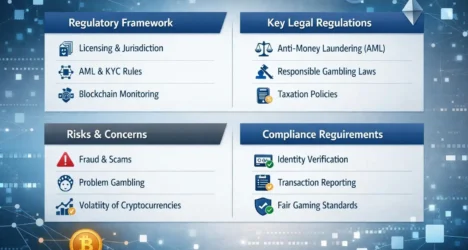
The February 2026 updates from the Gambling Commission introduce notable changes in compliance requirements and consumer protections. These adjustments affect operator costs, player safeguards, and the Commission’s approach to industry data collection.
Changes in Consumer Protections and Operator Compliance
Operator compliance costs have risen sharply with recent regulatory changes. For firms offering sports betting and online casino games, compliance now accounts for 12-15% of gross gaming revenue, according to industry data.
The 2025 stake limits continue to set the tone for consumer protections. Online slots have a £5 maximum stake for adults, with a reduced £2 limit for players aged 18 to 24. These measures aim to lower gambling harm, especially among younger adults.
Affordability checks now play a larger role in operator responsibilities. Operators must verify player finances before approving certain spending levels, reflecting increased regulatory scrutiny.
Consumer data reveals that slots sessions over one hour dropped by 16% year-on-year to 8.9 million. The average session length fell by two minutes to 16 minutes. Only 4.4% of sessions exceeded one hour, compared to 6.2% the previous year.
Implications for the National Lottery and Licensing
The fourth national lottery licence process continues under the Commission's oversight.
The national lottery operates separately from commercial gambling sectors, but it still falls under the Commission's regulatory framework.
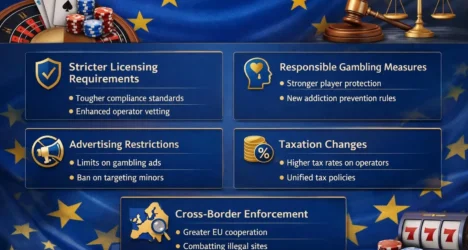
Licensing requirements have tightened across all gambling sectors.
Apps and digital platforms now face greater scrutiny as the Commission pushes for higher consumer protection standards.
The Commission reviews licensing conditions regularly to address emerging risks.
Operators must provide detailed data on player behavior and financial transactions.
This data helps the Commission spot problem gambling patterns and enforce responsible gambling measures.
The requirements apply to both online platforms and physical betting premises.
Market Data, Enforcement, and Industry Feedback
The Commission's operator survey data shows mixed market performance.
Richard Sutcliffe noted that online total Gross Gambling Yield (GGY) in Q3 dropped 2% to £1.5 billion, while total bets and spins increased 6%.
This suggests the current strategy is impacting high-level revenue, but engagement remains strong.
Average monthly active accounts fell 2% to 12.7 million during the same period.
Key market changes include:
-
Real event betting GGY decreased 18% to £530 million
-
Slots GGY increased 10% to £788 million
-
Betting premises GGY decreased 7% to £549 million
-
Number of spins in online slots increased 7% to 25.7 billion
Slots keep growing despite stake limits.
The number of spins and GGY hit new highs for the third quarter in a row.
Players seem to have adapted to restrictions while staying engaged.
Enforcement actions target operators who don't meet consumer protection standards.
The Commission uses survey data to spot compliance gaps and potential harm indicators.
Industry feedback points to concerns about the cost burden of new requirements.