

Evolution Gaming and Pragmatic Play Live really sit at the top of the live casino world right now. I’ve spent countless hours at their tables, soaking up the atmosphere and getting to know what makes each provider tick—and honestly, it’s not always easy to pick a favorite.
Evolution Gaming pulls ahead with wild game shows and absolutely top-tier production values, while Pragmatic Play Live gives you more bang for your buck with Drops & Wins promos and those sweet, low minimum bets. Evolution basically invented the live casino vibe as we know it. Their hits like Crazy Time and Lightning Storm are total game changers.
Pragmatic Play jumped in later, but they’ve built a loyal following by polishing up classic ideas and blending their live tables with their massive slot library. It’s a different flavor—and sometimes, it’s exactly what I’m in the mood for.
Your choice comes down to what you value. Want the flashiest tech and the wildest multipliers? Evolution’s your table. If you’re looking to stretch your bankroll and scoop up extra value from network promos, Pragmatic Play is the smarter pick.
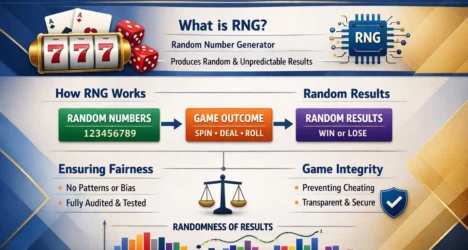
Both brands hold all the right licenses and follow strict rules, so I never worry about fairness. That’s a non-issue here.
Key Takeaways
-
Evolution Gaming leads the pack in innovation and variety—think Crazy Time, Lightning Storm, and those massive 20,000x multipliers.
-
Pragmatic Play Live is a haven for casual players, thanks to lower minimum bets and the Drops & Wins promo system.
-
Both offer similar RTPs (about 96-97%), but Evolution brings higher volatility while Pragmatic fires off more frequent bonus rounds.
Key Differences Between Evolution Gaming and Pragmatic Live
Evolution Gaming and Pragmatic Play take very different approaches to live casino. Their business models, strategies, and even where they’re licensed shape the whole playing experience. I always look at these differences before I settle in at a table.
Live Casino Provider Profiles
Evolution Gaming started back in 2006, and honestly, they’ve never looked back. They were first to really nail live dealer tech, and now they’ve got over 700 live casino games streaming from 12 studios around the globe.
They focus entirely on live games and game shows, which means every table—whether it’s Crazy Time or Lightning Storm—feels like a mini-event. Their production value is just off the charts.
Pragmatic Play arrived later, but they’ve carved out their own lane. They run about 250 games from four studios, and their big move is tying live casino to their slot empire. When I jump from Sweet Bonanza slots to Sweet Bonanza Candyland live, it feels like stepping into the next room at the same party.
Evolution’s scale lets them roll out new formats and experiment all the time. Pragmatic prefers to polish what works, giving each game a little extra shine instead of reinventing the wheel every month.
Strategic Market Position and Expansion
Evolution stays on top by making games so complex and visually stunning that nobody else can really match them. I’ve seen Crazy Time pull in more than 300,000 players worldwide in a single day—those numbers are wild.
Pragmatic Play’s growth has been explosive, especially in Europe and South America. Their secret weapon? They cross-promote like crazy, funneling slot fans straight to the live tables. That Drops & Wins network is a real treat—random cash drops and tourney entries just for playing? Yes, please.
If you’re playing with a smaller bankroll, Pragmatic is way more accessible. You can often get in for €0.10 or €0.20, while Evolution’s tables usually start at €0.50 or €1.00. That makes a difference on a long night.
Licensing, Compliance, and Regulatory Reach
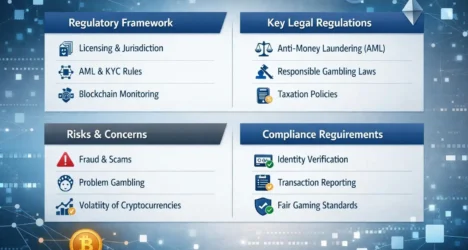
Both Evolution and Pragmatic Play hold licenses from the strictest regulators out there. I always check for the UK Gambling Commission (UKGC) and Malta Gaming Authority (MGA) badges before I sit down. Both providers have them, which is non-negotiable in my book.
Evolution goes even further, picking up approvals in places like New Jersey, Pennsylvania, and Michigan. Their equipment and random number generators get regular checkups from agencies like eCOGRA. That’s the kind of transparency I want.
Pragmatic Play keeps pace with similar certifications. I like that both companies put their licensing info front and center—there’s no hiding. That oversight means I can relax and just enjoy the game, knowing everything’s above board.
Where you live affects which games you can access. Evolution’s got a stronger foothold in the US, while Pragmatic Play dominates in new European and Latin American markets. I wish both were everywhere, but hey, that’s the casino world for you.
Game Portfolio and Feature Comparisons
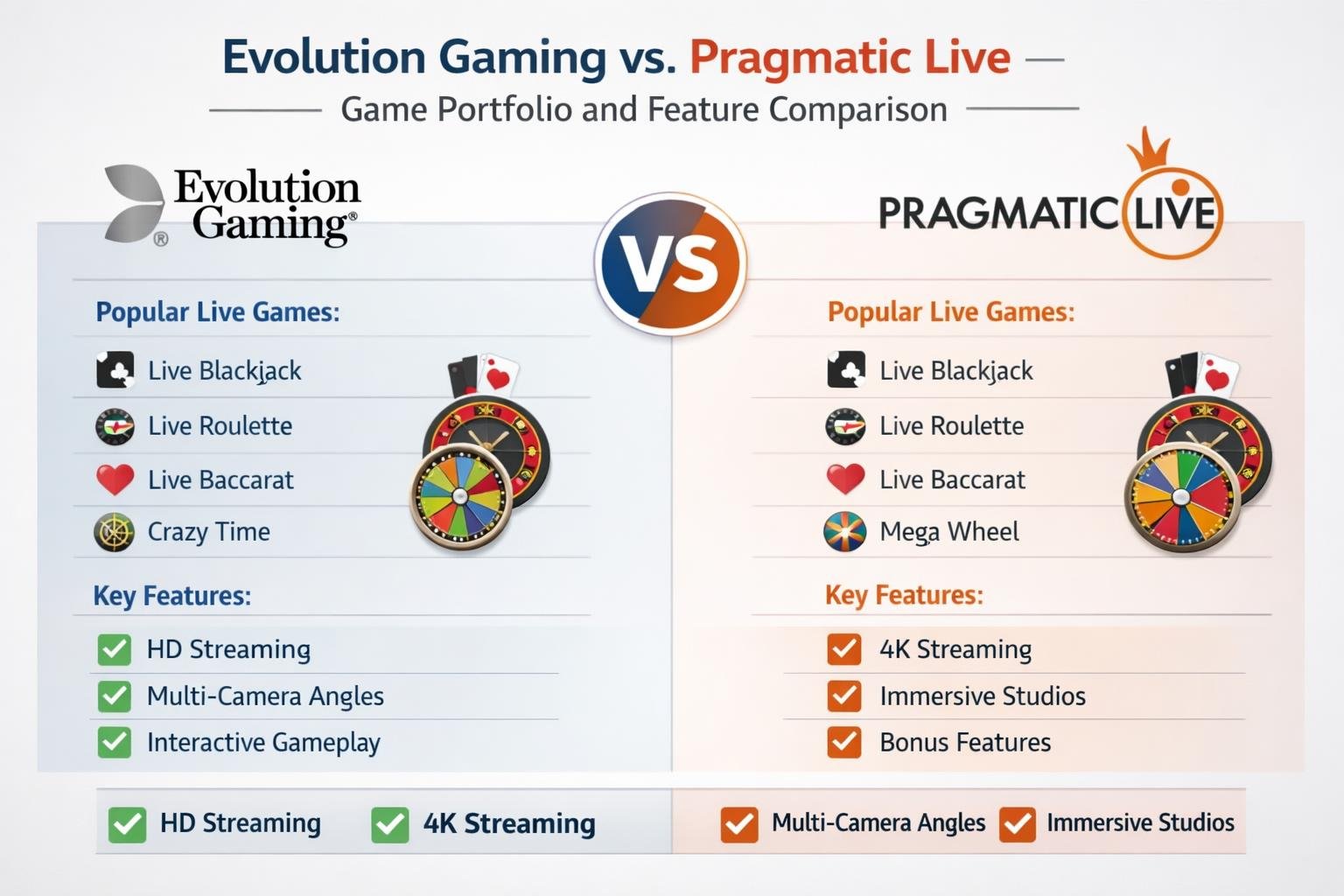
Evolution Gaming is all about live dealer innovation—you won’t find many slots in their catalog. Pragmatic Play, though, balances live games with a massive slot collection. Evolution delivers on wild game shows and technical wizardry, but Pragmatic’s Drops & Wins and lower minimums give casual players a real edge.
Live Dealer Games: Variety and Highlights
Evolution Gaming’s live dealer catalog is massive. I’ve seen over 200 different tables, each with its own vibe. Their roulette options are next-level—Lightning Roulette brings random 500x multipliers, while Immersive Roulette uses multiple camera angles and even slow-mo replays. It’s like watching a movie.
Blackjack fans get spoiled with Infinite Blackjack (everyone can join the same table, no waiting!) and Free Bet Blackjack (who doesn’t love a free split or double?). For baccarat, they offer Speed Baccarat and Lightning Baccarat, so you can go classic or turbo, depending on your mood.
Pragmatic Play Live may have fewer tables, but they’re catching up fast. Their roulette, blackjack, and baccarat games look just as sharp—crystal-clear HD streams, pro dealers who actually chat and joke, and a smooth interface that makes it easy to settle in.
What really stands out is how Pragmatic links their live games to their slots. Jumping between Sweet Bonanza and Sweet Bonanza Candyland feels seamless, and there’s a sense of community that keeps me coming back.
Signature Game Shows and Bonus Rounds
Evolution Gaming changed the game with their live show formats. Crazy Time is the king here—a 54-segment wheel, four bonus rounds (Cash Hunt, Pachinko, Coin Flip, and Crazy Time itself), and a host who keeps the energy high. Sometimes, you’ll feel like you’re on a real TV set.
Dream Catcher brought the money wheel to the mainstream, and Monopoly Live mixes the wheel with a 3D Monopoly board. Mega Ball is a bingo-money wheel mashup that’s surprisingly fun.
Pragmatic Play Live fired back with Mega Wheel, which uses RNG multipliers for a faster pace. Sweet Bonanza Candyland is a treat for slot lovers, with familiar branding and three quirky bonus rounds: Candy Drop, Sweet Spins, and Bubble Surprise.
Here’s the thing: Evolution’s bonuses are all about the spectacle—physical wheels, dramatic lighting, real-world suspense. Pragmatic keeps things digital and quick, which is great if you’re impatient, but sometimes I miss the drama of a real Pachinko puck bouncing down the board. Both styles work, but the vibe is totally different.
Slot Portfolio and Game Library Differences
Evolution Gaming doesn’t actually make slots. They bought NetEnt in 2020, so you’ll see classics like Starburst and Gonzo’s Quest around, but those stay under the NetEnt brand. Evolution just wants to own the live dealer and game show space.
Pragmatic Play, on the other hand, is a slot machine powerhouse. Over 200 titles, from Sweet Bonanza (with those addictive tumbling reels and multipliers) to megaways games and big jackpot networks. Their Drops & Wins promo splashes out more than €2 million a month in random prizes and tourneys, covering both slots and live games.
If you’re only here for live dealer action, Evolution is probably your best bet. But if you like to bounce between slots and live tables, Pragmatic Play’s ecosystem keeps things fresh—and the loyalty rewards don’t hurt either.
Return to Player, House Edge, and Betting Limits
When you’re sizing up Evolution’s games, you’ll notice the RTP jumps around quite a bit. Lightning Roulette clocks in at 97.30%—even with those wild multipliers in play.
Crazy Time averages out to 96.08%, but if you dig into each segment, you’ll see some as low as 94.41% and others up to 96.26%. Dream Catcher lands at 96.58% and tends to feel pretty fair for a wheel game.
Pragmatic Play Live usually posts slightly higher RTPs on their main titles. Mega Wheel gives you 96.51%, and Sweet Bonanza Candyland edges close at 96.48%.
Their standard roulette and blackjack tables stick to industry averages—97.30% for roulette, and if you play blackjack with solid strategy, you’ll see 99.28% or better.
Betting limits are where Pragmatic really opens the doors to casual players. I’ve sat at Pragmatic tables with minimums as low as €0.10, especially on the game shows. Evolution usually starts you at €0.50 or €1.00, so it’s not quite as welcoming for micro-stakes fans.
High rollers? Both offer similar upper limits—think €5,000 to €10,000 per round, sometimes more if you find a real VIP table.
Here’s something most folks miss: both providers cap maximum payouts at about €500,000 per round, no matter how big the multiplier. So, if you hit a 500x on Lightning Roulette with a €2,000 bet, you’ll get stopped at the payout ceiling. It’s a little frustrating, but that’s the reality.
|
Game Type |
Evolution RTP |
Pragmatic RTP |
Evolution Min Bet |
Pragmatic Min Bet |
|---|---|---|---|---|
|
Money Wheel |
96.58% (Dream Catcher) |
96.51% (Mega Wheel) |
€0.50 |
€0.10 |
|
Game Show |
96.08% (Crazy Time) |
96.48% (SB Candyland) |
€0.50 |
€0.20 |
|
Roulette |
97.30% (Standard) |
97.30% (Standard) |
€1.00 |
€0.50 |
Technology, User Experience, and Mobile Optimization
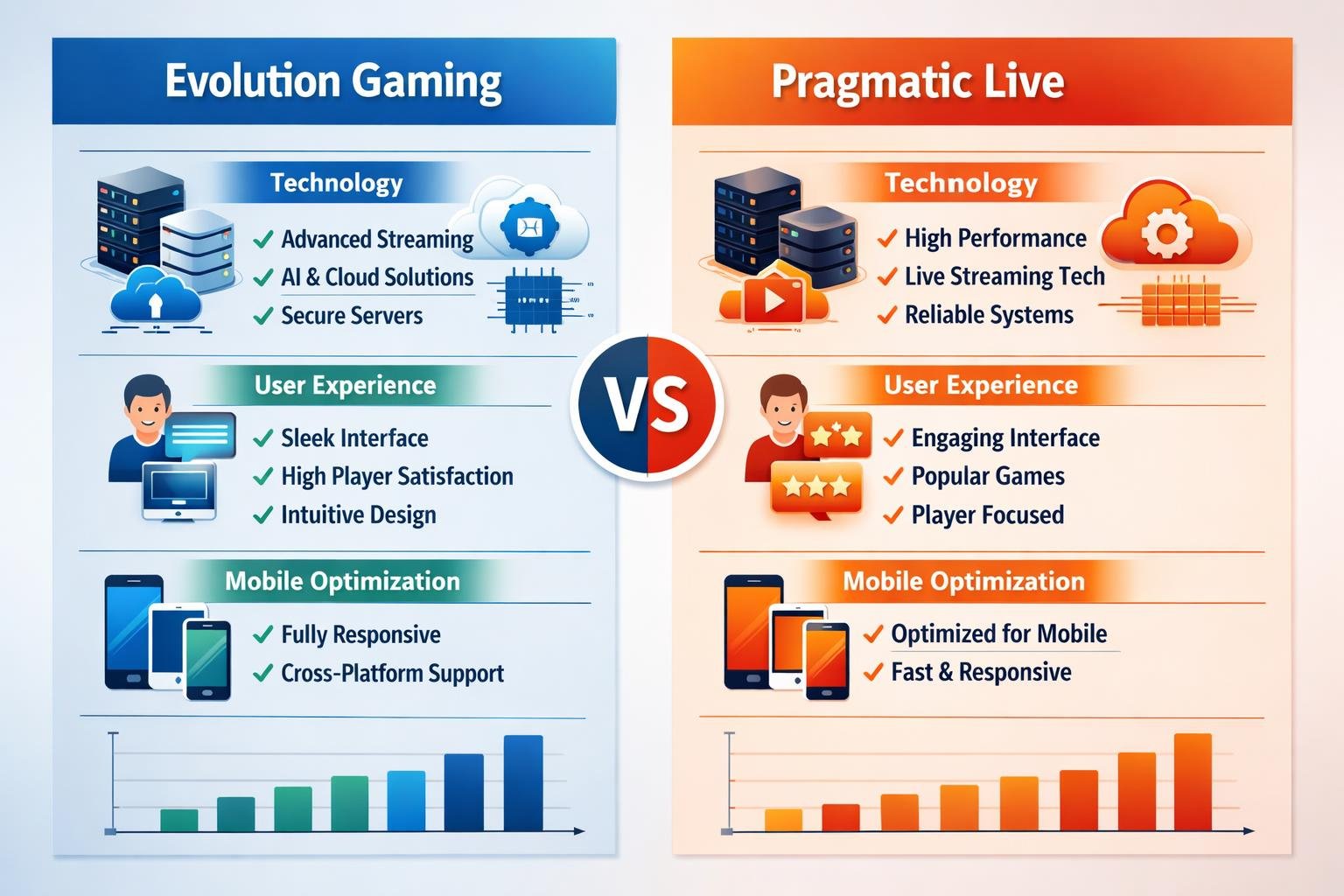
Both Evolution and Pragmatic Play have poured serious resources into their tech and mobile platforms, but their styles couldn’t be more different. Evolution chases that high-gloss, almost cinematic production, while Pragmatic seems to care most about making things fast, smooth, and super accessible.
Streaming Quality and Video Technology
Step into an Evolution studio—virtually, of course—and it’s like you’re on a movie set. They use broadcast-grade cameras and the lighting is always on point. Most games stream in crisp 1080p, and some newer ones even adapt the video quality to your connection. I’ve played during peak hours and never really noticed lag. The streams stay sharp, and the action feels seamless, even with a packed table.
Pragmatic Play’s “Smart Studio” approach is a little different. Their video quality usually matches Evolution’s at 1080p, but they compress things to save your data. That means games load lightning fast, even on sluggish Wi-Fi. Honestly, unless I’m running both side by side on a big screen, I barely notice any drop in quality.
Both companies take dealer training seriously. Evolution’s dealers tend to be a bit theatrical—they’ll chat, joke, and really set the mood. Pragmatic’s dealers keep it professional and efficient, so the pace is brisk and you’re never left waiting for the next hand or spin.
User Interface and Accessibility
Evolution’s UI depends on how new the game is. Lightning Storm, for example, has a gorgeous, modern grid that just feels good to use. But if you hop onto Dream Catcher, you’ll see it’s a bit dated—still works, but not exactly eye candy.
Pragmatic Play keeps things consistent across all their games. Their betting grids are clean, the buttons are big and easy to tap (especially on mobile), and the color-coded zones make it simple to see what’s what. I love those quick bet animations—they give you that satisfying “yep, my bet’s in” confirmation.
Both let you chat with the dealer and other players, which is honestly half the fun for me. Evolution’s stats panels go deep—they’ll show you heat maps and all sorts of trends. Pragmatic keeps it basic, just showing you what numbers have hit recently.
Mobile Gaming Performance and Compatibility
If you’re a mobile-first player, Pragmatic Play really shines. Their games feel tailor-made for phones—portrait mode fills every pixel, and the betting grid sits right under your thumb. I can play one-handed on the train without any hassle.
Lag is basically nonexistent, and games load in a few seconds even on 4G. I can’t remember the last time I lost connection mid-game.
Evolution’s mobile experience is solid, but not quite as slick. Their games work fine in both portrait and landscape, but sometimes portrait mode leaves empty space. Loading can take a little longer—maybe 5 to 8 seconds. Newer titles like Crazy Time look fantastic, but older ones feel a bit cramped on smaller screens.
Both providers support iOS and Android right in your browser, so you don’t have to mess around with apps. If you lose your signal, they’ll reconnect you automatically, which is a relief during a tense hand.
Operator Considerations and Impact on Player Retention

From the operator’s side, Evolution and Pragmatic Play come with totally different commitments. How you integrate, what you pay, and how you keep players coming back—all of it shifts depending on the provider. If you’re running a casino, platform stability is everything. Downtime means lost revenue and angry players, and nobody wants that.
Integration Complexity and Timeline
Getting Evolution up and running? You’ll need 8 to 12 weeks, start to finish. Their tech is demanding—real-time wallet updates with under 100ms latency, for example. Your payment systems have to handle instant balance changes on the fly, so you might need to upgrade your backend before you even start.
Pragmatic Play takes a lighter approach. You can usually go live in 4 to 6 weeks. Their requirements aren’t as tough, so basic wallet systems with a few seconds’ delay are fine. That makes Pragmatic a go-to for new or smaller operators who don’t have a massive IT team.
Aggregators like SoftSwiss or EveryMatrix can cut setup time by a few weeks for both providers. They handle most of the messy stuff, which is a lifesaver if you’re not a tech wizard.
Revenue Share Models and Financial Terms
Evolution’s entry fee isn’t for the faint of heart. They’ll ask for $50K to $100K minimum per month, and revenue share sits at 10-20% depending on your volume. You’ll need a solid license—MGA, UKGC, or something equivalent—before they’ll even talk numbers. Payments usually run on Net 30-60 terms if you’re established.
Pragmatic Play is more flexible. Revenue share starts at 15-20% for slots and 20-30% for live games. If you’re running under a Curacao license, there’s no monthly minimum. MGA-licensed casinos need to hit $15K to $20K. It’s a friendlier model if you’re just starting out.
Once your betting volume hits around $400K a month, Evolution’s lower percentage starts to make more sense, even with the higher base costs. Before that, Pragmatic’s model is easier on your budget.
Player Acquisition, Retention Metrics, and GGR
Evolution’s games keep players at the table longer—on average, about 2.3 times longer than other live casino brands. Their retention numbers are impressive, too. Operators report 45-52% of players still active after 90 days, and GGR per user is 8-15% higher than with other providers.
The house edge stays steady at 2-5% across their live dealer games. It’s the kind of consistency operators love.
Pragmatic Play shines in the slots department, with 38-44% retention at 90 days. Their live games don’t pull quite the same GGR per player as Evolution, but they’re cheaper to run. Titles like Sweet Bonanza and Gates of Olympus are magnets for new players when you feature them in promos.
Honestly, from what I’ve seen, casinos that use Evolution for live games and Pragmatic for slots get the best of both worlds. You get premium experience and strong retention, but you don’t break the bank on integration costs while you’re still growing.