Let’s be honest—when you play at online casinos, sneaky payment fees can nibble away at your bankroll before you even notice. Most folks don’t realize that every deposit and withdrawal method comes with its own set of charges, from tiny percentages to flat fees that pile up faster than you’d expect.
If you learn which payment options have the lowest fees and how to dodge hidden costs, you could easily save 1% to 5% on every transaction.
Picking the right way to move your money is a huge part of managing your casino budget. Before you even make that first deposit, it helps to have a simple plan for choosing payment methods that’ll protect your winnings.
I’ve dug into how casinos and payment companies set up their fees, and honestly, a lot of these costs hide in the fine print. E-wallets might look free at first glance, but then you get hit with conversion or withdrawal charges that sneak up on you.
Credit cards usually tack on processing fees of 1-3%, and bank transfers? Those can sting with flat rates anywhere from $10 to $30 each time.
The upside? Once you know where to look, you can cut these fees way down. Picking the right payment method and understanding what you’ll actually pay keeps more money in your account for games. Let me break down the typical fees for each payment type and share some real-world tips to help you pay less.
Key Takeaways
-
Each payment method brings its own fees—e-wallets might cost 1-5%, while bank transfers often charge flat fees of $10-30.
-
Watch out for hidden extras like currency conversion or withdrawal limits—these can quietly boost your total costs.
-
You can shrink fees by picking low-cost payment methods, cashing out less often, or joining casino loyalty programs that reward you for sticking around.
Understanding Casino Payment Method Fees
Both casinos and the companies that handle your money chip in when it comes to payment fees. Let’s walk through who charges what, and why some options cost more than others.
Types of Casino Fees
Deposit fees usually sit between 2% and 5% of whatever you put in. Sometimes, instead of a percentage, casinos just charge a flat $2 to $10 per deposit.
Withdrawals can be even pricier. I’ve seen them go as high as 7% or $25 per transaction, depending on how you cash out. High transaction costs really do eat into your actual winnings, since you’re left with less at the end.
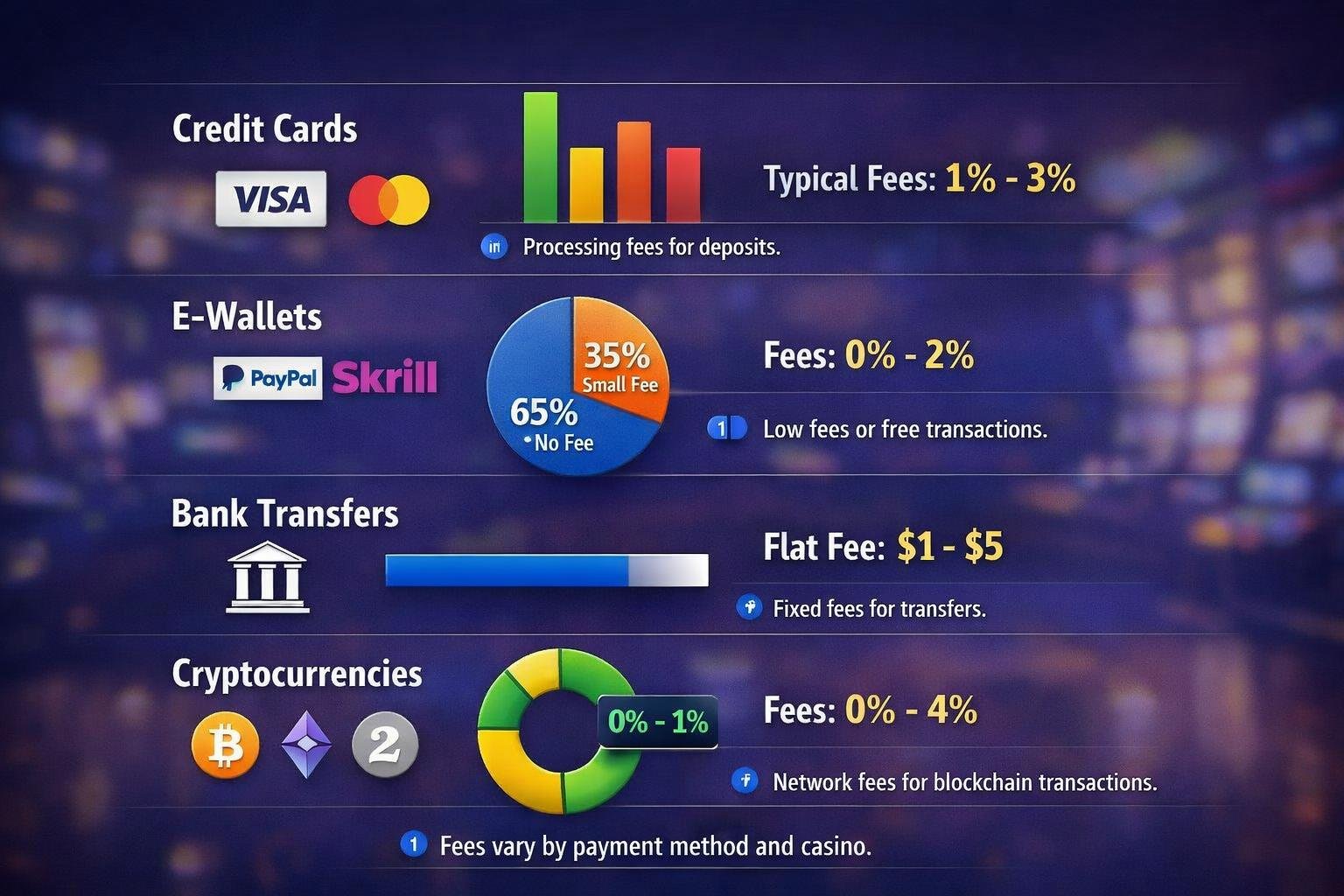
Every time you move money in or out, you’ll probably spot a transaction fee. These are just part of the territory with online gambling. Credit cards tend to have the highest transaction fees—think 3% to 5%. E-wallets like PayPal or Skrill? Usually 1% to 3%. Bank transfers swing between free and $10 to $25, depending on where you play.
Don’t forget about sneaky hidden fees. Some casinos charge inactivity fees of $5 to $50 if you don’t use your account for a month. Monthly maintenance fees might be another $1 to $5. And if your money has to be converted into a different currency, you’ll often pay another 1.5% to 4% for the privilege.
How Casinos and Payment Providers Charge Fees
Casinos themselves set certain fees, like withdrawal charges, inactivity fees, and those little monthly maintenance costs. These go straight into the casino’s pocket.
Meanwhile, payment providers—your bank, PayPal, or even the folks running the crypto network—take their own cut. Your bank might ding you for using a credit card, and e-wallet companies grab a slice for handling your transaction. Crypto networks charge what’s called a “network fee” to process your payment.
Here’s something important: these fees can stack up. Suppose you deposit $100 with your credit card. Your bank could take 3%, the payment processor another 2%, and then the casino grabs 2% on top. That’s $7 gone before you even place a bet.
Some casinos try to lure you in with “fee-free” deposits. They cover the payment provider’s fee themselves, so you don’t see a charge—but they’re still paying behind the scenes. It’s a marketing move that makes some payment methods look cheaper than they really are.
Common Myths About Casino Payment Fees
Lots of players think “no fee” means totally free. In reality, most casinos that claim zero fees still have hidden charges, like currency conversion or sneaky exchange rates.
Another common misconception? That all withdrawal methods cost the same. Not true—crypto withdrawals often cost nothing, while a bank transfer might set you back $25 or more each time.
Some folks believe getting VIP status wipes out every fee. VIPs might get faster service and some fee breaks, but you’ll still go through strict ID checks and pay third-party processing costs. Even with perks, you’ll rarely dodge currency conversion or payment provider fees entirely.
And then there’s the idea that faster withdrawals mean higher fees. Actually, speed and cost don’t always go hand in hand. E-wallets process quickly and charge moderate fees, while bank transfers can drag on and still cost more.
How Your Payment Method Choice Impacts Fees

Every payment method comes with its own fee structure, from totally free options to some that can take more than 8% per transaction. If you get a handle on these differences before picking a deposit or withdrawal method, you’ll keep a lot more money in your pocket over the year.
Credit Cards and Debit Cards
Credit cards like Visa, Mastercard, American Express, and Discover usually bring the steepest fees. When I use American Express or Discover, I see processing fees between 2.5% and 4.5% each time. Debit cards aren’t much better, but sometimes the fees dip down to 1.5% to 3.5%.
Here’s a twist: many casinos treat credit card deposits as “cash advances.” That means your card company could tack on an extra 3% to 5% fee, plus start charging interest right away—sometimes at rates over 25% APR, with no grace period.
It doesn’t stop there. When you want to cash out to your Visa or Mastercard, casinos often charge $15 to $35 per withdrawal. Some even set minimum withdrawal amounts of $50 to $100, so you have to rack up winnings before you can cash out.
Real-life example: If I deposit $1,000 with a credit card, I’m out $25 to $45 in casino fees, plus another $30 to $50 if my card company slaps on a cash advance fee.
E-Wallets and Digital Wallets
E-wallets like PayPal, Skrill, Neteller, Apple Pay, Venmo, and Google Pay are usually a bit friendlier on your wallet compared to cards. I typically see fees between 0% and 2.5% when depositing with these.
PayPal, where available, is often the most affordable. Many casinos cover PayPal’s processing fees, so I don’t pay anything for deposits. Withdrawals to PayPal usually cost $0 to $10—way less than card-based payouts.
Skrill and Neteller keep deposit fees modest (1% to 2%), but sometimes sneak in a 3% to 4% currency conversion markup if my account and the casino use different currencies. Withdrawals through Skrill generally cost about 1% of whatever I’m cashing out.
Apple Pay and Google Pay are popping up more often, with deposit fees as low as 0% to 1.5%. Withdrawals, though, are still pretty limited since most casinos only let you use these for deposits.
Prepaid cards like Play+ and Paysafecard are lifesavers if you want to stick to a strict budget. Play+ often lets you deposit instantly, though a few cards tack on monthly maintenance fees.
Bank Transfers and ACH Payments
Bank transfers, ACH transfers, eChecks, and services like VIP Preferred all have their own quirks. Old-school wire transfers usually cost $15 to $45 per transaction, both coming in and going out—so they’re not great for small amounts.
ACH transfers and eChecks are easier on the wallet. I often pay $0 to $5 for these, and some casinos skip the fee entirely if I deposit more than $100 or $500. VIP Preferred, which uses ACH, is usually totally free for deposits.
The main headache here is speed. Bank transfers can take 3 to 7 business days. Wire transfers are a bit quicker—maybe 1 to 3 days—but you’ll pay more for the privilege.
Sometimes, linking your online banking directly to your checking account unlocks special fee waivers. I’ve managed to deposit and withdraw for free by hitting certain minimums.
Cash Deposits and Retail Options
If you’re old-school and prefer cash, plenty of casinos let you deposit using services like PayNearMe at local shops. You can also walk into a physical casino and make a deposit or withdrawal at the cashier’s cage.
The casino cage is usually the fastest way to grab big payouts without the usual bank delays. Plus, you often avoid the digital payment fees entirely this way.
Cryptocurrency and Crypto Payments
Bitcoin and other cryptocurrencies are, hands down, the cheapest way I’ve found to move money in and out of casinos. Most crypto-friendly sites charge 0% to 1% for deposits, and some skip fees altogether to encourage you to use crypto.
The only real cost comes from the blockchain network itself. When I deposit Bitcoin, I pay a mining fee—anywhere from $0.50 to $15, depending on how busy the network is. This makes crypto especially smart for bigger deposits.
Crypto withdrawals are also a bargain. Usually, I just pay the blockchain fee, not the $15 to $35 that’s common with other methods. Since crypto payments can’t be reversed, casinos process them quickly—sometimes in just an hour or two, rarely more than a day.
Quick comparison: A $1,000 deposit with crypto might cost me as little as $1 to $25 total, while a credit card could run $65 to $90 in combined fees.
Other Hidden and Additional Costs to Expect

Besides the usual transaction fees, casinos and payment companies sometimes tack on extra charges that catch people by surprise. Currency conversion can quietly shrink your bankroll, and if you leave your account untouched, you might get hit with monthly fees. Some withdrawal limits or bonus rules can also force you to pay more when you switch payment methods or cash out.
Currency Conversion and International Transaction Fees
I’ve watched currency conversion fees quietly add 3% to 5% on every deposit or withdrawal if your bank or payment method uses a different currency than the casino. Some casinos show prices in one currency but process payments in another, so your bank or card issuer automatically converts the funds—usually at a rate that’s not in your favor.
Credit cards tend to be the worst for international transaction fees. Banks often add 2% to 3% on top of whatever the conversion rate is. E-wallets like Skrill and Neteller use their own exchange rates, sometimes with a 1% to 4% markup.
How to keep currency fees down:
-
Pick a casino that lets you play in your own currency
-
Choose payment methods that work with multiple currencies
-
Double-check the conversion rate before you hit “confirm”
-
Try to deposit or withdraw in bigger chunks, so percentage-based fees don’t add up as quickly
Inactivity and Maintenance Fees
Some casinos start charging monthly inactivity fees if you don’t log in or place a bet for 90 to 180 days. I’ve seen these fees run from $5 to $15 a month, and they keep going until your balance hits zero or you get active again.
E-wallets and prepaid cards can also ding you with maintenance fees. If you leave your e-wallet alone for six months, you might owe $2 to $5 a month. Some prepaid vouchers lose value or start charging dormancy fees after a year.
Always check the fine print when picking a payment method. If you know you’ll take a break from gambling, withdraw your balance and close any unused accounts so you don’t lose money to automatic fees.
Limits, Bonus Conditions, and Payment Switching Costs
Minimum deposit amounts change depending on how you pay. If you use a credit card, you’ll usually need to deposit at least $10 or $20. Crypto deposits can go as low as $1.
Big wins aren’t always paid out all at once. Some casinos set maximum withdrawal limits, which means you might need to split up your cashouts. That can lead to extra fees on each transaction, which is honestly a bit frustrating.
Casino bonuses—like deposit matches, free spins, or cash-back—don’t always work with every payment method. Usually, these restrictions tie back to the casino’s verification process or the costs they pay to payment processors. I’ve found that e-wallets often don’t count for bonuses, and using one could even cancel your welcome offer.
Credit card cash advance fees are a sneaky one. If the casino codes your deposit as a cash advance, your card company might hit you with a 3% to 5% fee, plus instant interest (sometimes over 25%). There’s no grace period, so you start paying interest right away.
Switching payment methods after you deposit can get expensive. If you try to withdraw using a different method than you used to deposit, casinos might charge $10 to $50. Sometimes, if you cancel a withdrawal and start over, you’ll pay another $5 to $25 just for changing your mind.
How to Reduce and Manage Casino Payment Fees
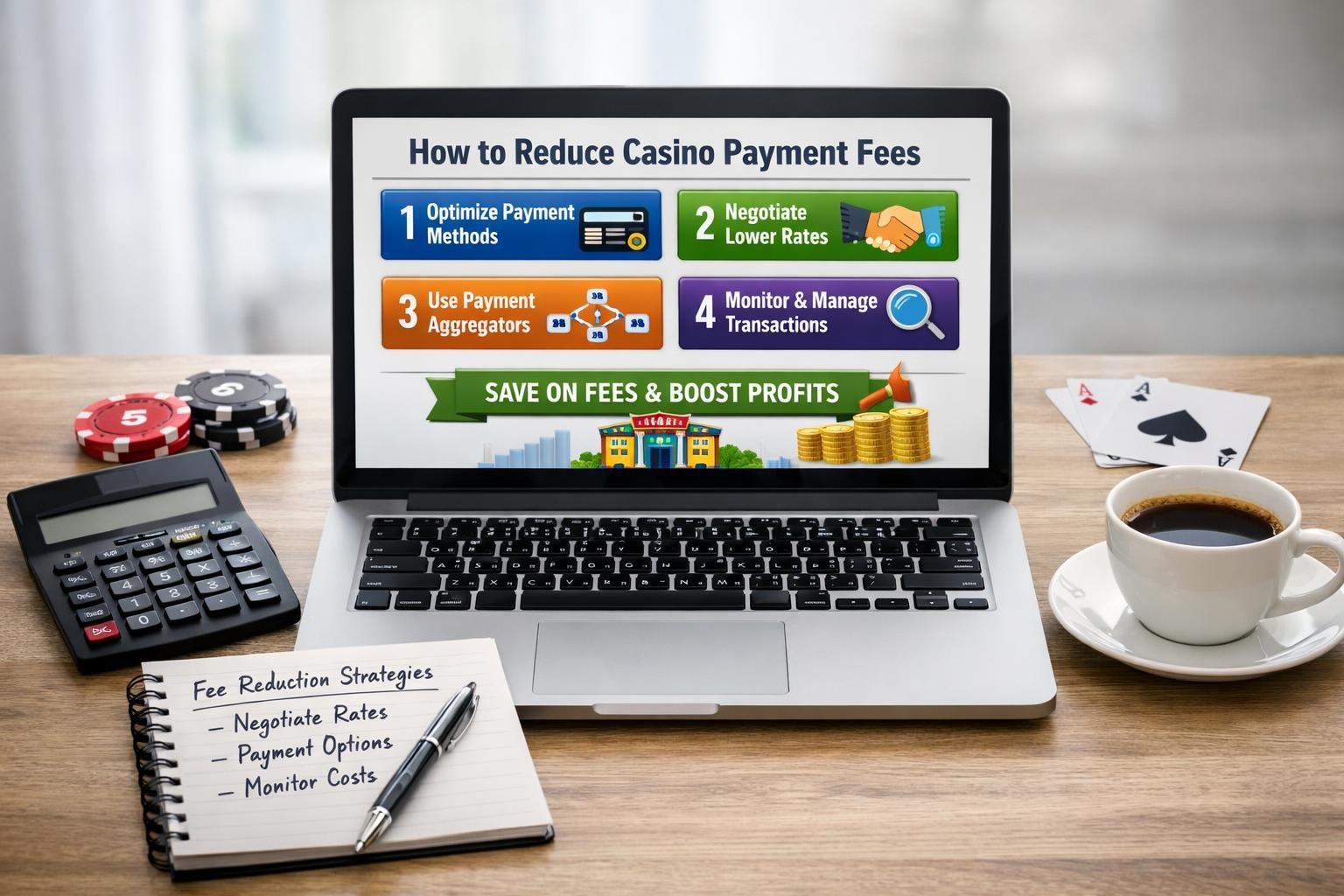
Let me break this down for you: picking the right payment method and managing your account well can save you a surprising amount of money. I look for low-fee options, keep my account active, and use rewards whenever I can to cut down on deposit and withdrawal costs.
Choosing the Most Cost-Effective Payment Methods
Before I deposit anywhere, I always check the fees for each payment method. It’s not just about the lowest cost—I try to balance speed, security, and how much I’ll pay per transaction. Bank transfers and e-wallets like PayPal usually have lower fees than credit cards, which tend to charge 3-5% each time. Crypto deposits often skip processing fees, but you’ll want to keep an eye on network costs and price swings.
Fee Comparison by Payment Method:
|
Payment Method |
Average Deposit Fee |
Average Withdrawal Fee |
|---|---|---|
|
Bank Transfer |
$0-$5 |
$0-$10 |
|
E-wallets |
0-2% |
0-2% |
|
Credit/Debit Cards |
3-5% |
Not available |
|
Cryptocurrency |
$0-$3 |
$0-$5 |
VIP Preferred pops up at a lot of legal US casinos like BetMGM, Borgata, and Golden Nugget. At BetMGM, it hooks straight into your bank account, and most of the time, you won’t pay deposit fees at all. Every casino sets their own rules, though, so I always check the banking page for the latest info.
Speed matters too. Instant deposits let me jump into blackjack or roulette right away, but withdrawals can take anywhere from a few hours to a couple of days, depending on how I cash out.
Minimizing Fee Impact Over Time
I try to keep my casino account active so I won’t get hit with inactivity fees. Some sites charge $5-$50 a year if you don’t log in for 30 days. I set a reminder to check in once a month, even if I’m not planning to play.
Switching payment methods can trigger extra charges—sometimes $2-$10. I usually pick one way to deposit and stick with it unless something much better comes along. Making bigger, less frequent deposits helps too, since many platforms charge a flat fee for each transaction.
Matching my account currency to my deposit currency is another trick. If you don’t, you’ll pay currency conversion fees of 1.5-4% every time you move money in or out, and that adds up fast.
Taking Advantage of VIP Benefits and Promotions
VIP programs at legal US casinos can wipe out most transaction fees. I keep an eye on my monthly deposits to see if I’m close to a higher tier. Premium accounts at places like Horseshoe Casino and Borgata sometimes need $10,000-$100,000 in deposits, but you might get all fees waived.
Don’t forget about promo codes! Many casinos have special offers for new players that cover your deposit fees. I always look for these before signing up. Some sites even have cash-back programs that return a chunk of your fees as account credits.
Referral bonuses are another bonus—literally. When I use these, I get deposit credits that don’t come with processing fees, so it’s basically free money in my account.
Responsible Gambling and Secure Transactions
Before I deposit, I double-check that the casino uses secure payment options and protects my data. Legal US casinos ask for ID and run KYC checks to keep accounts safe. Using multi-factor authentication gives me extra peace of mind that no one else can touch my funds.
Security ties right into fee management. If I try to withdraw and my verification isn’t done, the casino might reject my request and charge a cancellation fee of $5-$25. I make sure to finish all ID checks before I cash out for the first time.
Setting deposit limits helps me gamble responsibly and keeps my fees in check. If I only spend what I can afford, I make fewer transactions and pay less in fees. I also look for games with higher payout rates so my money goes further after fees.
Sweepstakes casinos work a bit differently. Instead of depositing gambling funds, you buy coins, and those sites usually have their own set of fees. It’s worth comparing if you want to try something outside the usual online casino model.