











Managing online casino payments can get tricky, but PaySafeCard really streamlines the process. It gives you a secure way to deposit money at online casinos, and those deposits hit your account instantly—no waiting around if you’re itching to play slots.
Technically speaking, Paysafecard stands out as one of the safest casino payment methods out there. You don’t have to reveal any sensitive banking details, which is a relief for anyone who values privacy.
Lots of players wonder how to use Paysafecard for anonymous deposits at the best casinos. If you check out independent casino reviews, you’ll spot the top-rated sites that accept this prepaid option.
These platforms usually roll out generous welcome bonuses and no deposit perks to draw in new sign-ups. I’ve seen many new Paysafecard casinos prioritize these offers to attract players who want a secure and private start.
You can buy a prepaid voucher with cash at local stores, then use its 16-digit PIN code to make instant casino deposits while keeping your financial information completely private. This method works in over 40 countries and sees a lot of use in the UK, Europe, Canada, and Australia.

Honestly, PaySafeCard appeals to folks who want anonymity and solid control over their spending. You just buy voucher amounts that fit your budget—no need for credit checks or lengthy forms.
Setup feels almost too easy. Deposits appear instantly in your casino account, and a lot of recommended sites feature Paysafecard as their go-to prepaid option.
But, there are some limitations. Standard vouchers don’t support withdrawals, so getting your winnings out isn’t always straightforward.
If you’ve got a My Paysafecard account, though, you can often withdraw at casinos that support it. Vouchers work like cash, but if you upload funds to an account, Paysafe can freeze lost PINs if you provide the serial number.
Key Takeaways
-
PaySafeCard lets you make instant casino deposits using a 16-digit PIN from prepaid vouchers—no need to share banking info.
-
This payment method works in over 40 countries. If you have a My Paysafecard account, you can often withdraw winnings directly.
-
You can combine multiple vouchers through a My PaySafeCard account for larger deposits and better balance management.
What Is This Payment Method?
Paysafecard is a prepaid payment method that lets me deposit at casinos without ever sharing my bank or credit card details. I can buy a voucher with cash or card, then use a simple 16-digit code to fund my casino account instantly.
When you’re weighing the best casino payment methods, its physical availability is a unique edge. You can just walk into a shop and walk out with a voucher.
Payment Method Overview
Under the hood, Paysafecard is basically a digital voucher system managed by the Paysafe Group. It’s pretty straightforward: I use it to fund my account at various gaming sites, and I never have to worry about my bank info leaking.
When I buy a Paysafecard, I get a unique 16-digit PIN that acts like digital cash. I enter this PIN at the casino cashier, and the money transfers to my account right away—no middlemen, no fuss.
Vouchers come in fixed amounts, and the denominations vary by country. In the UK, for example, you’ll find £5, £10, £25, £50, £75, or £100 options. Other regions have similar choices in their own currencies.
You don’t need a bank account or credit card to use this method. Just buy vouchers with cash at local shops, gas stations, or supermarkets—most major supermarkets have them at the checkout or customer service desk.
Want to deposit more than one voucher’s value? Register for a free My Paysafecard account. That way, you can combine multiple PINs into one balance and keep your funds organized.
History and Development
Paysafecard kicked off in Austria in 2000 as a simple way to pay online without a credit card. It grew fast across Europe because people wanted private, secure ways to pay for stuff online.
Paysafe Group later acquired the company and expanded it to over 40 countries. Now, I can use Paysafecard in the UK, most of Europe, Canada, Australia, New Zealand, and even some spots in South America.
They’ve added features over the years, too. My Paysafecard accounts let you combine vouchers and track spending, and in some places, you can grab a Paysafecard Mastercard as a reloadable prepaid card.
Popularity Among Online Casino Players
Players like me pick Paysafecard because it keeps deposits totally anonymous. Whether I’m playing slots or blackjack, nothing shows up on my bank statement.
The prepaid voucher also helps me keep a tight grip on my spending. I can only deposit what I’ve loaded onto the card, which keeps me from getting carried away during a gaming session.
Paysafecard works instantly at most online casinos. No waiting for bank transfers or dealing with declined cards—the 16-digit code processes in seconds and I’m ready to play.
Many UK and European casinos accept this payment method. It’s a trusted prepaid option at top Paysafecard casinos, and casino reviews often highlight it for privacy and budget control.
Why Do Casinos Use This Payment Method?
Casinos pick PaysafeCard because it streamlines payments, cuts down on processing costs, and reduces fraud risks. It also attracts privacy-focused players who might otherwise stay away.
The method integrates easily into casino platforms and doesn’t demand much from customer support teams. That’s a win-win for both sides, honestly.
Key Benefits for Casinos Table
|
Benefit |
Impact on Casino Operations |
|---|---|
|
Lower Processing Fees |
PaysafeCard charges lower fees than credit cards, reducing transaction costs. |
|
Reduced Chargebacks |
Prepaid vouchers eliminate chargeback disputes since funds are paid upfront. |
|
Broader Player Base |
Attracts unbanked players and those seeking anonymous transactions. |
|
Instant Deposits |
Players can start gambling immediately, increasing engagement rates. |
|
No Credit Risk |
Casinos receive guaranteed funds without risk of payment failures. |
Seamless Integration with Gaming Platforms
PaysafeCard offers a straightforward API, so most casino software providers can plug it right in. Casinos don’t have to overhaul their systems, which is a relief for their tech teams.
The payment method hooks directly into platforms like NetEnt, Microgaming, and Evolution Gaming. Casinos just add PaysafeCard to the cashier interface, where players enter their 16-digit PIN.
The verification process runs instantly through PaysafeCard’s secure servers. That means casinos can start accepting PaysafeCard payments in just a few days, and the technical requirements are pretty minimal.
In my experience, this also cuts down on the number of support tickets casinos get, since the process is so simple for players.
Security and Fraud Prevention

PaysafeCard really tackles the fraud risks you see with credit card transactions. Since players use prepaid vouchers with unique PINs, casinos never touch sensitive banking info.
The voucher system blocks stolen card use and identity theft. Each PIN works once and then it’s dead—kind of like a one-time padlock.
Casinos also get a boost from PaysafeCard’s built-in AML compliance. The payment provider takes care of regulatory checks and keeps an eye out for suspicious activity, which lightens the compliance load for casino operators.
Benefits for Players
Paysafecard delivers practical perks for players—simple deposits, strong privacy, and quick access to bonuses. You can grab a welcome bonus, free spins, deposit bonuses, or reload bonuses with this method.
Major sites like 888 support Paysafecard for quick funding. Some even throw in no deposit bonuses or a special welcome bonus for new players, though you’ll want to check the wagering requirements before jumping in.
Ease of Use and Accessibility
I find Paysafecard incredibly easy to use at online casinos. You don’t need a bank account or credit card—just buy a voucher from a local shop or online, and you get a 16-digit PIN.
When I’m ready to play or claim a casino bonus, I head to the cashier section, choose Paysafecard, enter the PIN, and specify my deposit. The funds hit my account instantly.
No registration is needed for basic vouchers. That means I can start playing slots or live dealer games within minutes of buying a card, which is a big plus for anyone who likes to jump right in.
Speed of Deposits and Withdrawals Table
|
Transaction Type |
Processing Time |
Availability |
|---|---|---|
|
Deposits |
Instant |
All paysafecard casinos |
|
Withdrawals |
1-5 business days |
Limited paysafe casinos only |
Deposits at paysafecard casinos are lightning fast. I enter my PIN code, and the money shows up in my account right away—no waiting around.
This instant transfer lets me grab a welcome bonus or jump into games almost immediately. For anyone who's impatient (like me), that's a real perk.
Withdrawals? Not quite the same story. Most paysafecard casino sites don't send winnings back to vouchers, so I usually need to pick something else—bank transfer, maybe an e-wallet.
A handful of casinos let me withdraw to a My Paysafecard account, but that takes anywhere from one to five business days. Not terrible, but not instant either.
Enhanced Security Features
Paysafecard keeps my bank details out of the casino's hands entirely. I never have to share my card numbers or personal banking info when I use it.
Because it's prepaid, I can't lose more than what's loaded on my voucher. It's a bit like carrying cash, but digital and way more secure.
This setup protects me from fraud and identity theft. Even if a casino gets hacked, my bank info stays safe since I never handed it over.
All I need for a transaction is that 16-digit PIN. No extra sensitive data floating around, which is honestly a relief.
There's also a built-in budget cap. I can't spend more than the voucher holds, so it's easier to stick to my limits without relying on pure self-control.
How Does This Payment Method Work?
Technically speaking, paysafecard runs on a prepaid voucher system. I buy a card with a 16-digit PIN, and that's all I need to fund my account.
There's no need to share banking details at all. For withdrawals, though, I have to set up a separate myPaysafe account—there's no way around that.
Step-by-Step Guide to Deposits
Depositing with paysafecard feels pretty straightforward. I pick up a voucher at one of over 650,000 retail locations, or just grab one online from the official site if that's easier.
Every voucher has its own 16-digit PIN. I head to the casino's cashier page, select Paysafecard, type in my deposit amount, and then punch in the PIN.
The funds land in my casino account instantly—no delays. Most casinos don't tack on any deposit fees, which is always nice to see.
If I want to deposit more than one voucher covers, I can combine multiple PINs in a single transaction. That flexibility comes in handy when chasing bigger bonuses.
With a myPaysafe account, I can store all my voucher codes in one place. It makes future deposits a breeze since I don't need to keep entering PINs over and over.
Step-by-Step Guide to Withdrawals
Withdrawals work a bit differently. I can't pull funds back onto a paysafecard voucher unless I've registered for a myPaysafe account.
Setting up myPaysafe means handing over some personal info—email, password, name, date of birth, address, and phone number. They make me verify both email and phone to finish registration.
Once that's done, I hit the casino's withdrawal section, pick Paysafecard, enter how much I want to cash out, and confirm. The casino processes the request, then the money moves to my myPaysafe account balance.
From there, I've got options. I can spend straight from my account at merchants, or use a prepaid Mastercard linked to my myPaysafe for ATM withdrawals. Not bad for flexibility.
Paysafecard Fees and Transaction Limits
It's smart to know about paysafecard fees before you dive in. I don't pay deposit fees at most casinos—just the face value of the voucher when I buy it.
There's a catch with inactivity, though. If I leave a voucher or account unused for 12 months, they start charging a monthly service fee—usually around €3. I avoid that by using my funds or logging in at least once a year. Simple enough.
The prepaid Mastercard option does bring a few extra costs:
|
Fee Type |
Cost |
|---|---|
|
Annual fee |
€9.90 |
|
Top-up fee |
4.00% |
|
ATM withdrawal |
3.00% (€3.50 minimum) |
|
Currency conversion fee |
2.00% |
|
Replacement card |
€5.00 |
Limits depend on where I live and whether I've registered. Without a myPaysafe account, my deposit amounts stay pretty low, and I can't withdraw at all.
Compatibility and Global Reach
Paysafecard's reach is actually impressive—it operates in over 40 countries and supports upwards of 25 currencies. That means casino players from all kinds of regions can get in on the action.
The service works smoothly on desktops and mobile devices, whether I'm using their app or just a mobile-friendly website. No compatibility headaches here.
Availability in Different Countries Table
Paysafecard covers Europe, North America, South America, and a chunk of the Middle East. The company started in Austria and Germany, then branched out globally.
|
Region |
Countries |
|---|---|
|
Europe |
Austria, Germany, United Kingdom, France, Spain, Portugal, Netherlands, Belgium, Switzerland, Czech Republic, Poland, Croatia, Slovakia, Greece, Romania, Bulgaria, Hungary, Denmark, Sweden, Norway |
|
North America |
United States, Canada, Mexico |
|
South America |
Argentina, Peru, Uruguay |
|
Middle East |
Saudi Arabia, Kuwait, United Arab Emirates, Georgia |
|
Other |
Australia, New Zealand, Turkey |
Online casinos that accept paysafecard seem most common in Europe and North America. In the UK, players usually stick with GBP, while Canadians lean on CAD for their gaming.
Some countries do restrict certain features, so it's worth checking the fine print if you're outside the main regions.
Supported Currencies Table
Paysafecard handles transactions in 27 currencies. That’s pretty convenient if you’re using online casinos that accept Paysafecard in your own currency.
|
Currency Code |
Currency Name |
Currency Code |
Currency Name |
|---|---|---|---|
|
EUR |
Euro |
USD |
US Dollar |
|
GBP |
British Pound |
AUD |
Australian Dollar |
|
CAD |
Canadian Dollar |
CHF |
Swiss Franc |
|
SEK |
Swedish Krona |
NOK |
Norwegian Krone |
|
DKK |
Danish Krone |
PLN |
Polish Zloty |
|
CZK |
Czech Koruna |
HUF |
Hungarian Forint |
|
RON |
Romanian Leu |
BGN |
Bulgarian Lev |
|
HRK |
Croatian Kuna |
RSD |
Serbian Dinar |
|
TRY |
Turkish Lira |
NZD |
New Zealand Dollar |
|
MXN |
Mexican Peso |
ARS |
Argentine Peso |
|
PEN |
Peruvian Sol |
UYU |
Uruguayan Peso |
|
SAR |
Saudi Riyal |
KWD |
Kuwaiti Dinar |
|
AED |
UAE Dirham |
GEL |
Georgian Lari |
If you pay with a currency that doesn’t match your voucher, Paysafecard adds a conversion fee. Using local options like GBP or CAD is pretty straightforward. The exact fee depends on which currencies you’re exchanging.
Mobile Compatibility and Usability
The Paysafecard app runs on both Android and iOS. You can grab it from the Google Play Store or Apple’s App Store and manage your account wherever you are.
Most mobile casinos work just fine with the Paysafecard app, whether you’re using a mobile site or a dedicated casino app. I use the app to check my balance, look over my transaction history, and punch in PIN codes for deposits—honestly, it’s quick and feels pretty secure.
There’s a store locator built in, so finding a place to buy vouchers isn’t a headache. You can even buy vouchers straight from the app with your card if you want. Technically speaking, the app uses the same encryption and PIN protections as the desktop version, so you’re not losing anything on the security front.
Comparison with Other Payment Methods
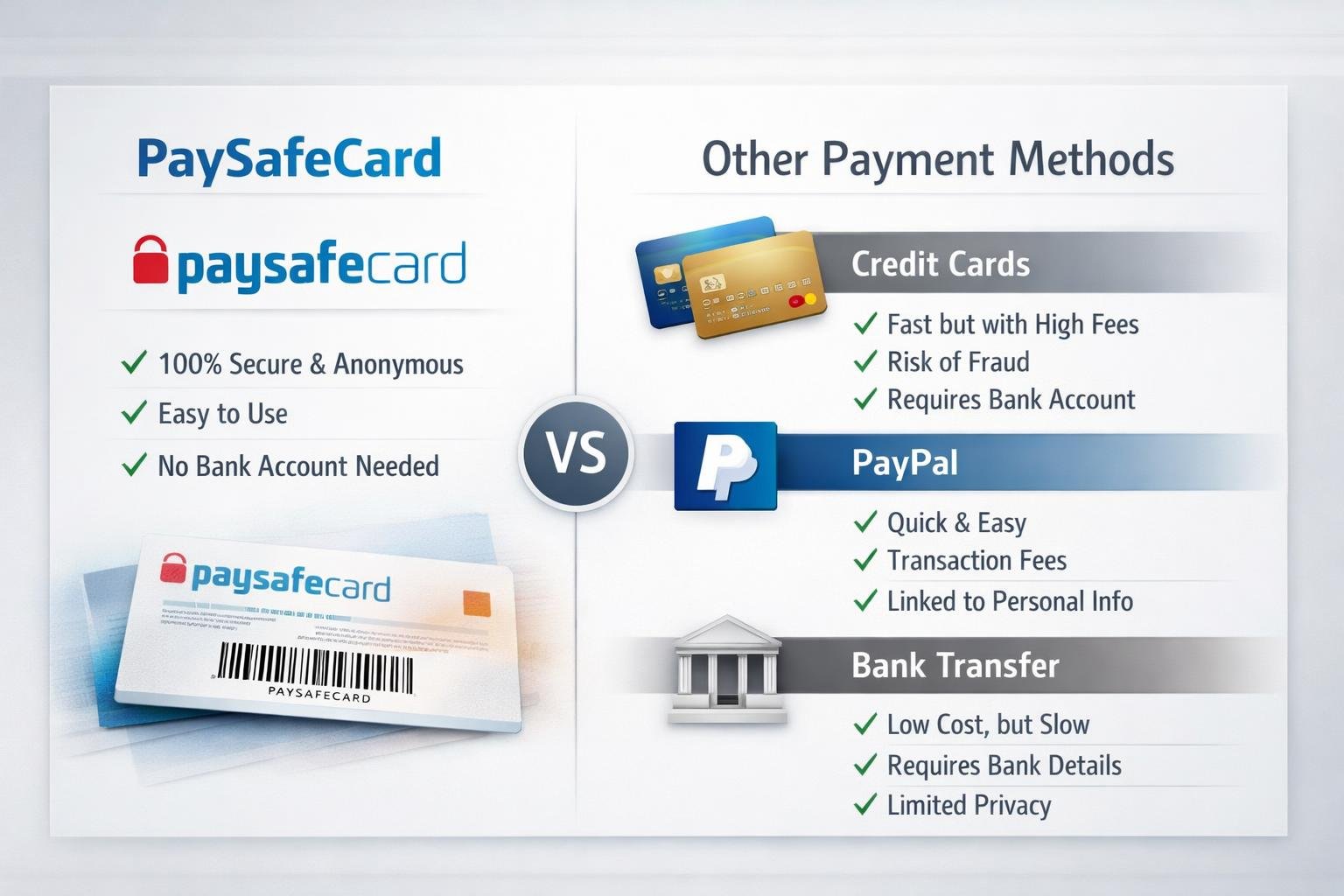
Paysafecard sits right alongside credit cards, e-wallets, and bank transfers in the online casino payments world. Each option has its own quirks—some are faster, some are more private, and some just feel easier. If you care about how your money moves, it’s worth looking at where Paysafecard stands out and where it can’t really compete.
Advantages Over Other Options
Privacy is Paysafecard’s real trump card. When I use a classic voucher, I never have to give the casino my bank info or card numbers. I just walk into a shop, buy a voucher with cash, and use the 16-digit PIN to deposit—no paper trail, no fuss.
Visa and other cards always make me share sensitive details. E-wallets like PayPal, Neteller, EcoPayz, or Skrill want a linked bank account. Even PayPal, which is great for withdrawals, still needs a card on file.
It’s the same story with Skrill, Neteller, and Payz—they’re great for cashing out, but not as anonymous. Some folks use Neosurf for a similar prepaid voucher experience, but Paysafecard is just more widely accepted.
Key privacy advantages:
-
No bank account needed
-
No card details shared with casinos
-
Cash purchase option maintains anonymity
-
16-digit PIN is the only required information
There’s also built-in budget control. Since you can only spend what’s loaded on the voucher, it’s a lot easier to avoid overspending compared to Visa or Payz. Neosurf is solid, but Paysafecard is just everywhere, especially on big international casino sites.
Disadvantages Compared to Competitors
Here’s the catch: Paysafecard’s prepaid system means you can’t withdraw your winnings with a classic voucher. If you win, you’ll need another withdrawal method or you’ll have to upgrade to a Paysafecard Mastercard.
Paysafecard withdrawal options:
|
Paysafecard Type |
Can Withdraw? |
|---|---|
|
Classic Voucher |
No |
|
Paysafecard Mastercard |
Yes |
Maximum deposit limits are on the lower side. High rollers who want to drop a few grand at once will probably find Paysafecard a bit limiting. PayPal, bank transfers, and credit cards usually let you move much larger amounts in one go.
Vouchers do expire after a while, and Paysafecard might charge maintenance fees on unused balances. E-wallets and cards don’t really have this problem. Plus, not every country has Paysafecard retailers, so sometimes finding a place to buy a voucher—or buying one online—feels like an extra step compared to just using your regular card.
Best Use Cases
If privacy is your top priority, I’d say Paysafecard is hard to beat. Most casino reviewers agree—this method is a great pick if you want high security and don’t want to share your financial info.
It’s especially good for players with small or medium budgets. The spending caps that annoy high rollers actually help casual players stick to their entertainment budget. If I’m only planning to deposit $25 to $200 at a time, Paysafecard fits perfectly.
For new players testing out unfamiliar casinos, Paysafecard is a smart move. You get to try the games and service with a small deposit, without giving up your bank details until you’re sure the casino is legit.
And if you don’t have a bank account or credit card, Paysafecard opens the door to online casino gaming. It’s a lifeline for anyone who deals mostly in cash or can’t get traditional banking products.
Licensing and Regulatory Compliance
Online casinos that offer Paysafecard have to meet strict licensing standards and anti-money laundering (AML) rules. From what I’ve seen, reputable casinos get audited regularly to show they’re handling payments correctly and keeping player funds safe.
Licensing Requirements
Casinos need approval from recognized gambling authorities before they can legally operate. The UK Gambling Commission (UKGC), Malta Gaming Authority (MGA), Kahnawake Gaming Commission, and Curacao Gaming Control Board are the big ones overseeing most sites.
Each regulator sets its own rules for payment systems. Casinos have to prove they use secure payment gateways and have proper controls in place. The licensing process checks that the casino can actually process deposits and withdrawals safely.
Some casinos hold licenses in multiple regions, so they end up following several sets of rules at once. You’ll usually find their license numbers at the bottom of their website—worth checking if you’re ever unsure.
Anti-Money Laundering (AML) and Know Your Customer (KYC) Policies
Paysafecard isn’t available at every casino, and that’s usually down to AML concerns. Regulators worry prepaid vouchers could hide where money really comes from.
Casinos that accept Paysafecard have to verify your identity using KYC checks. That means you’ll need to upload ID before you can withdraw, even if you deposited with a totally anonymous method like Paysafecard.
Under the hood, the casino software looks for suspicious transaction patterns. If you’re making large or frequent deposits, you might get asked for extra verification. Some casinos set lower deposit limits for Paysafecard just to keep AML risks under control.
Certifications and Third-Party Audits
Licensed casinos connect to certified payment gateways to handle Paysafecard transactions. These gateways have to meet PCI-DSS security standards, which, in simple terms, means they encrypt and protect your payment data behind the scenes.
Independent auditors regularly dig into casino financial records. They want to see that player funds stay separate from the casino’s operating cash, and they check that payment processing and payouts actually work as promised—not just on paper.
RNG certification is what keeps games fair at licensed casinos. Third-party labs like eCOGRA and iTech Labs test the game software to make sure the random number generators aren't rigged.
Casinos also roll out responsible gambling tools—think deposit limits and self-exclusion—because regulators require them to keep their licenses.
Common Issues and How to Resolve Them
Most of the time, Paysafecard just works. Still, players sometimes hit snags—timing delays, error messages, or the occasional need to wrangle with customer support.
Transaction Delays
Deposits usually show up instantly, but sometimes, they get stuck in limbo for technical reasons. If your Paysafecard deposit doesn’t land right away, give it 10-15 minutes and check your casino balance again.
Delays often happen on the casino’s end, not with Paysafecard itself. Double-check that you typed in the correct 16-digit PIN; even a single digit off will block the transaction entirely.
You can always verify your voucher balance on the Paysafecard website to see if the funds got deducted. If your voucher balance dropped but your casino account didn’t update, reach out to the casino first—they can look up the payment processor logs.
Most delays sort themselves out in under an hour, but keep your PIN and transaction details handy if you need to contact support.
Deposit or Withdrawal Errors
Deposit errors usually boil down to a wrong PIN or trying to deposit more than what’s left on your voucher. Always double-check the code before you hit submit, because even a typo kills the transaction.
For casino withdrawals, standard Paysafecard vouchers won’t cut it. You’ll need a My Paysafecard account, which links to your personal info and lets casinos send winnings back your way.
Some casinos set minimum deposit amounts that might be higher than your voucher value. A few won’t let you combine vouchers, which is annoying. If you run into wagering requirements issues, remember those rules are about bonus funds, not Paysafecard itself.
Contacting Support
I always start with the casino’s customer support for transaction hiccups. They can dig into your account history and payment logs, and live chat usually gets you an answer fastest.
If your issue is with the voucher—like a damaged PIN or an invalid code—go straight to Paysafecard support through their website. Have your receipt and PIN ready, so they can check if the voucher was already used or if there’s a technical glitch.
Most payment disputes get sorted within a day or two. I keep screenshots of error messages and jot down the exact time things go wrong; it speeds up the whole process.
Pros and Cons
Paysafecard gives you privacy and spending control—two things I really value when playing online. It’s popular at new paysafecard casinos, but there are some limits around how much you can deposit and how you get your money out. Here’s my take on the real pros and cons.
Four Advantages Table
|
Advantage |
Description |
|---|---|
|
Complete Privacy |
I never have to share my bank account or card details with the casino. All they see is my 16-digit PIN, so my financial info stays totally separate from my gaming. |
|
Enhanced Security |
Since I’m using a prepaid voucher, my banking data never touches the casino. If there’s ever a breach, the worst I lose is the voucher amount—not my whole account. |
|
Budget Control |
I can only spend what I’ve loaded onto the voucher. This setup makes it much easier to stick to a budget and avoid surprise deposits. |
|
No Account Required |
I can walk into a store, buy a voucher, and start playing—no need to create an online account or go through any identity checks. It’s quick and hassle-free. |
Four Disadvantages Table
|
Disadvantage |
Description |
|---|---|
|
Lower Deposit Limits |
One voucher usually tops out at $100–$300. I can combine PINs, but most casinos cap Paysafecard deposits at $1,000 per transaction, which isn’t great for high rollers. |
|
Limited Withdrawal Support |
Most casinos won’t let me withdraw directly back to Paysafecard. I need a My Paysafecard account, and even then, not every casino offers this. Usually, I end up using a bank transfer or e-wallet for cashing out. |
|
Inactivity Fees |
If I leave a voucher unused for 12 months, Paysafecard starts charging a monthly fee. So I try to use them up before that clock runs out. |
|
Currency Conversion Costs |
If I use a voucher in a different currency than I bought it in, Paysafecard tacks on a conversion fee. That adds up if you play at international casinos. |