










Let’s talk about eMerchantPay, a payment gateway that helps online casinos handle your transactions. Just a heads up—this guide is for info only, not advice. The world of online gambling keeps growing, and eMerchantPay is right there, making it easier for players to get in the game.
Since 2002, eMerchantPay has helped online gambling stretch across the globe. Picking the right payment method can make your gaming experience safer and smoother—no one wants to stress over payments when they’re just trying to have some fun.
Plenty of players trust eMerchantPay when searching for top casinos. It connects you to more than 300 local payment methods and over 80 alternatives, so funding your casino account feels as easy as paying for coffee.

When I check out casinos that accept eMerchantPay, I see they let you pay with everything from credit cards to local apps—all in one spot. You won’t have to worry about whether your bank or favorite payment app will work. The UK Financial Conduct Authority keeps an eye on things, which adds peace of mind for your transactions.
In this guide, I’ll walk you through how eMerchantPay works behind the scenes, what perks you get as a player, and how it stacks up against other ways to pay. We’ll also talk fees, speed, and how to fix those annoying hiccups that sometimes pop up.
Key Takeaways
-
eMerchantPay gives casinos access to 300+ local and 80+ alternative payment methods for deposits and withdrawals.
-
The service is regulated by the UK Financial Conduct Authority and FINRA, with specialized operations running since 2004.
-
Players get lots of payment options at eMerchantPay casinos—no need to sign up for a bunch of separate accounts. That’s a big reason top casino sites love it.
What Is This Payment Method?
Think of eMerchantPay as a bridge between online casinos and over 300 local payment methods, all rolled into one simple connection. It’s built for online gambling, so it knows what players and casinos need.
Globally, they offer services like risk management and card issuing to make sure every payment goes through without a hitch. Because it handles so many currencies, you can play from just about anywhere and pay in your own money.
Payment Method Overview
Here’s the thing: eMerchantPay isn’t something you sign up for directly as a player. It sits quietly between the casino and your actual payment method—whether that’s a credit card, e-wallet, or bank transfer.
When you deposit, you’ll usually get redirected to a special cashier page where you pick your payment option. The gateway is built to handle thousands of payments at once, so things move fast.
You can use major cards like Visa, Mastercard, and American Express, plus e-wallets, direct bank transfers, and local favorites like iDEAL, PIX, and SEPA Direct Debit. They even support Klarna, paysafecard, Apple Pay, Google Pay, and Neteller.
Security’s tight—eMerchantPay holds PCI DSS Level 1 certification (that’s the gold standard for payment safety). The company is also authorized by the UK Financial Conduct Authority and FINRA (via its Bulgarian branch).
History and Development
Back in 2002, eMerchantPay started up and by 2004, they launched their specialized gateway for online merchants. Their focus has always been on making online payments less of a headache.
They’ve picked up certifications like ISO 9001:2008 for quality and ISO/IEC 27001:2013 for security. With 10 offices in places like London, Munich, Amsterdam, and Sofia, the company now employs over 450 people worldwide.
Lately, they’ve expanded their reseller and ISO programs and teamed up with global payment providers like Novalnet AG and APEXX Global. This helps casinos accept payments from more countries with less hassle.
Popularity Among Online Casino Players
eMerchantPay works with all sorts of industries, but it’s especially useful for online casinos because it lets operators accept players from just about anywhere. I never have to make a separate eMerchantPay account—just pick my usual payment method and go.
This makes deposits and withdrawals a breeze compared to juggling a bunch of accounts. Casino deposits usually show up instantly, so you can start playing right away. Withdrawals might take a bit longer, depending on your chosen method and the casino’s review process.
E-wallets usually pay out faster than old-school bank cards or transfers. That’s handy if you’re itching to cash out your winnings.
Why Do Casinos Use This Payment Method?
Casino operators pick eMerchantPay because it opens the door to 300+ local payment methods. It takes the headache out of card processing and other complicated money stuff. Operators can even use POS solutions to keep everything under one roof.
Key Benefits for Casinos Table
|
Benefit |
Description |
|---|---|
|
Multi-Currency Support |
Handle payments in 150+ currencies all over the world |
|
Single Integration |
Connect to hundreds of payment methods with just one API |
|
Real-Time Processing |
Get deposits and withdrawals handled instantly |
|
Global Reach |
Accept players from Europe, North America, Asia-Pacific, Latin America, and Africa |
|
Cost Efficiency |
PCI DSS compliance is included—no extra tech expenses for casinos |
|
Local Payment Options |
Offer region-specific favorites like PIX, Interac, iDEAL, and SEPA Direct Debit |
Seamless Integration with Gaming Platforms
With eMerchantPay’s single-point API, casino operators don’t have to build a separate connection for every payment method. That’s a relief, especially for smaller casinos that can’t afford a big tech team.
The hosted cashier page pops up right on the casino’s site. You pick eMerchantPay at checkout, choose your payment method, and finish up—all without leaving the site. The system can handle a ton of transactions at once, which keeps everything moving quickly.
Smaller operators can compete with the big names by offering the same payment variety, without breaking the bank on infrastructure. That’s a win for everyone.
Security and Fraud Prevention
eMerchantPay takes security seriously—they’ve got PCI DSS Level 1 certification, which is as good as it gets. This helps protect casinos from data breaches and keeps compliance costs down.
The company is an Authorized Electronic Money Institution, regulated by the UK Financial Conduct Authority. Operators get built-in tools for fraud prevention and risk management, keeping the platform safe for everyone.
The platform’s real-time monitoring spots suspicious activity and flags it before it becomes a problem. That means less time and money spent on payment security, and more energy focused on the games.
Benefits for Players
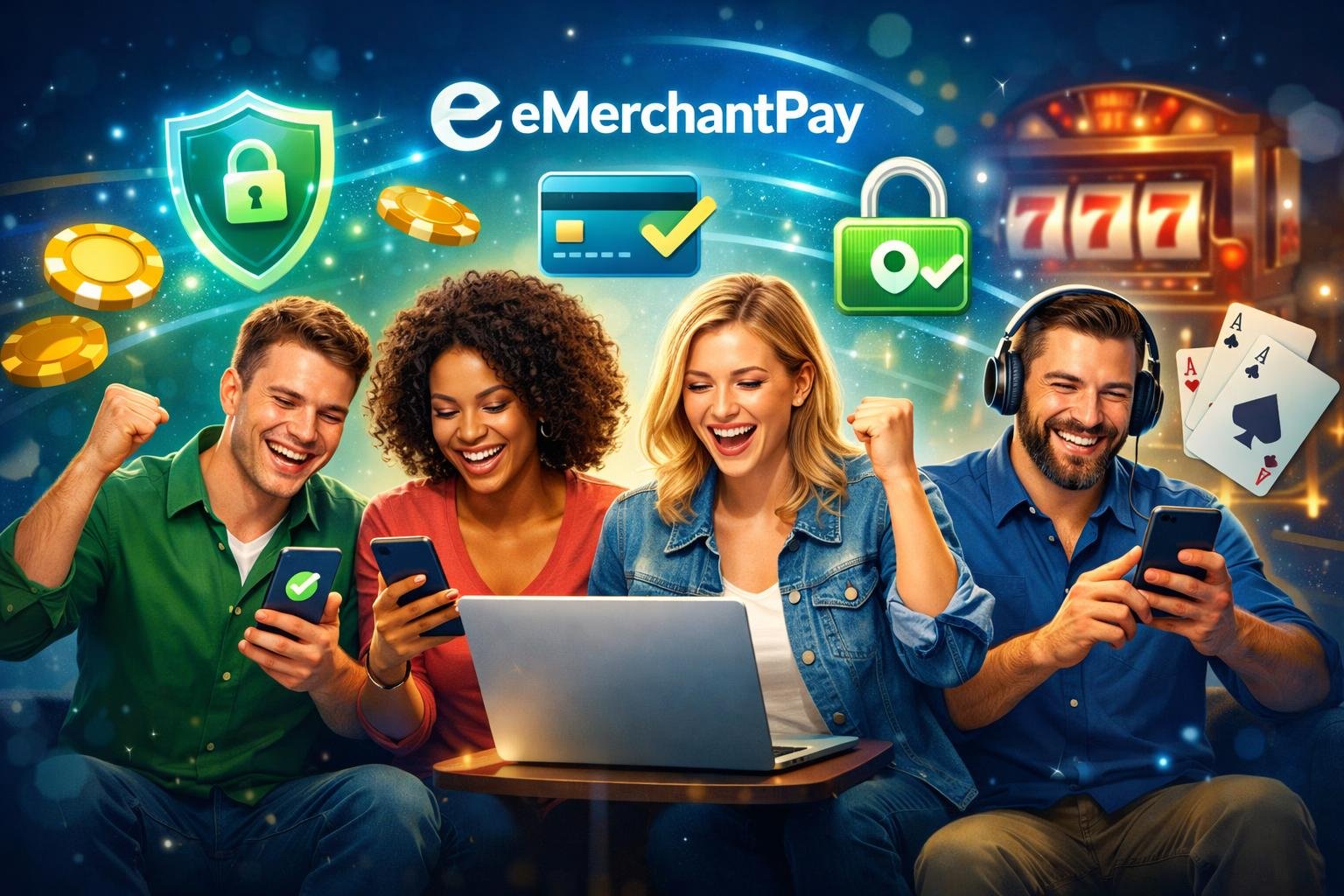
For players, eMerchantPay makes payments quick and secure. You don’t have to jump through hoops or stress about your info getting out—everything’s encrypted and protected.
Ease of Use and Accessibility
I’ve found eMerchantPay really easy to use at online casinos. There’s no need to open a separate account; just pick your favorite payment method right from the casino’s banking page.
You can choose from more than 300 local methods and 80+ alternatives—credit cards, bank transfers like Interac, e-wallets like EcoPayz, and prepaid options like Paysafecard. You can even use the eMerchantPay card if you want.
With so many choices, you’re not forced to try something new or unfamiliar. Just stick with what you already trust.
eMerchantPay works in over 150 currencies and supports multiple languages. You can deposit or withdraw in your own currency, which means no surprise conversion headaches. The system is global, so you can play at your favorite casinos no matter where you live.
Speed of Deposits and Withdrawals Table
|
Transaction Type |
Processing Time |
Notes |
|---|---|---|
|
Deposits |
Instant to a few minutes |
Most deposits show up in your casino account right away |
|
Withdrawals |
1-5 business days |
Speed depends on your payment method and the casino’s review process |
|
E-wallet transactions |
Faster than bank transfers |
Digital wallets usually pay out quicker than bank transfers—super handy if you’re playing live games. |
Depositing funds with eMerchantPay is almost always instant. I can top up my account and start playing in just a couple of minutes. Live casino players especially appreciate this speed.
Withdrawals do take a little longer, mostly because casinos have to double-check everything first. Still, eMerchantPay processes its side quickly.
Enhanced Security Features
eMerchantPay operates under the watchful eye of the UK Financial Conduct Authority, which means they have to stick to strict rules and protect your data.
All your banking info is protected with advanced encryption. Your card details and personal data stay locked down as they move between you, eMerchantPay, and the casino. Honestly, I don’t worry about my financial info getting into the wrong hands.
With authorization from both the UK Financial Conduct Authority and FINRA, eMerchantPay sets up multiple layers of security. Their system checks for anything fishy and stops fraud before it can mess with your account. That’s the kind of peace of mind I want when I’m playing online.
How Does This Payment Method Work?
eMerchantPay acts like a bridge, connecting your casino account to whatever funding source you prefer. The system moves your money securely between your bank, card, or e-wallet and the casino, and it actually supports over 300 local payment methods around the world.
Want to make a deposit with emerchantpay? Let me break it down for you in plain terms. The process is pretty simple, and knowing how it works can save you a lot of hassle. Plus, eMerchantPay backs up every deposit with top-tier security, so you can relax about your funds.
How to Deposit with eMerchantPay
Depositing with emerchantpay at an online casino is easier than it sounds. Usually, I just log into my casino account and head over to the cashier or banking section.
This step helps make sure your deposits and withdrawals get tracked properly. Before you add any funds, take a quick look at the casino’s rules about emerchantpay—every site’s a little different.
Once you’re in the cashier, pick eMerchantPay as your deposit method. The system will show you all the payment options they support—credit cards, debit cards, e-wallets, bank transfers, you name it.
Pick the one you like best and type in how much you want to deposit. The system might ask for your card info or e-wallet details, and sometimes you’ll get redirected to a super secure page to finish things up.
After you confirm the payment, eMerchantPay gets to work and processes your transaction right away. Most of the time, your deposit pops up in your casino account almost instantly, so you can jump right into the games.
How to Withdraw with eMerchantPay
Withdrawing with emerchantpay feels pretty similar to making a deposit. I just go to the casino’s withdrawal section and choose eMerchantPay as my payout option.
Then I enter how much I want to cash out and pick which payment method I want to use for receiving the money. Sometimes, the casino will ask for ID to double-check it’s really you—don’t worry, that’s normal.
Make sure you’ve met any wagering requirements before trying to withdraw, especially if you’re pulling out bonus funds. Casinos that use emerchantpay do check this kind of thing.
Once you submit your withdrawal request, eMerchantPay reviews and processes it. Depending on the payment method and the casino’s own rules, the timing can vary. Card withdrawals usually take about 3-5 business days, but e-wallets are often much quicker—sometimes just 24-48 hours.
Transaction Fees and Limits
Here’s some good news: eMerchantPay usually doesn’t charge players any fees for deposits or withdrawals. But your casino or payment provider might tack on their own, so it’s worth double-checking before you hit confirm.
Deposit limits depend on the method you use and the casino’s own policies. Most places set the minimum between $10 and $20, while the max can range from $5,000 up to $10,000 per transaction.
Withdrawal limits are a bit more personal—they can shift based on your account status and the casino’s terms. Regular accounts might have daily caps of $2,000 to $5,000, while VIPs get a little more wiggle room. Some casinos also set monthly withdrawal limits, so keep an eye out for that if you’re planning a big cash-out.
Compatibility and Global Reach
eMerchantPay works on pretty much every continent and supports a bunch of currencies, so players from all over can use it. Whether you’re on your phone or your laptop, the gateway runs smoothly.
Availability in Different Countries Table
This company’s been around since 2002 and has really spread out since 2004. You’ll find eMerchantPay in the UK, Europe, Latin America, and a bunch of other regions.
|
Region |
Availability |
Regulatory Status |
|---|---|---|
|
United Kingdom |
Available |
FCA Regulated |
|
Europe |
Available |
Licensed |
|
Latin America |
Available |
Expanding |
|
United States |
Available |
Varies by state |
|
Canada |
Available |
Licensed |
|
Australia |
Available |
Licensed |
|
Asia-Pacific |
Available |
Select markets |
They’re still growing in places like Latin America. eMerchantPay also falls under the watchful eye of the UK Financial Conduct Authority and FINRA, thanks to its subsidiary.
Supported Currencies Table
eMerchantPay lets you pay in all the big global currencies, plus some local ones. This means you can usually skip those annoying currency conversion fees.
|
Currency |
Code |
Region |
|---|---|---|
|
US Dollar |
USD |
Global |
|
Euro |
EUR |
Europe |
|
British Pound |
GBP |
UK |
|
Canadian Dollar |
CAD |
Canada |
|
Australian Dollar |
AUD |
Australia |
|
Japanese Yen |
JPY |
Japan |
|
Brazilian Real |
BRL |
Brazil |
|
Mexican Peso |
MXN |
Mexico |
On top of that, the platform supports 300+ local payment methods and more than 80 alternative ones. You can usually pick whatever works best in your country. For example, Trustly and EPS are big in Europe if you want direct bank payments.
Mobile Compatibility and Usability
eMerchantPay’s got your back if you’re on the go. You can use it on your phone or tablet, and there’s no need to download a separate app.
All the same security features from desktop carry over to mobile. The interface adjusts itself to fit your screen, so you don’t have to squint or scroll endlessly.
Deposits and withdrawals work just as quickly on mobile as they do on desktop, which is honestly a relief. You can keep track of your payments wherever you are.
Since the payment gateway plugs right into casino mobile sites, you don’t need to jump between apps or windows. A lot of live casino players love this because they can handle payments without missing a beat, especially when every second counts at the tables.
Comparison with Other Payment Methods
eMerchantPay isn’t your standard payment method. Instead, it’s a gateway that connects you to over 300 local payment options, not just one way to pay. This setup gives it some pretty unique pros and cons when you compare it to single services like PayPal or straight-up bank transfers.
It’s a flexible choice for anyone who wants more options at online casinos. But is it for everyone? Let’s see.
Advantages Over Other Options
The biggest plus here is having tons of payment choices in one place. If you play at a casino that uses eMerchantPay, you can pick from credit cards, e-wallets, bank transfers, and a bunch of local methods—all without the casino needing to set up deals with each one separately.
eMerchantPay supports over 150 currencies, which is a lot more than single payment services that only work in certain countries. If PayPal isn’t available where you live, you can probably find a local option through eMerchantPay.
Deposits usually hit your casino account instantly, which matches the speed of most e-wallets and leaves old-school bank transfers in the dust.
Security’s solid, too. eMerchantPay meets the highest industry standards (PCI DSS Level 1)—the same stuff major credit card companies use to keep your info safe.
Disadvantages Compared to Competitors
Now, here’s the catch: eMerchantPay isn’t a direct payment method you can use anywhere you want. Unlike PayPal or Skrill, you can’t send money to a friend or shop online with it outside of merchant websites.
You’ll need an account with one of the payment providers that eMerchantPay links to, like Visa, Mastercard, or an e-wallet. So, you’re really just using those services—eMerchantPay is the connector, not the wallet.
Some payment methods have better rewards programs. Credit cards might give you cashback or points, and some e-wallets have loyalty perks. eMerchantPay doesn’t offer those extras since it’s just the middleman.
It’s not as famous as PayPal or Visa, and that can make new players a bit cautious—even though the platform is legit and secure.
Best Use Cases
Where does eMerchantPay really shine? When you want flexibility at online casinos. If your favorite payment method isn’t directly listed on a casino’s site, chances are you’ll find it through eMerchantPay’s gateway.
International players get the most out of it. If you’re traveling or playing at a casino that takes players from lots of countries, eMerchantPay lets you use local payment options and your preferred currency. That’s huge for folks in places like Latin America, Asia, or Africa, where Western payment methods don’t always reach.
It’s also a lifesaver if you want backup options. If one payment method hits a snag or maxes out, you can switch to another without leaving the payment page.
High rollers and casual players both benefit. With minimum deposits around $10 and maximums up to $4,000, there’s room for almost any budget.
Licensing and Regulatory Compliance

eMerchantPay runs as an Authorized Electronic Money Institution. They follow strict rules set by major financial authorities and use thorough anti-money laundering (AML) and know your customer (KYC) checks to keep both casino operators and players safe.
Licensing Requirements
eMerchantPay Ltd. holds a license from the United Kingdom Financial Conduct Authority (FCA), which is one of the most respected financial watchdogs out there. This license means eMerchantPay has to stick to tough standards, both financially and operationally.
To keep their license, they need to have enough capital and do regular, detailed reports. They also have to play by the rules in every country where they operate.
If you’re running an online casino, working with a payment processor like eMerchantPay makes your business look legit to licensing authorities. Payment processors face regular audits and have to stay transparent if they want to keep their license.
Anti-Money Laundering (AML) and Know Your Customer (KYC) Policies
eMerchantPay puts AML and KYC procedures in place to block financial crime and keep payments flowing safely. Basically, you’ll need to prove who you are, and the system keeps an eye on transactions for anything fishy.
Here’s what these checks usually involve:
-
Verifying ID documents for everyone with an account
-
Watching for odd or suspicious transaction patterns
-
Reporting big or unusual transactions
-
Regularly checking for risks in payment activity
Their team keeps up with changes in the rules to make sure everything stays above board. They also help their casino partners support responsible gambling, which is a nice touch.
Casinos still need their own AML programs, but using a payment processor with strong protections adds another safety net. Licensing authorities look at how casinos move money, so this stuff really matters.
Certifications and Third-Party Audits
eMerchantPay holds security certifications that show their payment systems meet strict standards. Independent auditors regularly check how they handle security and operations.
These audits dig into how they keep transactions secure, protect your data, and follow the rules. Since they handle card payments, they must meet Payment Card Industry Data Security Standard (PCI DSS) requirements.
Financial regulators keep an eye on them, too. For casino operators, using a certified payment processor like this makes it easier to meet licensing requirements.
Most gambling authorities actually require casinos to use payment methods that pass certain security and compliance checks.
Common Issues and How to Resolve Them
Payment hiccups can really throw off your casino experience, but don’t stress—most of the time, the fix is simple. The main culprits are network problems, wrong payment details, or delays in processing.
Transaction Delays
Sometimes payments just take longer than you’d expect. Depending on your payment method and your bank, a delay might last anywhere from a few minutes to a few hours.
Unstable internet often causes slow transactions. If your Wi-Fi or data is acting up, the payment info might not reach eMerchantPay’s servers right away.
Bank processing times play a big role, too. Some banks take their time, especially during weekends or holidays. If you’re making an international payment, extra checks can slow things down even more.
If your payment seems stuck, give it at least 30 minutes before you do anything. Most delays sort themselves out. Don’t try to resend the same payment over and over—you could end up with double charges.
Deposit or Withdrawal Errors
When a payment doesn’t go through, it’s usually because of an expired card, not enough money in your account, or a typo in your payment details.
Here are the usual suspects:
-
Cards that are expired or damaged
-
Wrong card numbers or security codes
-
Not enough money in your account
-
Daily limits reached
-
Trying to use a card type that isn’t supported
Double-check your card’s expiration date and make sure you’ve typed everything in correctly. Also, see if there’s enough money for the payment and any fees that might come with it.
If you keep running into trouble, try another payment method. Switching between contactless, chip and PIN, or even a different card can help you figure out what’s going wrong.
Contacting Support
If you’ve tried everything and you’re still stuck, it’s time to reach out to eMerchantPay’s support team. Having all your info ready will help them help you faster.
What to have on hand:
-
Your merchant name and ID
-
Terminal serial number (if you have one)
-
The brand of card you used
-
When the transaction happened
-
Any error messages you saw
Use the official support channels on their website. If you can, include screenshots of error messages. The more details you share, the quicker they’ll get to the bottom of it.
Keep track of your payment attempts—confirmation numbers, timestamps, everything. It’ll make the support process go a lot smoother.
Pros and Cons
eMerchantPay gives you a payment gateway with lots of payment options and solid security. Still, there are a few things you’ll want to think about before you use it at a casino.
Four Advantages Table
|
Advantage |
Description |
|---|---|
|
Wide Payment Selection |
You get access to over 300 local payment methods and 80+ alternatives—all in one place. That covers credit cards, e-wallets, and bank transfers, so you can pick what fits your style. |
|
Strong Security Standards |
They’ve got PCI DSS Level 1 certification and a license from the UK FCA. You’re protected by advanced fraud detection and risk tools every time you make a payment. |
|
Global Reach |
You can use eMerchantPay at casinos all over North America, Europe, Asia, and beyond. With 10 offices worldwide, they offer local support wherever you are. |
|
Quick Integration |
Casinos can get eMerchantPay up and running in about a week, so more sites are starting to offer it. Their payment pages are customizable and make deposits and withdrawals feel pretty seamless. |
Four Disadvantages Table
|
Disadvantage |
Description |
|---|---|
|
Gateway Dependency |
You have to go through eMerchantPay instead of dealing with your bank or payment provider directly. It adds another step between you and your money. |
|
Limited Direct Information |
It can be tricky to find details on fees or transaction limits, since these often depend on each casino’s agreement with eMerchantPay. |
|
Processing Variations |
Depending on which of the 300+ payment methods you pick, your transaction speed and costs might change. Not every option works the same way. |
|
Regional Restrictions |
Even though they cover a lot of ground, some countries or regions might have limited access to certain payment methods because of local laws. |
Conclusion and Final Thoughts
I’ve found eMerchantPay to be a reliable payment gateway for casino players who want flexibility. You get access to hundreds of payment methods—over 300 local and 80+ alternatives—all through one connection.
The company’s been around since 2002 and started offering specialized gateway services in 2004, so there’s a lot of experience behind the scenes. With PCI DSS Level 1 certification, your financial details stay locked down tight.
Here’s what stands out to me:
-
Most casinos process deposits instantly
-
You can use loads of local and alternative payment methods
-
The gateway itself doesn’t charge fees (though casinos might)
-
Support for 150+ currencies
Things to keep in mind:
-
eMerchantPay is a B2B service, so you don’t need your own account with them
-
Withdrawal times depend on the payment method and the casino’s pending period
-
Not every casino has added this gateway yet
If you’re curious, reach out to your casino’s support and ask if they use eMerchantPay. Also, check which payment methods are actually offered through their setup—sometimes the list is shorter than you’d expect. There are plenty of solid casinos using eMerchantPay right now, and a lot of them try to lure in new players with a 100 free spins bonus when you sign up.
This platform really works for anyone who likes having options. Whether you prefer cards, e-wallets, or direct bank transfers, you’ll probably find something that fits.
Just be sure to check for fees with your chosen payment provider before hitting “submit.” Most reputable sites also offer resources to help you gamble responsibly—use them if you need to. Safe gaming is always the goal.