




Let’s dive in! This Three Card Poker Casino Game Guide will show you why this game has exploded in popularity at casinos everywhere.
Three Card Poker brings something totally different to the table—literally. The rounds fly by, the choices are simple, and honestly, it’s so much less intimidating than regular poker. If you’re thinking about moving from slots to table games, learning how to play 3 card poker is usually the first step.
You don’t have to battle a table full of sharks or memorize dozens of strategies. The rules are refreshingly straightforward. Players love that you’re only up against the dealer, and you only have three cards to worry about—so the excitement stays high, but the decisions don’t get overwhelming.
Three Card Poker gives you multiple ways to win in a single round through different bet types, bonus payouts, and straightforward hand rankings that take minutes to learn. I’ve seen beginners walk up to a table and start playing confidently within their first few hands.
The game moves fast, the rules are clear, and you can choose how much risk you want to take with each bet. That’s part of the magic.
Here’s what surprised me: it doesn’t take long to feel like you belong at the table. In this guide, I’ll show you how the game works, which strategies actually help, how casinos keep things fair, and what you should keep an eye out for as a player.
Maybe you’re planning your first casino trip, or maybe you just want to know what all the hype is about. Either way, you’ll find what you need right here.
Key Takeaways
-
Three Card Poker puts you head-to-head with the dealer, not other players. The betting is simple, and the game moves way faster than classic poker.
-
The dealer has to show at least Queen-high to qualify, and—here’s a twist—a straight actually beats a flush in this game.
-
If you play hands of Queen-6-4 or better and fold the rest, you’re already using the best long-term strategy.
What Is This Casino Game?
Three Card Poker is a casino table game where you face off against the dealer with just three cards each. It blends simplicity with a quick-fire pace, and honestly, it’s one of the easiest poker games you’ll ever learn.
Lots of folks start their casino journey here because the structure is so approachable. You don’t need to be a math whiz or a poker pro.
Game Overview
Three Card Poker doesn’t play by the same rules as traditional poker. Instead of going up against a crowd, you get three cards and it’s just you versus the dealer.
There are two main ways to bet. The Ante bet is your chance to beat the dealer’s hand. The Pair Plus bet pays you if you land a pair or better, no matter what the dealer has.
One thing that caught me off guard: the hand rankings. In 3 card poker, a straight actually beats a flush! That’s because with only three cards, making a straight is trickier. The top hand is a straight flush, then three-of-a-kind, straight, flush, pair, and finally high card. If you can remember that order, you’re already ahead of the game.
History and Evolution
Derek Webb came up with Three Card Poker in 1994, aiming to mash up the thrills of poker with the speed of other table games. He spent years tweaking the rules and getting casino approval.
By 1997, casinos started offering it, and it caught on fast. Dealers picked it up quickly, players could jump in after a quick explanation, and by the early 2000s, 3-card poker was everywhere—in the US, the UK, you name it.
Webb drew inspiration from the British card game Casino Brag but trimmed the rules and threw in the Pair Plus bet to make it more modern. Some folks compare it to Caribbean Stud Poker, but Three Card Poker is way zippier and more beginner-friendly.
Popularity Among Players
Three Card Poker sits comfortably in the top five casino table games. If you walk into a busy casino, you’ll probably spot several tables running at once.
People love that you can learn the ropes in minutes. But don’t let the simplicity fool you—side bets can get risky, so you need to keep an eye on your bankroll.
The pace is relentless—in a good way. You can play dozens of hands an hour, and the Pair Plus bet adds a shot at a big win even if you’re not beating the dealer. Every hand feels like it could be the one.
Why Do Casinos Offer This Game?

Three Card Poker is a win-win for casinos. It keeps players glued to the table with its fast pace and offers plenty of betting options.
The house edge is solid, the rules are easy, and both newbies and veterans find something to like. That’s a rare combo.
Benefits for Casinos Table
|
Benefit |
Description |
|---|---|
|
House Edge |
3.37% on Ante bets provides steady profit margin |
|
Side Bets |
Pair Plus bet increases house edge to 7.28% |
|
Game Speed |
Quick rounds allow 50-70 hands per hour |
|
Low Overhead |
Single dealer handles multiple players efficiently |
|
Table Efficiency |
Requires minimal space compared to traditional poker |
Casinos love that this game can run dozens more hands per hour than most other table games. More hands means more bets, which means more revenue. The simple setup means dealers can get up to speed fast, and the casino doesn’t need as many staff members hovering around.
Player Appeal and Retention
Here’s where it gets interesting: Three Card Poker takes away all that poker-table pressure. You’re not up against a bunch of card sharks—just the dealer. That’s a relief for a lot of folks.
Anyone can pick up the basics in just a few minutes. The Ante Bonus is a nice touch, too. If you land a strong hand, you get paid even if the dealer doesn’t qualify. That’s a small win that keeps people smiling and sticking around.
The Q-6-4 strategy rule is easy to remember. It gives new players a real confidence boost, so you don’t feel lost on your first try.
If you’re the type who likes to chase a big win, the side bets add an extra thrill. The Six Card Bonus can be a game-changer, keeping the excitement alive even if you fold your main hand.
Unique Features Table
|
Feature |
Player Benefit |
Casino Benefit |
|---|---|---|
|
Dealer Qualification |
Push on Play bet if dealer fails to qualify |
Keeps players betting longer |
|
Ante Bonus |
Automatic payout on straight or better |
Encourages continued play |
|
Multiple Bets |
Three independent wagers per hand |
Triple revenue potential per round |
|
Modified Rankings |
Straight beats flush, making wins more frequent |
Aligns payouts with 3-card mathematical rarity, ensuring fair game volatility |
That queen-high dealer qualification? It’s a sneaky bit of psychology. If the dealer doesn’t qualify, you get your Play bet back, and it feels like a little win—even if your cards were terrible. That tiny boost keeps people playing longer than they might expect.
Benefits for Players
Three Card Poker is a blast because it’s fast, easy to pick up, and you can tailor your bets to fit your comfort zone. Once you get the hang of it, you can explore different betting systems and bonus options at most tables.
Entertainment and Skill Development
Learning Three Card Poker takes minutes, not hours. Each round flies by—usually under a minute. That quick pace keeps you on your toes and never lets boredom set in.
You don’t have to overthink things. The strategy is simple: know when to fold, know when to play. After a few hands, you’ll feel right at home.
I love the dual betting structure. You can go for Ante bets to challenge the dealer, take a shot at Pair Plus for those juicy bonus payouts, or do both if you’re feeling bold. That flexibility lets you mix things up and play your way, whether you’re cautious or a little daring.
Winning Potential Table
|
Bet Type |
Hand |
Typical Payout |
|---|---|---|
|
Ante Bonus |
Straight Flush |
5:1 |
|
Ante Bonus |
Three of a Kind |
4:1 |
|
Ante Bonus |
Straight |
1:1 |
|
Pair Plus |
Straight Flush |
40:1 |
|
Pair Plus |
Three of a Kind |
30:1 |
|
Pair Plus |
Straight |
6:1 |
|
Pair Plus |
Flush |
3:1 |
|
Pair Plus |
Pair |
1:1 |
Alright, let's talk numbers because this is where things get spicy. The house edge on the Ante bet usually sits around 3.37% if you stick to solid strategy. For Pair Plus bets, the house edge floats between 2.32% and 7.28%, depending on the paytable—so yeah, it pays to check the fine print.
Understanding the odds in 3 card poker helps you keep your expectations in check. Sure, the dealer will scoop more hands, but those big bonus bet payouts? They add a whole new twist for players chasing that rush.
Accessibility Across Devices
You can jump into Three Card Poker almost anywhere now. I love that I can play at a buzzing casino table, on my laptop, or just tap away in a casino app on my phone.
Most online casinos let you start at just $1 or $5 per hand, so you don’t need to break the bank to join in. That’s awesome for testing strategies or just playing for fun.
On mobile, the game's layout stays clean and easy to use. Touch controls make decisions quick, and nothing important disappears off the screen—no squinting required.
Here's what really surprised me: live dealer versions stream real casino action straight to your device. Suddenly, you get that real-table vibe without ever leaving your couch. It's a cool blend of convenience and authenticity.
How to Play
Three Card Poker is wild because you get two ways to win. You can go head-to-head with the dealer using the ante bet, or you can bet on your own hand strength with pair plus.
Learning how to play isn’t rocket science, but timing your bets just right makes all the difference. I’ll walk you through the rules, some beginner tips, and the strategy basics so you can make choices that feel smart (and maybe even a little lucky).
Rules and Gameplay Overview
The action starts when you toss your bets into the circles on the table. You can pick the ante bet, the pair plus bet, or hey, why not both?
Once bets are down, you get three cards face down. The dealer gets three too. Now comes that little jolt of excitement—what’s in your hand?
If you placed an ante bet, you’ve got two choices:
-
Play: Match your ante with an equal play bet
-
Fold: Surrender your ante and sit out the hand
The dealer flips their cards next. For them to qualify, they need at least a queen high. If they don’t, your ante pays 1:1 and your play bet just comes back to you, no harm done.
Even if the dealer doesn’t qualify, you still snag the ante bonus if you hit a straight or better. This queen high rule is a sneaky little advantage for players, especially when the dealer’s hand is weak.
If the dealer qualifies, it’s showdown time. Whoever has the best poker hand wins. No pairs? The highest card takes it.
The pair plus bet is a different beast. It pays out just based on your hand—doesn’t matter what the dealer has. You’ll need at least a pair to win here; high cards alone won’t cut it.
Three card poker hand rankings from highest to lowest:
|
Hand |
Example |
Pair Plus Payout |
|---|---|---|
|
Straight Flush |
8♥ 7♥ 6♥ |
40:1 |
|
Three of a Kind |
K♣ K♦ K♥ |
30:1 |
|
Straight |
Q♣ J♠ 10♥ |
6:1 |
|
Flush |
A♦ 9♦ 4♦ |
3:1 |
|
Pair |
J♠ J♥ 8♣ |
1:1 |
Some casinos crank up the excitement with a 6-card bonus side bet. This one combines your three cards with the dealer’s three, looking for the best five-card poker hand. If you somehow land a six-card diamond straight flush (9 through Ace), get ready—that usually pays 1,000:1 on standard tables.
Those wild 100,000:1 payouts you might’ve heard about? Those are tied to separate Progressive Jackpot side bets, not the regular 6-card bonus.
Here's where it gets interesting: a few casinos toss in a "Mini-Royal" payout (Ace-King-Queen suited) as a special tier under the straight flush. It’s technically just a bonus within the straight flush category, but it often pays the most on the board.
Tips and Strategies for Beginners
Want to get a grip on three card poker? The first thing you need is a plan for when to play or fold. I always stick with Q-6-4 or better and fold anything weaker. This little rule only applies to the Ante and Play bets—Pair Plus is all about the luck of the draw, since you can’t change anything after the deal.
If your highest card is a queen, make sure your second card is at least a six, and your third is at least a four. It sounds simple, but it works.
Hands I always play:
-
Any pair or better
-
Any king-high or ace-high
-
Queen-high with 6-4 or better
I ditch hands like Q-6-3, Q-5-4, or J-10-9. Sticking to the Q-6-4 rule keeps the house edge at 3.37% on ante and play bets, which is about as good as it gets.
For Pair Plus, I always glance at the payout table first. The best ones pay 40:1 for a straight flush, 30:1 for three of a kind, 6:1 for a straight, and 3:1 for a flush. Some casinos lower the straight to 5:1 or the flush to 4:1—watch out, because that bumps up the house edge.
If you’re just starting out, try playing both ante and pair plus. You’ll get the thrill of beating the dealer plus the bonus payouts for strong hands. The dealer qualifies about two-thirds of the time, so you see plenty of action.
Most beginners chase too many weak hands. Folding feels like a snooze, but it saves you cash in the long run. I promise, sticking to Q-6-4 is worth it.
Advanced Techniques for Experienced Players
If you're looking to level up, pay serious attention to pay tables. They can make or break your expected returns. The pair plus house edge can swing from 2.32% on the best tables (40-30-6-3-1) all the way up to 7.28% on stingier ones (25-15-5-4-1). That’s a massive difference—almost 5%—so don’t just sit anywhere.
Three card poker moves at a breakneck pace—over 60 hands per hour. If you’re betting $10 on both ante and pair plus, you’ll lose about $0.57 per hand on average with perfect play. That adds up to roughly $34 per hour. I always adjust my bets to fit my bankroll and keep things fun, not stressful.
For longer sessions, I usually bring 30-40 times my combined bet. So if I’m putting $20 in play each hand, I’ll want $600-$800 to handle the swings. Variance can sneak up fast.
I usually skip the six card bonus bet. The house edge on that thing is brutal—usually 6-8%—and it can drain your stack before you know it. The big payouts look tempting, but the math just doesn’t back it up most of the time.
Some folks use a simple Q-7-4 strategy instead of Q-6-4. It makes decisions faster, but the house edge goes up by a hair—about 0.002%. Only go for this if Q-6-4 keeps tripping you up.
One more thing: dealer qualification matters. Dealers don’t qualify about a third of the time. When that happens, the Ante Bonus still pays out, but your Play bet just pushes if the dealer doesn’t qualify and pays 1:1 if the dealer qualifies and you win.
I never change my strategy based on streaks or gut feelings. Every hand is its own story. The Q-6-4 rule comes from cold, hard math—not superstition.
Game Variations
Since its 1994 debut, Three Card Poker has exploded into all sorts of variations. Casinos love to spice things up with progressive jackpots and new betting twists.
Most versions keep the core gameplay you know and love, but they tweak payouts or toss in extra side bets to keep things fresh. There's always something new popping up, and honestly, that's half the fun.
Common Variations Table
|
Variation |
Key Differences |
House Edge |
|---|---|---|
|
Prime |
Adds side bet on card colors |
2.32-3.62% |
|
6 Card Bonus |
Uses best 5 of 6 cards (yours + dealer's) |
2.00-8.00% |
|
Progressive |
Links to progressive jackpot for royal flush |
3.37% + jackpot bet |
|
Ante Bonus Plus |
Higher bonus payouts on premium hands |
3.20-3.50% |
Let’s dive in! Out of all the tweaks, Prime pops up the most often on casino floors and online. If you land all three cards in the same color, you’re in for a payout—and if they’re all red or all black, the rewards jump even higher. It’s a simple twist, but it adds a burst of excitement to every deal.
Here’s what surprised me about the 6 Card Bonus: you get to mash up your three cards with the dealer’s three, hunting for the best five-card poker hand. This side bet does its own thing, sticking to classic poker rankings, and it can lead to some wild swings when the stars align.
Regional and Casino-Specific Variations
Pay tables for Pair Plus can swing wildly from one casino to another. I’ve noticed straight payouts can be as low as 5:1 or as generous as 6:1, and flushes might pay 3:1 or 4:1. These little changes sneakily shift the house edge, so it pays to keep your eyes peeled.
Some Indian casinos and cruise ships toss in a “Mini Royal” bonus. If you manage to hit a Queen-King-Ace straight flush, the payout can rocket up to 100:1. Not every place offers it, but when you see it, you know you’re in for a treat.
In certain spots, you might stumble on a mini-royal side bet that’s all about chasing that suited Ace-King-Queen. It’s a niche bet, but it’s got a diehard following.
Online casinos love to spice things up with progressive side bets. I’ll often throw in a small wager for a shot at the jackpot. Sometimes there’s an envy bonus too—if someone else hits a monster hand, you get a little slice of the pie. The jackpot itself climbs for mini royal flushes, and even straight flushes or trips can score a chunk if the meter’s high enough. It’s honestly a rush watching that progressive meter tick up, even if the odds are long.
Emerging Trends
Live dealer Three Card Poker has exploded online lately. These games beam real dealers straight from fancy studios, blending the buzz of a real casino with the chill of playing at home. I can almost hear the chips clack and cards snap through my screen.
Multi-hand versions let me juggle up to five hands at once against a single dealer. It’s fast, it’s hectic, and it definitely eats up my bankroll faster—but wow, it keeps the adrenaline pumping.
Some tables now offer a “Bet Behind” feature. If all the seats are taken, I can still get in on the action by betting on someone else’s hand. I don’t make any decisions, but I get the same payouts as the main player. It’s a clever workaround when tables are packed.
Progressive jackpots just keep getting bigger. The biggest ones I’ve seen have tipped over a million bucks. Of course, chasing those means I’m putting an extra dollar or more on every hand, so it’s a balancing act between thrill and budget.
Technology Behind the Game

Playing 3 card poker online feels like peeking behind the curtain at a magic show. There’s a whole tech orchestra running in the background—random number generators, live streaming, mobile platforms—all working together to keep things fair and seamless. I can play from my couch, my phone, or even on a lunch break, and it just works.
Software and RNG Integration
Online casinos rely on Random Number Generator (RNG) software to shuffle and deal cards. The RNG spits out millions of number combos every second, each tied to a specific card layout. That’s how every hand stays unpredictable and totally independent from the last.
Big-name software companies like Playtech, Microgaming, and Evolution Gaming power these platforms. Their systems handle everything—game interfaces, bet buttons, payouts, hand comparisons. I don’t have to double-check anything; the software instantly figures out if the dealer qualifies with Queen-high or better, and whether I’ve won.
Independent testing labs like eCOGRA and iTech Labs keep the RNGs honest. They run audits to make sure the software stays random and fair. Most legit casinos proudly show off their certification badges right on the homepage.
Live Dealer Technology
Live casino Three Card Poker cranks up the realism with HD video streaming. I’m watching real dealers shuffle and deal at real tables, all from my phone or laptop. Multiple cameras zoom in on the action—cards, chips, dealer’s hands—so I don’t miss a thing.
The dealer’s cards get scanned by Optical Character Recognition (OCR) software, which beams the info straight to my screen in real time. Companies like Evolution and Playtech have built slick systems for this, and a lot of “English” tables stream out of studios in Riga and Bucharest. The software syncs up everything—results, payouts, the whole shebang—without a hitch.
I can even chat with the dealers, though they’ll politely dodge any strategy questions. The studios themselves look sharp—good lighting, soundproofing, and rows of tables buzzing with action for players worldwide.
Mobile and VR Compatibility
Three Card Poker fits right in my pocket now. Whether I’m using a casino app or just a mobile browser, the game adjusts to my screen and keeps all my betting options handy. Tapping to bet feels natural—no mouse required.
Mobile games use the same RNG tech as desktop versions, so fairness doesn’t change. Most new platforms run on HTML5 or WebGL, so I don’t have to download anything bulky. They load quickly and run smoothly, even if live dealer games can lag a little on slower connections.
VR poker is still a bit of a novelty, but it’s creeping in. With a headset, I can sit at a virtual table and look around a 3D casino. It’s visually wild, but the gameplay and odds stick to the basics. Still, it’s a glimpse of where things might be headed.
Licensing and Fair Play

Let’s talk trust. When I play Three Card Poker online, I always check if the casino holds a real license and uses certified random number generators. That’s the only way I know the games aren’t rigged—and I can play with peace of mind.
Regulatory Standards Table
Licensing rules aren’t all created equal. The gold standards are the UK Gambling Commission, Malta Gaming Authority, and Gibraltar Regulatory Authority. If a casino’s got one of these, I breathe easier.
|
License Authority |
Jurisdiction |
Requirements |
Player Protections |
|---|---|---|---|
|
UK Gambling Commission |
United Kingdom |
Strict financial audits, game fairness testing, responsible gambling measures |
Strong dispute resolution, segregated player funds |
|
Malta Gaming Authority |
Malta |
Regular compliance checks, technical standards, AML policies |
Fair gaming enforcement, complaint procedures |
|
Gibraltar Regulatory Authority |
Gibraltar |
Software certification, financial stability, player protection protocols |
Independent dispute resolution |
|
Curacao eGaming |
Curacao |
Basic operational requirements |
Limited oversight |
I always hunt for casinos with those top-tier licenses. Curacao might be easy to get, but honestly, it just doesn’t give me the same warm fuzzies as a UK or Malta license.
Ensuring Fairness
Random number generators decide what cards I see in online Three Card Poker. A good RNG spits out unpredictable results with zero patterns or bias—exactly what I want as a player.
Licensed casinos rely on certified RNG software that’s checked by independent labs. The RTP (return to player) percentage gives me a clue about long-term payouts. With solid strategy, Three Card Poker’s Ante/Play bet usually sits at 96.63% RTP.
Certified software locks in those RTP values, so casinos can’t mess with individual hands. Testing labs run millions of simulated hands to confirm the numbers actually match what’s advertised.
Certifications and Audits
Labs like eCOGRA, iTech Labs, and Gaming Laboratories International (GLI) check out casino games before they launch. These folks test the RNGs, verify the rules, and make sure RTPs are on the level. Audits don’t just happen once—they keep coming back to keep everyone honest.
I always scroll down to the footer or check the game info for certification seals. Reputable casinos put those badges front and center, and some even share monthly payout reports so I can see real RTP numbers for myself.
Common Issues and How to Solve Them

Let’s be real—problems pop up, even in a game as straightforward as Three Card Poker. Whether it’s a rules mix-up or a tech hiccup, I’ve seen (and made) plenty of rookie mistakes. Here’s how I tackle the most common snags so you can sidestep them too.
Gameplay Challenges
The number one headache? Knowing when to play or fold. I’ve watched folks fold way too often, or chase hands they should’ve ditched. If you want to trim the house edge, just stick to this: play any hand with Queen-6-4 or better, and fold the rest. Seriously, that’s the golden rule.
Another thing that trips people up is the dealer qualification rule. If the dealer doesn’t qualify, you actually win your Ante bet and get your Play bet back. Plus, if you’ve got a strong hand, you still pocket the ante bonus—even if the dealer’s hand doesn’t make the cut.
Don’t forget about the Ante bonus! If you land a Straight or better, you’ll collect the bonus no matter what the dealer is holding. Just make sure you’ve placed the Play bet, or you’ll miss out.
Key strategy points:
-
Always play Q-6-4 or better
-
Remember: dealer non-qualification means you win the Ante
-
The Ante bonus pays out regardless of the dealer’s hand
Technical Errors or Glitches
Online Three Card Poker sometimes throws you a curveball—frozen screens or sudden disconnections right in the middle of your session. If your game freezes mid-hand, take a breath. Licensed casinos usually finish the hand for you using their own strategy rules, then pop any winnings into your account.
Disconnected? Just log back in and peek at your game history. The system should've wrapped up your hand and sorted all bets. If your balance looks off or something feels wrong, reach out to support and ask questions.
Occasionally, you'll notice buttons not working or bets that just don't stick. Clearing your browser cache or updating the casino app often fixes these little headaches. A solid internet connection helps a ton, but if the hiccups keep coming, try a new browser or device before you message support.
Contacting Casino Support
Need a hand? Most casinos have live chat, email, and phone support ready to go. Live chat is my go-to for urgent stuff—missing payouts or weird game errors. I always snap a screenshot of the problem before I contact support, just in case.
If you’re dealing with a payout dispute, have your game ID and the timestamp handy. You’ll usually find those in your betting history. Spell out what happened versus what you expected, and include those details right up front.
Email works for questions that aren’t time-sensitive, like bonus rules or quirky policies. If you’d rather talk to a real person, phone support is there at most big casinos. I keep records of every conversation just in case I need to chase up an issue later.
Pros and Cons
Three Card Poker is a blast if you love simple rules and quick-fire action. But heads up—it comes with a slightly higher house edge than some other table games, and there isn’t a ton of room for deep strategy.
Four Advantages Table
|
Advantage |
Details |
|---|---|
|
Easy to Learn |
I can teach someone the basics in less than five minutes. All you really need are three-card hand rankings and the one golden rule: play or fold with Q-6-4 or better. |
|
Fast-Paced Action |
Each hand wraps up in seconds. I’ve played 60 hands in an hour—no long pauses, just pure entertainment and more chances to win. |
|
Dual Betting Options |
Want to bet against the dealer with Ante/Play? Or maybe you like testing your luck with Pair Plus? You can even do both for double the excitement. |
|
Good Bonus Payouts |
Land a straight flush on Pair Plus and you’ll snag a 40:1 payout. The Ante Bonus even pays for straights or better, even if the dealer doesn’t qualify or beats you. |
Four Disadvantages Table
|
Disadvantage |
Details |
|---|---|
|
Higher House Edge |
The house edge on Ante/Play sits at 3.37%, and Pair Plus jumps anywhere from 2.32% to 7.28%. That’s steeper than blackjack or baccarat, so your money’s up against tougher odds per hand. |
|
Limited Strategy |
Each hand gives you just one decision. There’s not much room for creative tactics beyond sticking with the basic Q-6-4 rule—it keeps things simple but limits your strategic play. |
|
Variable Pay Tables |
Pair Plus payouts swing wildly from casino to casino. If you don’t check the pay table first, you might play with a 7.28% house edge instead of 2.32%—a big difference. |
|
Rapid Bankroll Depletion |
The game’s speed can drain your bankroll in a flash. At $20 per hand and 60 hands an hour, you could risk $1,200 in just sixty minutes. |
Responsible Gaming
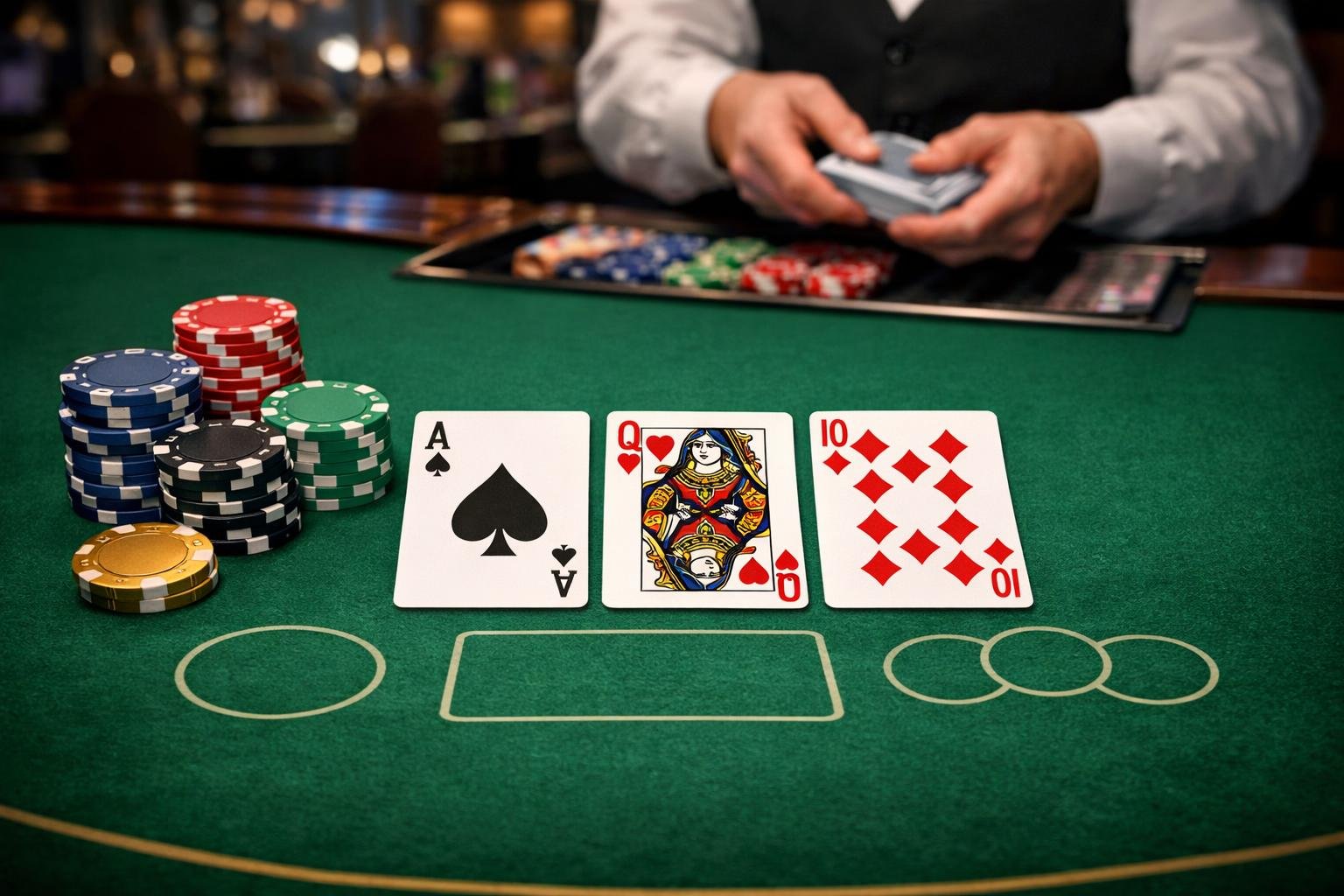
Three Card Poker moves at lightning speed, so keeping your bankroll in check is absolutely crucial. I always remind myself: this is entertainment, not a side hustle.
Setting Limits
I set my budget before I sit down. That means deciding exactly how much I’m okay with losing—no dipping into bill money or savings.
No matter what happens, I stick to my number. If I hit my limit, I walk away, no debate. Effective bankroll management means setting loss limits and actually honoring them.
Some folks use the 50/30/20 rule for their gambling money:
-
50% for regular play
-
30% as a backup stash
-
20% for higher stakes or side bets
I never chase losses by upping my bets. And I steer clear of credit cards or borrowing—nothing good comes from that road.
Recognizing Problematic Behavior
I watch myself for warning signs. If I’m playing to escape stress or avoid problems, that’s a big red flag.
Lying to family, skipping work, or feeling anxious when I’m not playing? Those are signs I need to step back. If I’m risking money I shouldn’t or ignoring real-life stuff, it’s time to pause.
I ask myself: Am I playing longer than I planned? Do I feel guilty after a session? Am I spending money that was meant for something else?
Available Tools and Support
Most casinos now offer self-exclusion programs. I can ask them to ban me for a set time, either at the cage or online.
Online casinos let me set deposit and loss limits, or even get session time reminders. I use these features to help keep myself in check.
Need help? Here are some resources:
-
National Problem Gambling Helpline: 1-800-522-4700
-
Gamblers Anonymous meetings—free and confidential
-
Casino staff who can point you to support services
-
Self-assessment tools on responsible gaming sites
If I spot a pattern I don’t like, I reach out. Getting help early is way easier than digging out from a bigger mess later.