






Let’s dive in—poker stands out as one of the most popular and skill-driven games in any casino. Unlike games that leave you at the mercy of luck, poker mixes strategy, psychology, and gutsy decision-making into a wild ride where what you do actually matters.
Whether you’re eyeing a seat at a Texas Hold’em table or firing up an online game, knowing the rules and strategies sets you apart. Those choices? They’ll decide if you leave with a grin or a story about what not to do.
This guide is your backstage pass to casino poker. I’ll walk you through the basics, highlight the different styles you’ll see, and show you how to keep your bankroll safe.
We’ll break down betting, talk real strategy, and flag the rookie mistakes you’ll want to dodge. My hope? You’ll walk up to any poker table with a little swagger and a lot of know-how.
Playing poker in a casino isn’t just about cards—it’s a blend of competition and social energy you don’t really get anywhere else. Every session is a shot at getting better, and honestly, that’s half the fun.
Key Takeaways
-
Poker is all about skill—strategy, reading people, and managing your chips are key if you want to win.
-
Different games like Texas Hold’em and Omaha have their own rules and betting quirks, so get familiar before jumping in.
-
Good poker etiquette, a cool head, and responsible play make for a way better experience at the tables.
What Is This Casino Game?
Poker’s a card game where I’m up against other players, all of us trying to scoop the pot by making the best hand or by bluffing everyone else into folding. It’s a mashup of skill, guts, and reading people—way more than just drawing lucky cards.
Game Overview
Here’s where it gets interesting: my job at the table is to win chips or money, either by showing down the best hand or forcing everyone else out with smart bets. A standard 52-card deck keeps things classic.
Most casino poker is player versus player, but sometimes you’ll find house-banked versions where you’re up against the dealer. That’s a different vibe.
To get started, I need to learn hand rankings, how the betting rounds work, and which starting hands are worth playing. Knowing when to fold or hang on is a big deal, too.
In Texas Hold’em, which is everywhere, I get two cards to myself and share five community cards with everyone else. My best five-card combo out of those seven cards is what matters.
During each hand, we go through several betting rounds. I can check, bet, call, raise, or fold, depending on how the action unfolds. The dealer button moves around the table after every hand so everyone gets a fair shot.
History and Evolution
Poker’s roots go way back—think Europe and Persia in the 16th and 17th centuries. The game as we know it really took off in the U.S. along the Mississippi River in the early 1800s.
Texas Hold’em started in Texas (no surprise there) in the early 1900s, but it didn’t blow up until the 1970s when the World Series of Poker started featuring it. The real explosion came in the 2000s with TV tournaments and the online poker boom.
These days, poker rooms are everywhere. I can find games with all sorts of stakes, from a few bucks to nosebleed limits, in just about any major casino.
Popularity Among Players
Poker pulls in millions because it rewards skill and sharp thinking, not just luck. I get to control my fate and, with enough practice, actually get better over time.
The social side is a huge draw, too. I get to read people, chat between hands, and match wits with all sorts of personalities. There’s always a new twist—no two sessions feel the same.
Some folks even go pro, making a real living from tournaments and cash games. Cash games are flexible—play as long or as little as you want. Tournaments are a different beast, with a set structure and big prizes for the top finishers.
Most U.S. casinos start at $1/$2 blinds, so you can buy in for $200 or so and not feel like you’re risking your rent money. That makes it pretty approachable for newcomers.
Why Do Casinos Offer This Game?

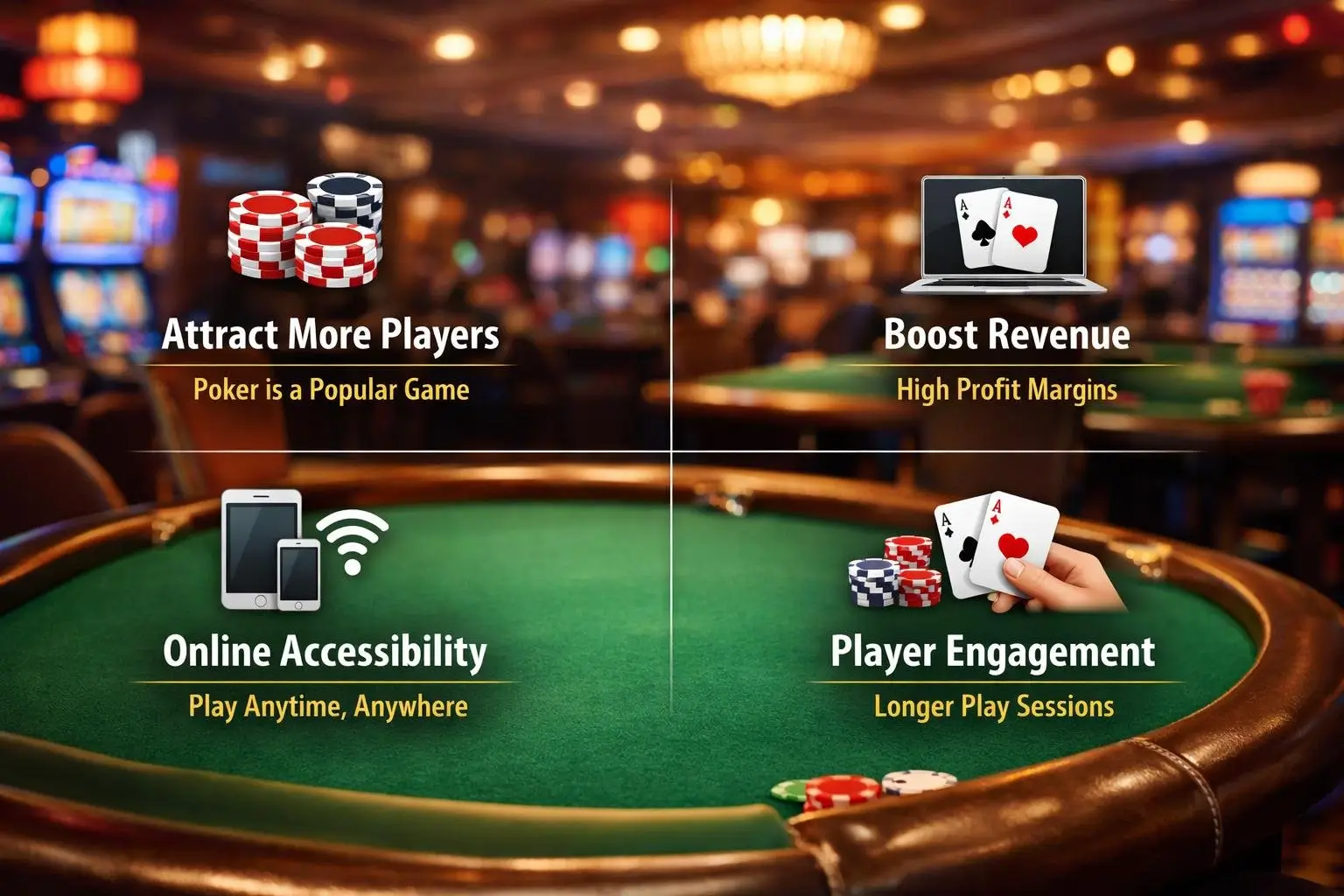
Casinos love poker because it brings in steady cash through rake—basically their cut of every pot. Plus, poker players tend to stick around, grab drinks, and maybe try their luck elsewhere, which is great for business.
Benefits for Casinos Table
|
Revenue Source |
Description |
Typical Range |
|---|---|---|
|
Rake |
Percentage taken from each pot |
2.5-10% of pot |
|
Time Collection |
Flat fee charged every 30 minutes |
$4-$10 per half hour |
|
Tournament Fees |
Entry fee percentage |
10-20% of buy-in |
|
Food & Beverage |
Sales from players during sessions |
Varies by venue |
Here’s what surprised me: casinos don’t risk losing to poker pros. Instead, they just collect their share from each hand while players battle each other. It’s a win-win for the house.
The poker room isn’t just about the tables, either. Players walk by rows of slots and other games on their way in and out, and plenty of them stop to try something else. That boosts the casino’s bottom line in ways you might not expect.
Player Appeal and Retention
Poker rooms attract regulars who show up week after week. Some folks settle in for marathon sessions, which keeps the place buzzing even during slow hours.
For a lot of players, the fact that skill matters keeps them coming back. I know I can improve, so the game never feels stale or hopeless.
Tournaments are a big deal, too. They fill up hotel rooms, pack restaurants, and bring in crowds that spend money all over the property. One good tournament weekend can mean a big payday for the whole casino, not just the poker room.
Unique Features Table
|
Feature |
Casino Advantage |
Player Benefit |
|---|---|---|
|
Professional Dealers |
Faster games, fewer disputes |
Fair, efficient play |
|
Structured Games |
Organized cash games and tournaments |
Easy game selection |
|
Security |
Protected funds and fair play |
Peace of mind |
|
Comps & Rewards |
Tracks play for marketing |
Free meals, hotel stays |
Casino poker rooms feel totally different from home games. Dealers keep things moving fast, so you see more hands and the casino collects more rake. Floor managers handle disputes right away, so you’re not left arguing over a pot for half an hour.
Benefits for Players
Poker gives you a mental workout and a shot at real rewards, whether you’re at a casino or playing online. It’s a mix of entertainment, skill-building, and, if you’re lucky, walking away with extra cash in your pocket.
Entertainment and Skill Development
Every hand of poker makes my brain fire on all cylinders. I’m reading opponents, calculating odds, and tweaking my approach as the game shifts.
It never gets dull. Every session throws new puzzles at me, and I’ve got to keep my cool even when the pot gets big. The more I play, the sharper those decision-making muscles get.
What I love most? Poker connects me with people who geek out over the same stuff. Whether I’m at a buzzing casino table or grinding online, there’s a real sense of community.
Friendly competition keeps things lively, and learning new forms of poker online means I’m always picking up tricks for my next live game. It’s a game that grows with you, and honestly, that’s what keeps me coming back for more.
Winning Potential Table
|
Game Type |
Typical Stakes |
Potential Returns |
|---|---|---|
|
Low-Limit Cash Games |
$1-$2 blinds |
Steady small wins |
|
Mid-Limit Cash Games |
$2-$5 to $5-$10 blinds |
Moderate profits |
|
Tournament Entry |
$20-$200 buy-ins |
Variable payouts |
|
High-Stakes Games |
$10-$20+ blinds |
Significant rewards |
Let’s talk bankroll. I pick stakes that fit my budget and skill level—nothing ruins the fun faster than playing over your head.
Setting limits before I sit down and actually sticking to them? That’s my secret weapon.
Most seasoned players suggest keeping 20 to 30 buy-ins for your stake level. That buffer helps me weather the ups and downs that poker always throws my way.
Accessibility Across Devices
Here's what surprised me: I can play poker on pretty much any device I own—phone, tablet, laptop, you name it. Mobile apps let me sneak in a few hands while I’m waiting for coffee, but when I want to get serious and multi-table, I hop onto my desktop for that big-screen experience.
This kind of flexibility means I can fit poker into my life, not the other way around. Honestly, it’s a game-changer.
Online casinos keep the tables open 24/7. No more waiting lists, no more long drives to a smoky card room—just instant action, whenever I want it.
Most sites throw in side bets and quirky variants, so there’s always something new to try. Whether you love classic online poker or crave the buzz of live casino tables, there’s a seat with your name on it.
And don’t get me started on freerolls—they’re a risk-free way to practice, experiment, and maybe even snag a win without spending a dime.
How to Play
Jumping into casino poker means learning the basics: how the game flows, what beats what, and when to fold, call, or crank up the pressure with a raise.
Most folks start with Texas Hold’em. It’s everywhere, and trust me, it’s the friendliest way in.
Getting the hang of Hold’em is all about seeing how your cards work with the board. There’s a certain magic to it, honestly.
I’ll walk you through the rules, some handy beginner tips, and a few tricks that make you feel like a pro in no time.
Rules and Gameplay Overview
Ready to shuffle up and deal? Every hand in the casino starts with two players posting the small and big blinds—forced bets that keep the action moving. These blinds rotate around the table each hand.
The dealer controls the pace, handing out two hole cards to each player. These are your secret weapons—no one else can see them.
The first betting round (pre-flop) kicks off with the player left of the big blind. I get to decide: fold, call the big blind, or raise. No pressure, right?
Once everyone’s acted, the dealer lays out three community cards—the flop. Now we’re cooking. Another round of betting follows, and I can check, bet, call, raise, or fold, depending on how brave I’m feeling.
The turn brings a fourth community card, and we go another round. The river is the grand finale, with the fifth card and one last betting opportunity.
If more than one player sticks around after all the betting, it’s showdown time. We flip our cards, and whoever can make the best five-card hand (using any combo of hole and community cards) scoops the pot.
Tips and Strategies for Beginners
Note: These strategies for position and odds apply exclusively to PvP variants like Texas Hold’em and Omaha, and not house-banked table poker.
Let’s dive in—strong starting hands are my bread and butter. I focus on playing premium pairs like aces, kings, and queens, plus big combos like ace-king.
That way, I avoid sticky spots after the flop. Honestly, folding trash hands early saves me a ton of chips in the long run.
Hand rankings can feel like a puzzle at first. From royal flush down to high card, knowing these is half the battle.
Sometimes I catch myself double-checking the order when things get wild—better safe than sorry!
Position is a secret edge. When I’m last to act (on the button), I’ve seen everyone else’s moves, so I can play looser and squeeze out more value.
Pot odds help me make smarter calls. If there’s $100 in the pot and someone bets $20, I’m getting 6-to-1. I do the quick math: can I win often enough to make this call profitable?
Bet sizing is an art. Small bets lure in weaker hands, while big bets scare off draws and protect my monsters.
I also make a point to learn the lingo—knowing the jargon makes the table chatter way less intimidating.
Advanced Techniques for Experienced Players
These advanced techniques focus exclusively on reading players and adjusting to betting structures in PvP environments.
Here’s where it gets interesting: I love watching betting patterns. If someone only raises with monsters, I know to steer clear or set a trap.
When a player suddenly fires a huge bet on the river, I get suspicious—they’re probably holding the nuts.
Bluffing isn’t just about guts. I save it for tight players who fold too much, especially when the board looks scary and my story adds up.
Going wild with bluffs every hand? That’s a fast track to the rail.
I tweak my approach depending on the betting structure. In no-limit, I can shove all-in and put max pressure on my opponents.
But in limit games, I have to tighten up and choose my battles, since I can’t scare anyone off with a monster bet.
Post-flop play is all about reading the board. If it’s coordinated with flush or straight draws, I slow down. On dry boards, I push my top pair harder.
Managing my stack is crucial. I set stop-losses so I don’t chase losses, and I’m not afraid to leave a bad table.
Taking notes on regulars gives me an edge for next time—who doesn’t love a little inside info?
Game Variations
Poker isn’t just one game—it’s a whole universe of styles, rules, and wild twists. Each version brings its own flavor, whether you’re battling other players or taking on the house.
Room poker is all about outsmarting humans, while house-banked games pit you against the dealer. I love mixing it up to keep things fresh and find the juiciest tables.
The classics show up everywhere, from Vegas floors to online lobbies, but new variants pop up all the time. It’s honestly hard to keep up, and that’s part of the thrill.
Common Variations Table
|
Variation |
Players |
Cards Dealt |
Key Feature |
|---|---|---|---|
|
Texas Hold'em |
2-10 |
2 hole, 5 community |
Most popular worldwide |
|
Omaha |
2-10 |
4 hole, 5 community |
Must use exactly 2 hole cards |
|
Seven-Card Stud |
2-8 |
7 cards (3 down, 4 up) |
No community cards |
|
Caribbean Stud Poker |
1 vs dealer |
5 cards each |
Includes progressive side bet option |
|
Pai Gow Poker |
1-6 vs dealer |
7 cards split into 2 hands |
Based on ancient Pai Gow tiles game |
Texas Hold'em is the king—if you walk into a poker room or fire up an online site, this is what you’ll see first. I think it’s the easiest on-ramp for newbies, and the action never gets old.
Omaha shakes things up by dealing four hole cards and forcing you to use exactly two. The extra cards mean crazier hands and way bigger pots. It’s wild, honestly.
Seven-Card Stud used to rule the poker world before Hold’em took over. Everyone gets their own set of cards, so you can’t rely on community cards—strategy shifts in a big way.
Regional and Casino-Specific Variations
Casinos love house-banked games where you’re up against the dealer. Caribbean Stud Poker tempts me with its progressive jackpot side bet—sometimes those prizes get absolutely massive.
Pai Gow Poker is a twisty blend of Chinese Pai Gow and poker hands. I get seven cards and have to split them into two hands. It’s slower-paced, and pushes (ties) happen all the time, which can actually be a relief after a wild Hold’em session.
For a solo vibe, video poker machines are everywhere. Jacks or Better is the classic—just hit a pair of jacks or higher and you’re in the money. I used it to learn hand values before ever risking chips at a live table.
Deuces Wild turns all twos into wild cards, which totally flips the math and lets you chase wild, rare hands like five of a kind. It’s chaotic, but in a good way.
Emerging Trends
Short-deck poker is making waves. By cutting out cards two through five, every hand feels turbocharged, and traditional hand rankings get a shakeup.
Six-plus Hold’em is a close cousin—same short deck, but with a twist: flushes beat full houses, because they’re harder to hit. The pace is electric, and pots can get huge fast.
Online sites keep rolling out wild hybrid games that mash up different poker styles. Some catch on, some don’t, but I love exploring these oddball formats just to see what sticks.
Technology Behind the Game

Here’s the cool part: modern poker runs on some seriously slick tech. From shuffling algorithms that keep things fair to live-streamed dealers you can chat with, the systems behind the scenes make the whole experience feel seamless and secure.
No matter where or how I play, I know the cards are random, the games are safe, and I can jump in from anywhere. That’s the magic of today’s poker scene.
Software and RNG Integration
Let’s dive in—when I play poker online, the software shuffles cards and deals hands using a Random Number Generator (RNG). This little digital wizard cranks out millions of number sequences every second, making sure the results stay unpredictable.
Key RNG components include:
-
Seed values that kick off each random sequence
-
Encryption algorithms to block any sneaky manipulation
-
Regular audits from independent testing agencies
Online poker platforms have to get creative since there are no physical cards. The software’s job is to mimic the randomness of a real deck, all while locking down security. Gaming authorities set tough standards, and platforms have to prove their RNGs meet them before they let you play for real money.
Most online casinos proudly display badges from eCOGRA or iTech Labs. Those are your proof that the RNG software passed some serious fairness tests.
Live Dealer Technology
This is where it gets interesting—live dealer poker streams actual games straight from studios or real casinos right to your screen. High-def cameras capture every angle, and optical character recognition (OCR) tech reads the cards, turning them into digital data on the fly.
The setup’s no joke: you need dedicated studios with sharp dealers, low-latency streaming to squash delays, and chat functions to keep the table lively. Watching the dealer shuffle real cards in real time brings that classic trust factor, but you still get all the online perks.
The streaming uses WebSockets so bets update instantly. Adaptive bitrate tech keeps the video smooth, even if your Wi-Fi decides to take a nap.
Mobile and VR Compatibility
Here’s what surprised me—now I can jump into poker games through my phone browser, thanks to HTML5 and Progressive Web Apps (PWAs). The big poker networks still offer slick standalone apps for hardcore multi-tabling and extra security, but most casino poker games use web wrappers to stay on the right side of app store rules.
Mobile poker uses cloud sync to track my progress across devices. VR poker is on the rise, too. With a headset, suddenly I’m sitting at a 3D table, chatting and bluffing with avatars that feel almost real.
The mobile versions compress data to save my battery without making the game look or feel cheap. Cross-platform play means I can start a tournament on my laptop and finish it on my phone, no problem.
Licensing and Fair Play

Licensed poker rooms don’t mess around—they work under strict oversight to keep your money safe and the games fair. State regulators write the rules, and independent labs double-check that cards get dealt randomly and payouts match what’s advertised.
Regulatory Standards Table
Every state that allows legal online poker builds its own licensing system. Many join the Multi-State Internet Gaming Agreement (MSIGA) so players can compete across state lines. The rules affect which sites you can join and what protections you get.
|
State |
Regulator |
License Type |
Key Requirements |
|---|---|---|---|
|
Nevada |
Nevada Gaming Control Board |
Online poker only |
Location verification, age checks, land-based casino partnership |
|
New Jersey |
Division of Gaming Enforcement |
Full online casino |
Independent testing, segregated player funds, responsible gaming tools |
|
Pennsylvania |
Pennsylvania Gaming Control Board |
Multiple license categories |
Software certification, geofencing, quarterly audits |
|
Michigan |
Michigan Gaming Control Board |
iGaming operator license |
Background checks, technical testing, complaint resolution system |
|
Delaware |
Delaware Lottery |
State-run system |
Interstate player pooling, lottery oversight |
Before I sign up, I always check the regulator’s name and the license number. Licensed sites tuck this info in their footer or legal section, so it’s easy to spot if you know where to look.
Ensuring Fairness
Every card dealt in online poker comes from a random number generator. When the code’s solid, nobody can predict or rig the results—period.
State-approved labs dig into the RNG code before launch. They run millions of hands to make sure card distribution lines up with the math. Labs also check that shuffle algorithms deliver true randomness, not weird patterns.
I look for certification badges from GLI, eCOGRA, or iTech Labs. These groups publish certificates showing the software version, test dates, and whether it passed.
Return to player rates aren’t a huge deal in poker since I’m playing against other people, not the house. The casino just takes a rake from each pot, and you’ll find that percentage in the game rules.
Certifications and Audits
Labs do a deep dive on the poker software before it launches. They check the source code, test weird edge cases, and make sure the platform blocks underage accounts and keeps out-of-state players away.
Ongoing audits keep everyone honest. Most states want quarterly or yearly reviews to catch any unauthorized code changes. Auditors check the books, too, to make sure player funds stay separate from the casino’s own money.
Here’s a tip—I always check for current certification dates. If the certificate is two years old and hasn’t been renewed, that’s a red flag. Active licenses show when they expire and how often audits happen.
Common Issues and How to Solve Them
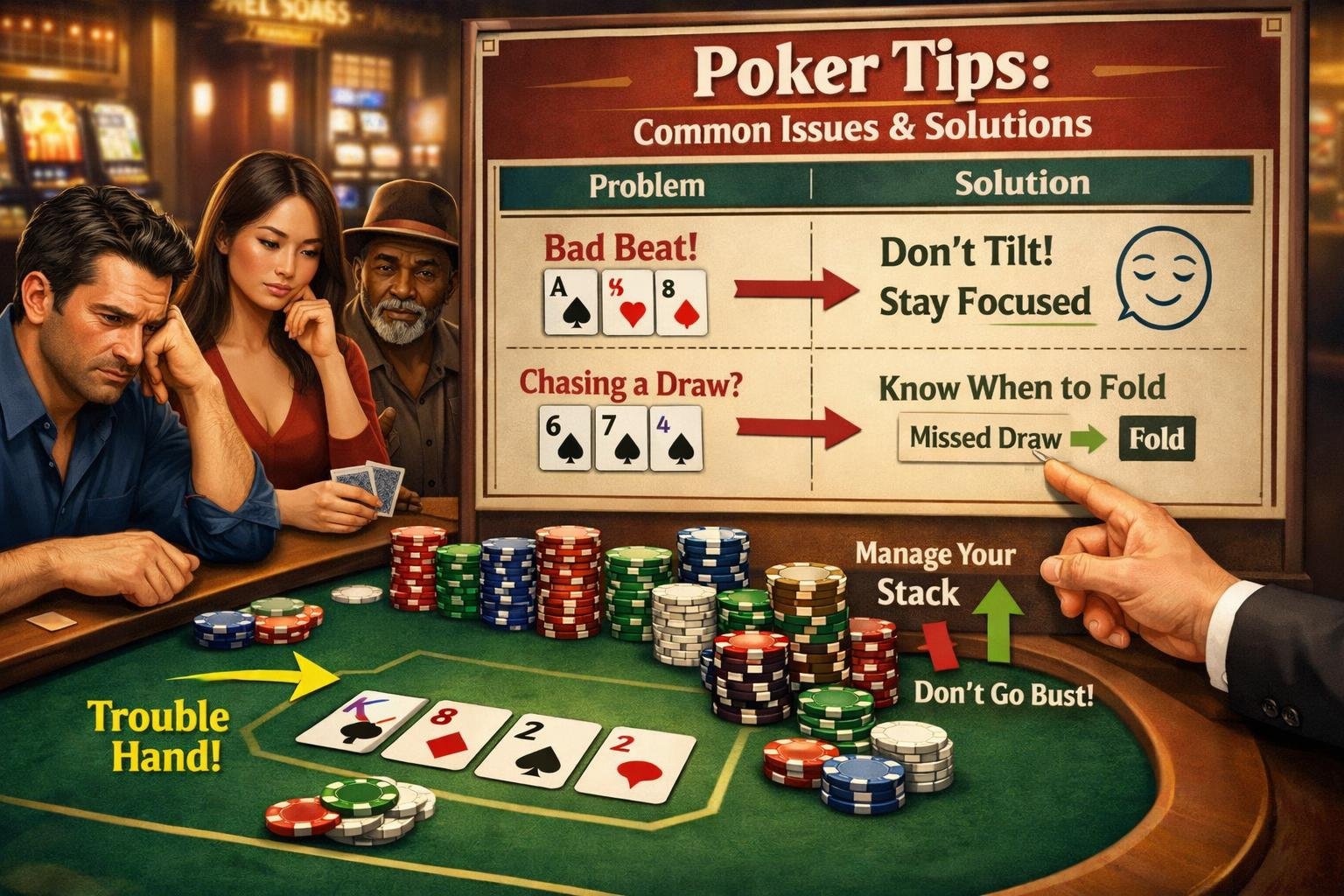
New poker players run into all sorts of bumps—confusing rules, tech hiccups at electronic tables, or just needing a hand from casino staff. If you know how to handle these, you’ll keep your game on track and protect your buy-in.
Gameplay Challenges
String bets trip up beginners all the time. Most tables have a betting line on the felt. If you push chips across that line in several moves without saying anything, that’s a string bet. The fix? Announce “raise” before you touch your chips, or just move all your chips forward in one go.
Good poker etiquette keeps the table running smooth. Respect the dealer and act only when it’s your turn—it’s basic, but you’d be surprised how often people forget.
Acting out of turn, flashing your cards, or splashing the pot are all no-gos. I like to watch a full round before I play, just to get a feel for how the table flows.
Managing buy-ins can get confusing. Most casinos set a minimum buy-in of 20 to 40 big blinds. If you lose your stack, you can rebuy, but always check the table’s max. If the table feels too tough, don’t hesitate—ask the floor for a seat change or even a different game.
If you’re lost on a rule, just ask the dealer. They’re trained for this and will pause the action to help you out.
Technical Errors or Glitches
Sometimes electronic poker tables freeze or don’t read your card picks right. If that happens, just raise your hand and call for the dealer or floor manager. Don’t keep tapping the screen or mashing buttons—it won’t help.
The dealer can pull up the hand history to see what went wrong. Usually, they sort it out in a couple of minutes.
Chip runners can make mistakes, too. Always count your chips before you play a hand. If something’s off, let the dealer know before you act—they’ll fix it fast.
Contacting Casino Support
Every poker room has a floor manager on duty. They settle disputes, answer questions, and keep the rules in check. If you need them, just raise your hand or ask the dealer to call them over.
For payment or player card issues, head to the cage or main desk. Take your ID and any receipts. I’ve found most problems get sorted in five to ten minutes.
If you feel unsafe or someone’s harassing you, talk to security right away. They’re all over the casino and move quickly. Don’t try to deal with aggressive players yourself—let the pros handle it.
Pros and Cons

Playing poker at a casino is a wild ride—it’s got perks and pitfalls you won’t find in other games. The house edge works differently in poker, and if you know the ups and downs, you’ll make smarter choices about what to play.
Four Advantages Table
|
Advantage |
Description |
|---|---|
|
Skill-Based Gameplay |
Poker isn’t just luck—strategy and quick thinking matter. I can actually boost my odds of landing hands like a flush or straight by practicing and learning from mistakes. |
|
Multiple Winning Hands |
Poker gives you tons of ways to win, from a humble pair to a rare royal flush or four of a kind. Sometimes, even a two pair or three of a kind can scoop the pot. |
|
Low House Edge Options |
Some poker games have a house edge under 3% if you play smart. Caribbean Stud and Three Card Poker often beat the odds you’ll find on the slots floor. |
|
Social Interaction |
Poker tables are social hubs. I get to chat with dealers and other players, all while battling for hands like a full house or straight flush. |
Four Disadvantages Table
|
Disadvantage |
Description |
|---|---|
|
Complex Strategy Required |
Figuring out when to hold or fold? That takes some serious study time. You’ll need to wrap your head around pot odds and hand rankings—from a simple pair all the way up to a royal flush. |
|
Higher Minimum Bets |
House-banked poker games usually ask for bigger minimum bets than slots—think $10 to $100 per hand. PvP "Room Poker" uses blinds (like $1/$2), but either way, you’re looking at a hefty buy-in to get started. |
|
Slower Gameplay |
You’ll play way fewer hands per hour compared to video poker or spinning the slots. Every round drags out a little, with dealing, betting, and all those decisions slowing things down. |
|
Variable House Edge |
The house edge jumps around depending on your choices and the game you’re playing. Mess up your strategy on something like Let It Ride, and suddenly the house edge can soar past 5%. |
Responsible Gaming
Poker in a casino should feel like entertainment, not a stress test for your wallet or your emotions. Set some boundaries before you even shuffle up, and know where to turn if things ever get out of hand.
Setting Limits
Honestly, if you ask me, always decide on a budget before you sit at the table. Only risk money you can lose without messing up your rent, groceries, or savings.
Casinos now have all sorts of tools to help you stay on track—deposit limits, loss caps, timers. Online poker sites make this even easier, letting you set daily or weekly restrictions. I’ve found that putting a timer on myself keeps me from losing track of hours.
Set a win goal, too. If you hit a certain profit, just cash out and walk away for a bit. It’s way too easy to give back your winnings if you stick around after a hot streak.
Stick to your limits. Chasing losses or stretching your budget? That’s a slippery slope. Don’t do it.
Recognizing Problematic Behavior
Some warning signs are pretty obvious—spending more than you planned, hiding your gambling from family, or playing just to escape stress.
I also keep an eye out for these:
-
Borrowing money just to play
-
Skipping work or family stuff for poker
-
Getting restless or cranky when you can’t play
-
Trying to quit but always coming back
If you’re playing poker to win back losses instead of just having fun, pause for a reality check. Problem gambling can wreck your finances, relationships, and mental health. Spotting these patterns early makes a huge difference.
Available Tools and Support
Most legit casinos offer self-exclusion programs—basically, you can ban yourself for a while. Online poker sites let you close your account for a set period or even for good.
The National Council on Problem Gambling runs a confidential helpline at 1-800-522-4700. You can talk to trained counselors any time, day or night.
Many states offer free or low-cost programs for gambling problems. You’ll find everything from one-on-one counseling to group therapy and even help with financial planning.
Reality check features on online poker sites are a lifesaver. They’ll pop up reminders about your play time and spending, so you don’t lose track in the heat of the game.
Conclusion and Final Thoughts
Playing poker at a casino isn’t just about luck—it’s about showing up prepared and knowing what you’re getting into. There’s a lot to learn before you ever take a seat, but trust me, it’s worth the effort.
Here’s what you’ll want to remember:
-
Brush up on the rules for whatever poker variant you’re playing
-
Decide on your spending limit before you start
-
Get a grip on the basic strategy for your game
-
Understand betting structures and table etiquette
-
Bring your ID and keep an eye on your bankroll
Casinos feel different from your home game. You’ll run into skilled players who know all about position, hand rankings, and betting moves. I’d say start at a low-stakes table until you get comfortable.
Discipline and learning matter more than luck in the long run. Poker’s a mix of skill and chance, so even the best have losing days. The real edge? How you handle those swings.
Take a moment to watch the table before you jump in. Notice how the experienced players handle themselves. Look for patterns in their bets and decisions.
Try practicing online or with friends before you step into a real casino. That way, you’re not fumbling over the basics when you should be thinking about strategy.
Skills you’ll want to sharpen:
-
Reading your opponents
-
Keeping your cool—win or lose
-
Working out pot odds on the fly
-
Adjusting your play as the table changes
Start small, stay within your means, and focus on making smart choices. The more you play, the better you’ll get—and honestly, that’s half the fun.