





Casino Hold'em gives poker fans a refreshing, simpler way to play—no need to outwit a roomful of opponents. In this guide, I’ll walk you through what makes this game stand out among casino table games and why it’s become a personal favorite for so many of us.
Casino Hold'em is a poker twist where you go head-to-head with the dealer, not a crowd, using two hole cards and five shared community cards to build your best hand. If you already love poker, learning how to play Casino Hold'em is a breeze and honestly, pretty fun.
Once you get a grip on the basic rules and a solid strategy, you’ll find yourself making quick, confident decisions at the table. The house edge sits around 2.16 percent—pretty standard for table games, so you’re not fighting an uphill battle.
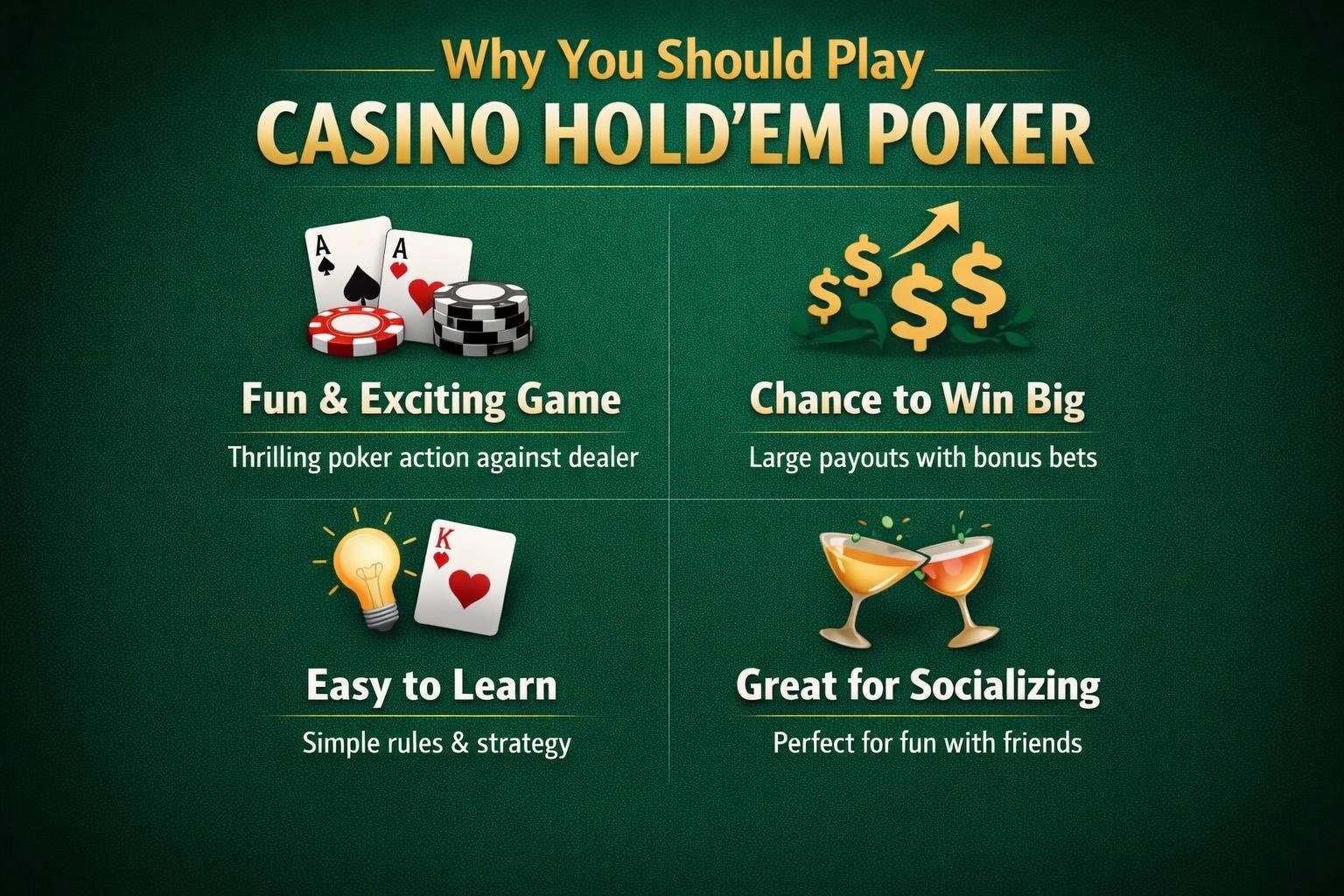
What grabs me about Casino Hold'em is how it strips out the stress of reading other players. There’s no bluffing wars or mind games—just you, your cards, and the dealer. I love that you decide to fold or call after seeing your hand and the first three community cards. Even better, you can win on strong hands even if the dealer doesn’t qualify, so you’re never totally out of it.
If you know your poker hand rankings, you’ll pick up the rules in no time. You start with an ante, get your two cards, then see the flop—three community cards right in the center. Now, it’s decision time: fold and lose your ante, or call (which doubles your bet). Two more cards hit the board, and the dealer needs at least a pair of fours to play.
Key Takeaways
-
Casino Hold'em lets you play poker against the dealer with easier rules than classic poker.
-
The dealer needs at least a pair of fours to qualify, and you can still get paid for strong hands even if the dealer doesn’t qualify.
-
The house edge is 2.16 percent, and the best move is to call about 82 percent of the time.
What Is This Casino Game?
Casino Hold'em blends the familiar Texas Hold'em setup with a house-banked twist. You’re not battling a crowd—just the dealer. Whether you’re at a physical casino or playing online, you’re aiming to beat the dealer’s hand. The table layout will look familiar if you’ve played poker before—felt, chips, and that unmistakable casino buzz.
Game Overview
The game uses a standard 52-card deck. I always start by putting down an ante, and then both the dealer and I get two face-down cards.
The dealer deals three community cards to the center. After checking my cards, I choose: fold and lose the ante, or call and double down. If I call, the dealer adds two more community cards, making five in total.
Both of us build our best five-card poker hand from our two cards plus the five on the table. The dealer needs at least a pair of fours to qualify. If the dealer doesn’t qualify, I get paid according to the Ante-Win paytable—imagine hitting a royal flush and scoring 100:1! The call bet just sits as a push.
If the dealer qualifies and I win, both my bets pay out. Usually, a straight or lower pays 1:1 on the ante, but if you hit a flush or better, you unlock those sweet bonus payouts.
History and Evolution
Stephen Au-Yeung dreamed up Casino Hold'em in the late '90s as a way to teach his partner Texas Hold'em. He turned that teaching tool into a real casino game and launched it in 2000.
It first showed up in live casinos in Egypt, Russia, and South Africa. Au-Yeung brought it to the 2001 World Gaming Congress Expo in Las Vegas and the 2002 International Casino Exhibition in London.
By 2007, Casino Hold'em got the green light for UK casinos, opening the door to the European market. These days, you’ll spot it everywhere—brick-and-mortar casinos, and all over online gaming sites.
Popularity Among Players
Casino Hold'em really clicks with folks who find regular poker a bit intimidating. You don’t have to outthink a table full of sharks or worry about reading tells.
On the standard pay table, the house edge is 2.16 percent on the ante. Regulators want that number front and center, so you know what you’re getting into. The rules are easy, so new players can jump in without memorizing complicated charts.
Online casinos have exploded Casino Hold'em’s popularity, especially where live casinos are hard to find. Now, you can dive into a game from your couch, no need to dress up or travel.
Playing online feels a lot like the real thing, especially with live dealers and HD streams. The pace is smooth—perfect for casual players or anyone who loves poker but wants a more relaxed vibe.
Why Do Casinos Offer This Game?
Casino Hold'em fills a unique spot on the casino floor. It takes the best of Texas Hold'em and builds in a house edge, so casinos can offer poker fun without running tournaments or big poker rooms. Poker fans get their fix, and the house still earns its keep with the math and those tempting bonus bets.
Benefits for Casinos Table
|
Benefit |
Description |
|---|---|
|
House Edge |
Gives casinos about a 2% advantage on ante bets |
|
Game Speed |
Plays faster than regular poker, so more hands per hour |
|
Staff Requirements |
Only needs one dealer—less staff, less fuss |
|
Table Space |
Fits on a standard poker table with just a few extras |
|
Revenue Streams |
Brings in money from both the main game and bonus bets |
I like that I’m not stuck waiting for a table to fill up or for other players to act. Every round moves fast, since it’s just you versus the dealer.
Casinos love the bonus bet, since it usually has a higher house edge. Most players can’t resist putting chips on both bets, which ramps up the action and the stakes.
Player Appeal and Retention
Casino Hold'em draws in poker lovers who’d rather skip the mind games and just play cards. It’s less about skill than classic poker, so anyone can sit down and have a shot.
The familiar hand rankings and community cards make it comfortable for Texas Hold'em fans. You don’t need to learn a whole new set of rules—just bring your poker basics and you’re good to go.
Those bonus payouts? They’re a thrill. Hit a premium hand and you could land 100:1, even if you lose the main bet. That’s the kind of excitement that keeps folks coming back.
The game’s rhythm is just right. You get time to check your cards and the flop, but you’re not sweating out every decision. It’s engaging, but not overwhelming.
Unique Features Table
|
Feature |
Impact on Casino Operations |
|---|---|
|
No Player vs Player |
No worries about collusion or heated disputes |
|
Fixed Betting Structure |
Makes dealer training easy and cuts down on mistakes |
|
Dealer Qualification Rule |
Pair of fours minimum means more chances for players to win |
|
Ante Bonus Payouts |
Pays out on strong hands, even if the dealer doesn't qualify |
|
Side Bet Options |
Boosts the average bet size at the table |
That dealer qualification—pair of fours or better—really adds spice. You can win your ante bonus even if the dealer doesn’t play, which makes for more frequent payouts and keeps things lively.
Benefits for Players
Casino Hold'em delivers real perks for players, whether you’re in a buzzing casino or at home in your pajamas. It’s got entertainment, a touch of skill, clear odds, and you can play on any device you like.
Entertainment and Skill Development
Casino Hold'em gets rid of the headaches of traditional poker, but still lets you flex your strategic muscles. No need to read faces or juggle a bunch of players—just focus on your cards and the dealer’s moves.
The basics come quickly, but the game keeps you interested for the long haul. Every hand gives you that classic poker decision: call or fold after the flop. It’s easy to start, but there’s always room to sharpen your strategy.
It’s a great way to pick up core poker skills without the pressure of a crowded table. You’ll learn hand rankings by heart, and you’ll start to get a feel for pot odds and value. If you ever want to try other poker games, those skills carry over—trust me, it helps.
Winning Potential Table
|
Outcome |
Payout |
Example (£10 Ante) |
|---|---|---|
|
Royal Flush |
100:1 |
£1,000 |
|
Straight Flush |
20:1 |
£200 |
|
Four of a Kind |
10:1 |
£100 |
|
Full House |
3:1 |
£30 |
|
Flush |
2:1 |
£20 |
|
Straight or Lower |
1:1 |
£10 |
The house edge sits at 2.16% on the ante for Pay Table 3. UKGC 2025/2026 standards push us to focus on that figure for regulation, even though the theoretical risk is a bit lower at 0.85%.
It’s worth noting that this edge compares pretty favorably to slots, but don’t get caught up in the numbers—slots calculate the edge per spin, while poker-based games like this include several betting stages.
When I plan a session, I always make sure my bankroll can handle the swings. For a £10 ante, I like to have £500–£1,000 ready to ride out those inevitable ups and downs.
Accessibility Across Devices
Casino Hold'em runs smoothly on any device with a modern browser thanks to HTML5 and WebGL. Those so-called native mobile apps? They're just wrappers for the same web content, nothing extra under the hood.
By 2026, pretty much every casino switched over to a WebAssembly (WASM) video layer to keep the streams crisp and latency under 500ms. I haven't noticed any lost features—everything scales, looks, and plays the same whether I'm on my phone, tablet, or big monitor at home.
You get the same RTP, the same game, and the same experience no matter where you log in. It’s honestly liberating.
One thing that stands out online is the pace. No dealer tapping their fingers, no other players sighing if you take a moment. You can step away between hands, refill your drink, or just soak in the vibe—nobody minds.
Of course, nothing beats the old-school social buzz of a brick-and-mortar casino. The feel of real cards, the clatter of chips, the banter at the table—if you crave that, live venues deliver.
But the rules don’t change, and you can use the same Casino Hold’em strategy in both settings. I’ve bounced between live tables and online plenty of times, and the transition is seamless.
How to Play
Casino Hold'em is all about beating the dealer with the best five-card poker hand. The structure’s simple, but there’s a rhythm to it—the ante, the call, the tension as the cards come out.
Once you get the hang of the betting and dealing phases, it really starts to feel natural. The anticipation builds with each card, just like at a real casino table.
Rules and Gameplay Overview
So, here’s how a round unfolds for me. I put down my ante bet, and the dealer slides me two hole cards face down.
Three community cards—the flop—hit the table face up. Now, I’ve got to decide: fold or call?
If I fold, my ante’s gone and the hand’s over. If I call, I place a play bet equal to twice my ante and the action continues.
The dealer then reveals the turn and river, bringing the community cards to five. Both of us use any combo of our two hole cards and those five community cards to make the best hand.
To qualify, the dealer needs at least a pair of fours. Sometimes a high card is enough for me, but more often, I’m gunning for something stronger—pairs, two pair, or better.
|
Dealer Outcome |
Result |
|---|---|
|
Dealer doesn't qualify |
I win on Ante according to the Ante-Win paytable; play bet pushes |
|
Dealer qualifies, my hand wins |
I win on both bets according to paytable |
|
Dealer qualifies, dealer's hand wins |
I lose both ante and play bet |
|
Tie |
All bets push |
Tips and Strategies for Beginners
After plenty of sessions, I’ve learned that sticking to a simple strategy keeps the house edge in check. I call on about 82% of hands—sounds high, but it works.
If I have any pair, trips, or two pair, I call, no matter the rank. Flush draws or open-ended straight draws? I’m in, even if I haven’t hit anything concrete yet.
Two overcards (higher than anything on the flop) are enough for me to stay in. If there’s a shot at trips or two pair, I’m not folding.
But when I’m dealt total garbage—low, unconnected cards, no pair, no hope—I fold. Like, if I’m holding 7-2 offsuit and the flop comes K-J-9, I’m out without a second thought.
Those AA+ Bonus side bets can look tempting, but the house edge is brutal—over 6%. I stick to the main game, where I can keep things around 2.16% if I play smart.
Advanced Techniques for Experienced Players
Once you’ve played a while, you start reading the board and hand rankings almost instinctively. I’m always checking for trips or two pair and weighing my equity before making a move.
Managing the relationship between ante and call bets is crucial—every call triples your initial wager, so you have to watch your bankroll. I usually start with smaller antes to ride out the swings.
On monotone flops, I’ll fold queen-high or jack-high hands unless I’m suited. I try not to let the lure of bonus payouts cloud my judgment on the main game.
The dealer qualifies about 81.6% of the time, so I build my betting system around that reality. It’s easy to get caught up in short-term luck, but I always remind myself to play the long game.
Game Variations
Casino Hold'em has picked up a handful of variations over the years, but the heart of the game stays the same. Most of the differences come from tweaks to the pay tables, side bets, or whether you see your hole cards face up or down.
Common Variations Table
The ante pay table is where you’ll spot the biggest changes from one casino to the next. Each version shakes up the payouts for winning hands, which can really affect the feel of the game.
|
Pay Table |
Royal Flush |
Straight Flush |
Four of a Kind |
Full House |
Flush |
House Edge |
|---|---|---|---|---|---|---|
|
Table 1 |
20 to 1 |
20 to 1 |
10 to 1 |
3 to 1 |
2 to 1 |
2.40% |
|
Table 2 |
25 to 1 |
25 to 1 |
12 to 1 |
3 to 1 |
2 to 1 |
1.96% |
|
Table 3 |
100 to 1 |
20 to 1 |
10 to 1 |
3 to 1 |
2 to 1 |
2.16% |
|
Table 4 |
100 to 1 |
49 to 1 |
17 to 1 |
3 to 1 |
2 to 1 |
0.35% |
You’ll see Table 3 at most casinos these days. Table 4 has the lowest house edge, but there’s a catch—they usually tack on a 10% commission, and it’s mostly vanished from regulated markets because of new transparency rules.
Casino Hold'em Open is a fun twist where your hole cards are dealt face up. Otherwise, it plays just like the classic version, so you don’t have to relearn the ropes.
Regional and Casino-Specific Variations
I’ve played Casino Hold’em everywhere from the bustling floors of South Africa to the neon-lit rooms of Malta, and even in tucked-away corners of Estonia, Ireland, and Morocco. Each spot puts its own little twist on things—maybe it’s the pay tables, maybe it’s the side bets, but you’ll always find something unique in the atmosphere or the way dealers interact with players.
The AA+ side bet pops up all over the place and, honestly, it’s become a favorite for many. Sometimes they call it “pair plus” or something close, but the idea’s the same: you’re betting on your five-card hand after the flop, and if you hit something juicy, you get paid—win or lose the main hand.
I’ve seen some live dealer Casino Hold’em tables where you can toss in several side bets at once. It adds a layer of excitement, especially when the table chat lights up after a big side bet win.
Those old “Zero House Edge” versions that used to charge commission? They’re pretty much gone now, at least in regulated casinos. Instead, you’ll find high-RTP tables with tweaked payouts—simpler, and honestly, easier to follow when you’re caught up in the moment.
Realtime Gaming has their own spin with Caribbean Hold'em. It’s close to Casino Hold’em, but the Ante only pays 1 to 1 if the dealer doesn’t qualify, which bumps up the house edge. Not my favorite, but some folks like the change of pace.
Just to be clear, Caribbean Stud Poker, Ultimate Texas Hold’em, and Three Card Poker? Those are whole different beasts. The vibe, the rules, even the way the dealers interact—totally different experience.
Emerging Trends
One thing I’ve noticed lately: progressive jackpots are showing up on more Casino Hold’em tables. It’s wild—every hand bumps up the prize pool, and you can feel the tension build as the jackpot grows.
People flock to these tables online, hunting for that life-changing payout. The best part? You don’t even have to win the main hand to hit it big; it pays out based on your seven-card combo, no matter what.
Online play’s really taken over the scene. You’ve got software from Net Gaming, Real Time Gaming, and others—everything runs smooth, cards fly fast, and you can jump in at any stake you like.
It’s true, online tables move a lot quicker than anything you’ll find in a brick-and-mortar casino. There’s always a seat, no waiting, and you can usually pick your limits right from the lobby.
Some sites even let you play multi-hand, which shakes things up. In live dealer rooms, you’ll usually see a “Common Draw” table—one hand dealt, but everyone makes their own moves. Real multi-seat play? That’s strictly for the RNG digital tables, since the physical shoe can only handle so much action.
Technology Behind the Game
Casino Hold’em online is all about fairness and real-time action. RNGs (random number generators) keep the cards unpredictable, while live dealer versions use crisp video streams to bring you face-to-face with real dealers—no bots, no gimmicks, just a genuine casino vibe.
Software and RNG Integration
The digital tables rely on RNG software to shuffle and deal every hand. These little algorithms run thousands of number sequences every second, so you never know what’s coming next. Before you even place your bets, the system’s already locked in the cards.
Regulated casinos have to put their RNGs through the wringer with outside testers. Agencies check that the cards fall just like they would in a real deck, and regulators in each country set the bar pretty high.
Key RNG features include:
-
Cryptographic algorithms that keep things unpredictable
-
Constant number generation, even between hands
-
Math based on true 52-card deck odds
-
Tamper-proof systems so the casino can’t mess with the deal
Most of the big software providers—Playtech, Net Gaming, RTG—bake their RNGs right into the game engine. The same tech powers everything from Hold’em to blackjack, so you get a consistent, fair experience.
Live Dealer Technology
If you’ve never tried live Casino Hold’em, you’re missing out. The stream puts you right at the table, watching a real dealer shuffle and deal in real time. HD cameras catch every card, every smile, every little gesture—it’s honestly the closest thing to being there.
Studios use smart shufflers like the Shufflemaster i-Deal PLUS, which track the cards as they’re dealt and feed the data straight into the system. That means fewer mistakes, no weird lighting glitches, and a smoother experience all around.
Live dealer systems include:
-
Low-latency streams, so you’re never waiting long for the action
-
Chat features that let you talk to the dealer—sometimes they’ll even call you out by name or banter with the table
-
Different camera angles and betting layouts so you can see the table your way
-
Backup systems in case the stream hiccups (it does happen, but they’re quick on the fix)
Game Control Units (GCUs) keep everything in sync. What you see on your screen matches what’s happening at the table, down to the last chip.
Mobile and VR Compatibility
These days, you can play Casino Hold’em on your phone just as easily as on a desktop. The interface shrinks down for smaller screens, but you don’t lose any features—the cards are clear, betting is easy, and you can tap to act instead of clicking.
Most new versions run straight from your browser with HTML5 and WebGL. Old-school desktop apps are basically extinct. Everything’s instant, and the RNG works exactly the same as on a PC.
VR Casino Hold’em is still a bit of a novelty, but it’s growing. If you’ve got a Meta Quest or PlayStation VR, you can sit at a virtual table, look around a 3D casino, and use controllers to place your bets. It’s not quite the same as a real table, but it’s a step closer—definitely worth a try if you’re curious.
Licensing and Fair Play
Regulators keep Casino Hold’em honest. Licensed casinos have to jump through hoops—regular audits, certified RNGs, and strict standards—so you know every hand is as fair as it gets. It’s not just about rules; it’s about trust, and you can feel it when you sit down at a reputable table.
Regulatory Standards Table
Each country’s gaming authority sets its own rules for Casino Hold’em. Malta, for example, wants casinos to separate player funds, run monthly audits, and post RTP stats front and center. Over in the UK, the Gambling Commission cracks down on consumer protection and makes sure there’s a clear way to resolve disputes.
|
Licensing Body |
Key Requirements |
Audit Frequency |
|---|---|---|
|
Malta Gaming Authority |
Player fund segregation, RTP disclosure |
Monthly |
|
UK Gambling Commission |
Dispute resolution, responsible gaming tools |
Quarterly |
|
Gibraltar Regulatory Authority |
Server location verification, game fairness testing |
Bi-annual |
|
Kahnawake Gaming Commission |
Technical standards compliance, payout records |
Annual |
Most regulators demand a minimum RTP—usually 97.84% for Casino Hold’em if you play the right way. They actually check to make sure the casinos stick to it. That’s peace of mind you can’t put a price on.
Ensuring Fairness
I put my faith in RNGs when I play Casino Hold’em online. These things use complex algorithms to spit out billions of card combinations—no way to predict what’s coming next, no matter how sharp you think you are.
The shuffle happens before every hand. Every card’s got the same shot at popping up, just like a real dealer mixing the deck right in front of you.
Testing labs like GLI and eCOGRA run millions of rounds to sniff out any patterns or weirdness. They want to see the house edge match the math—2.16% for Casino Hold’em. If it’s off, they flag it, and the casino has to fix it.
Certifications and Audits
Before you ever play a hand, independent testers like BMM Testlabs and GLI tear through the software. They check the code, confirm the RNG works, and make sure payouts line up with what’s advertised.
eCOGRA does monthly spot checks for licensed casinos. They look at fairness, payout stats, and player safety. If a site passes, they get to show the eCOGRA seal—always a good sign when you’re picking where to play.
I always double-check a casino’s license number—usually in the website footer. If you click it, you should land on the regulator’s page, where you can see if the license is real and up to date. Top casinos also post their latest audit results and RTP certificates for anyone to see.
Common Issues and How to Solve Them
Casino Hold’em isn’t without its headaches. Players run into three big problems: figuring out when to call or fold, dealing with tech glitches that kill the vibe, and getting help when something goes sideways. I’ve been there, so here’s what works.
Gameplay Challenges
Honestly, the trickiest part is knowing when to call or fold after the flop. I watch people freeze up with Ace-high and no pair, or chase weak pairs on scary boards—it happens to everyone.
My rule of thumb: call with any pair or better, or if you’ve got a strong draw (like an open-ended straight or four to a flush). Weak Ace-high with no draw? I let it go. Save a basic chart on your phone if you’re just starting out—it helps.
Dealer qualification rules trip people up too. Some tables want the dealer to have a pair of fours or better, others have different cutoffs. If the dealer doesn’t qualify, you usually get your Ante paid 1:1 and your Call bet back. Always peek at the table rules before you start—small details can change your whole strategy.
Board texture is another thing. A single pair on a board with three to a straight or flush is a lot shakier than the same pair on a dry board. I adjust my calls depending on how many ways the dealer can outdraw me.
Technical Errors or Glitches
Nothing kills a session like a dropped connection, especially in live dealer Casino Hold’em. One second you’re sweating a big hand, the next your screen freezes and you’re out of the loop.
Most legit casinos have your back. If you disconnect, the software finishes your hand using your last action, or it’ll default to a safe choice. It’s smart to check the casino’s disconnection policy before you dive in—better safe than sorry.
If you keep hitting lag or freezes, close other tabs, kill any bandwidth hogs, and, if you can, plug in with a wired connection. Clearing your browser cache and cookies, then restarting, can work wonders.
Pixelated cards or choppy video? That’s usually your internet dragging. Drop the video quality in the settings—most sites let you switch between standard, HD, and mobile-friendly streams. Sometimes you just need to give your connection a break.
Contacting Casino Support
If you hit a snag—disputed hand, missing payout, account glitch—reach out to support right away and keep records. Screenshots of your hand history, bet slip, or any error messages make things go a lot smoother.
Most casinos offer live chat (best for quick fixes), email (for longer issues), and sometimes even phone support. I always start with chat for urgent stuff, then follow up by email if I need to send attachments or explain things in detail.
Have your username, date and time of the issue, table or game ID, and hand number ready. The more info you give, the faster they can sort you out.
If the first support agent can’t help, ask for a supervisor. Licensed casinos have to follow complaint procedures and stick to response deadlines. If they won’t budge, you can always file a complaint with their regulator (check the site footer for details).
Pros and Cons
Casino Hold’em gives you that direct, head-to-head poker rush with a low house edge—and you don’t need a poker face to have a good time. Still, it’s not as deep as classic poker, and luck plays a bigger role than skill. But if you’re after a social, lively table and a real casino feel, it’s tough to beat.
Four Advantages Table
|
Advantage |
Explanation |
|---|---|
|
Low House Edge |
The house edge sits at 2.16% on the ante, but the real risk is just 0.85%. You’ll notice that’s way better than what you’ll find on slot machines, and honestly, it’s about as good as it gets for casino poker. |
|
Simple Learning Curve |
You really only have one big choice to make: call or fold after seeing your cards and the flop. No need to stress about complex betting rounds, bluffing, or reading other players—just focus on your own hand. |
|
No Player Competition |
Here, you’re just facing the dealer, not a table full of sharks. That takes away a lot of the pressure and makes it much less intimidating, especially if you’re new or just want to relax. |
|
Bonus Bet Potential |
The optional Bonus bet pays out on strong hands, no matter what the dealer holds. Land a Royal Flush and you’ll usually get 100:1 on the Bonus—suddenly, you’re chasing a jackpot that’s totally separate from the main action. |
Four Disadvantages Table
|
Disadvantage |
Explanation |
|---|---|
|
Limited Strategic Depth |
Your only move is to call or fold, following a pretty basic plan—call with any pair or Ace-King high. If you’re someone who craves deep, layered poker strategy, this game might feel a little too straightforward. |
|
High Variance on Bonus Bets |
The Bonus bet can be a bankroll killer since its house edge hovers around 6-8%. Sure, the payouts look tempting, but you’ll feel the sting if you chase those side bets too much. |
|
Dealer Qualification Rules |
The dealer has to qualify with a pair of fours or better for the hand to play out. If the dealer doesn’t qualify, you’ll get a 1:1 payout on the Ante for a straight or lower, and flushes or better score bonus odds, but the Call bet just pushes—so your big hands sometimes feel a bit capped. |
|
Card-Dependent Outcomes |
Unlike regular poker, you can’t bluff or outplay anyone—it’s all about the cards you’re dealt. Your edge comes from knowing when to fold, not from reading opponents or betting clever. |
Responsible Gaming
Playing Casino Hold'em should always be fun and feel like it’s under your control. I always suggest setting clear limits before you even sit down at the table—whether it’s a real felt table or a virtual one with a live dealer smiling back at you.
Setting Limits
Before I join a live Casino Hold’em table, I decide on my budget. I’ll only play with money I can afford to lose, never touching what’s meant for bills or essentials.
Time can slip away when you’re chatting with the dealer and enjoying the table vibe, so I rely on session timers. Most good casinos have built-in tools for deposit and loss limits—use them, seriously.
If I hit my loss limit, I walk away—even if the table’s buzzing and the dealer’s on fire. Deposit limits help keep things in check, so I don’t get swept up in the excitement and reload too much.
Recognizing Problematic Behavior
I always keep an eye out for warning signs in my own play. If I’m spending more than I planned, or ever feel tempted to borrow money to keep playing, that’s a big red flag.
Lying to friends or family about how much I’m playing? That’s a sign things might be off track. If I’m feeling irritable or anxious when I’m away from the table, or skipping work just to play, I know I need to step back.
When live casino play starts messing with my mood or sleep, I take it seriously. Chasing losses—doubling down after a bad streak—usually just digs a deeper hole.
Available Tools and Support
Most legit casinos offer self-exclusion, so I can block myself for a while if I need a break. Cooling-off periods are easy to set, whether I need 24 hours or a few weeks to reset.
Reality checks pop up during sessions, letting me know how long I’ve been at the table. I can always review my entire gaming history, which helps me spot any patterns before they become problems.
If things ever feel out of hand, there’s help:
-
National Council on Problem Gambling (NCPG): Their 1-800-GAMBLER helpline is always there.
-
GamCare: Especially for UK players, with a lot of support options.
-
Gamblers Anonymous: Peer support meetings that can make a real difference.
Most casinos link straight to these resources on their responsible gaming pages, so help is never far away.