





Learning Caribbean Stud Poker starts with the basics, and honestly, that's where the fun begins. This guide covers everything from simple bets to those tempting advanced payouts, blending the energy of classic five-card stud with a casino twist—you're just trying to beat the dealer, not a whole table of poker sharks.
What really sets Caribbean Stud apart is how it strips away the intimidation factor. You only go up against the dealer, making your moves based on your hand and that one tantalizing dealer card that's flipped face up.
Caribbean Stud Poker deals you five cards, then it's your call—fold or raise—depending on your hand's strength. If you manage to beat the dealer's qualifying hand, you win payouts based on a fixed pay table. The dealer needs at least an ace-king high to qualify, and if they don't, you'll pocket even money on your ante while your raise bet quietly slides back to you, untouched.
Most tables throw in a progressive jackpot side bet, and that's where things can get wild—flushes and straight flushes suddenly mean more than bragging rights. I love how the side bet keeps everyone at the table just a little bit more invested, eyes darting around, hoping for that miracle hand.
This guide? It's my way of sharing all the rules, betting choices, payouts, and the strategy basics that make the game tick. Whether you play in a buzzing casino or online, knowing when the dealer qualifies and when to raise or fold really changes the game.
Key Takeaways
-
You're playing against the dealer, not other players, and you have to raise exactly twice your ante if you want to stay in.
-
The dealer qualifies only with ace-king or better, and honestly, raising with a pair or higher is almost always the smart move.
-
The house edge sits at 5.22% on the ante, but if you play your cards right, your overall risk drops to about 2.56%.
What Is This Casino Game?
Caribbean Stud Poker is all about facing off against the dealer. The game uses standard poker hands, but forget the usual poker drama—no bluffing wars or endless betting rounds here.
Game Overview
Picture a classic green table, a single deck of 52 cards, and a vibe that's somewhere between blackjack and a low-key poker night. Caribbean Stud (sometimes called Caribbean Poker) ditches the bluffing and focuses on straightforward play. It's you versus the house, and honestly, that's a relief sometimes.
Each round starts with an ante, and you get five cards face down. The dealer gets five too, but one of theirs is flipped up, just enough to give you hope or ruin your plans.
Poker hand rankings still matter—a royal flush is king, straight flush next, then four of a kind, and so on. Once you peek at your cards, it's decision time: fold and lose your ante, or raise by doubling it.
The dealer only plays if they have at least ace-king high. If they don't, you snag even money on your ante, and your raise comes back to you. But if the dealer qualifies and your hand wins, both bets pay out, with the raise following a set payout table.
History and Evolution
Caribbean Stud has a backstory as colorful as a casino neon sign. Some folks say David Sklansky invented it in the '80s, calling it "Casino Poker" before it took on its tropical identity. Others swear it started on cruise ships, which honestly fits the laid-back, sun-soaked vibe the game gives off.
The first patent appeared in 1982, and by the '90s, the game was everywhere on casino floors. Casinos jumped at the chance because the house edge is a bit friendlier to them than in standard poker. Once the progressive jackpot arrived, everyone wanted a seat at the table.
Online casinos picked up Caribbean Stud in the early 2000s, and suddenly, you could play from your couch. No need to dress up, but you still get that casino rush.
Popularity Among Players
Honestly, Caribbean Stud is a magnet for anyone who loves poker but doesn't want the stress of reading opponents. You never have to bluff or outsmart other players; it's just you and the dealer, which makes it a great entry point for newcomers.
That progressive jackpot? It's a siren song, drawing in players despite the odds. I've seen it listed among the top five table games in plenty of casinos, both online and off.
What I really appreciate is how every hand stands alone. You set your own pace, and nobody's rushing you to make a move.
Why Do Casinos Offer This Game?
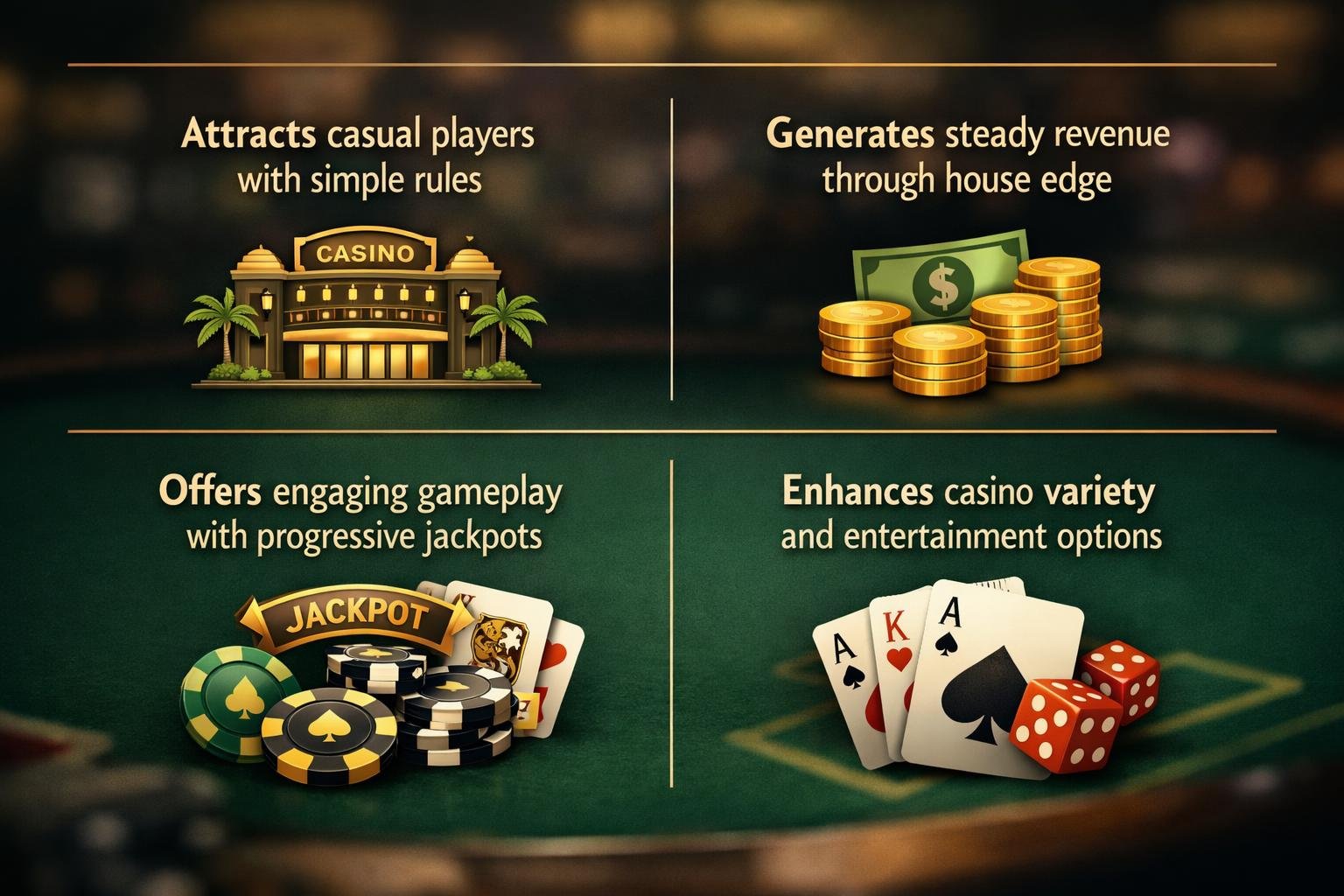
Casinos keep Caribbean Stud Poker in the lineup because it brings in steady profits and draws players who want a taste of poker without the cutthroat competition.
Benefits for Casinos Table
|
Benefit |
Description |
|---|---|
|
House Edge |
The casino enjoys a 5.22% edge on the main game, higher than blackjack but in line with plenty of other table games. |
|
Fast Gameplay |
Rounds fly by—no drawn-out betting, just quick hands and more action per hour. |
|
Simple Staffing |
One dealer runs the show, unlike poker rooms that need a whole crew. |
|
Predictable Revenue |
No player-versus-player drama means the casino's earnings stay steady. |
|
Progressive Jackpot |
Side bets rake in extra cash, and only a slice goes to the jackpot pool. |
Progressive jackpots are a goldmine. From what I've seen, most casinos keep about 25-30% of those side bets, letting the rest feed the growing prize pool.
Player Appeal and Retention
Players stick with Caribbean Stud because it feels familiar and takes away the pressure of facing other sharp players. You never have to worry about getting outplayed by a table full of pros.
The game attracts casual gamblers who know their poker hands but aren't interested in memorizing complex strategies. That ease of entry keeps the tables busy all day long.
And let's be honest, the progressive jackpot adds a thrill that's hard to find elsewhere. Even a small bet can spark dreams of a life-changing win, especially if you hit that elusive royal flush. That kind of suspense keeps people coming back for more.
Unique Features Table
|
Feature |
Impact on Casino Business |
|---|---|
|
No Player Competition |
No arguments or slowdowns—just smooth, fast gameplay. |
|
Fixed Betting Structure |
Advanced betting systems can't chip away at the house edge here. |
|
Visible Dealer Card |
The one upcard keeps things interesting but doesn't really tip the odds in your favor. |
|
Qualification Requirement |
That ace-king rule? It's a subtle way the house keeps an edge. |
|
Optional Side Bet |
Extra revenue for the casino, and a shot at the jackpot for you. |
Honestly, the dealer qualification rule is a crafty bit of game design. When the dealer doesn't qualify, you get your ante paid and your raise handed back—it's not a full win, but it feels better than losing both bets.
Benefits for Players
Caribbean Stud Poker has a lot going for it, whether you're a first-timer or a seasoned player. It's entertaining, offers clear ways to win, and you can find it in just about every casino—live or online.
Entertainment and Skill Development
What I really love about Caribbean Stud is how you can jump in with almost no learning curve. The game moves at a brisk pace, and each hand wraps up in just a few minutes. There's no need to master the art of bluffing or keep track of complicated betting patterns.
Honestly, you can pick up the rules in five minutes flat. The main choice is simple: do you fold, or do you raise after seeing your cards and the dealer's upcard?
But don't let the simplicity fool you—there's still strategy involved. You size up your hand against that one dealer card, and if you're holding ace-king, you start weighing your odds. It's just enough to keep your brain engaged without any stress.
The progressive jackpot side bet spices things up. Even if your main hand doesn't pan out, you might still score a bonus just from your cards. That little twist keeps the energy up, especially during longer sessions.
Winning Potential Table
|
Hand |
Raise Payout |
Typical Odds |
|---|---|---|
|
Royal Flush |
100:1 |
1 in 649,740 |
|
Straight Flush |
50:1 |
1 in 72,193 |
|
Four of a Kind |
20:1 |
1 in 4,165 |
|
Full House |
7:1 |
1 in 694 |
|
Flush |
5:1 |
1 in 509 |
|
Straight |
4:1 |
1 in 255 |
When you hit a premium hand in Caribbean Stud Poker, the payouts can get pretty wild. I always check the payout table before I sit down, just to scope out where the real money hides.
Those set rates mean you know exactly what you'll get if you manage to snag something big. Understanding the odds is half the battle—otherwise, you're just hoping for miracles every hand.
Say you throw down a $10 ante and somehow land a royal flush. Suddenly, you’re looking at $1,000 on the raise bet alone, not counting the ante or any jackpot.
And let’s not forget that progressive jackpot. If you’re lucky enough to catch a royal flush while that meter’s high, you could walk away with tens of thousands. That’s the kind of rush you dream about when you sit at a live table.
Accessibility Across Devices
I’ve played Caribbean Stud everywhere—from smoky casino pits to my couch. Most top online casinos have the game, and the rules barely change from one place to another.
Casino apps these days are slick. I can switch from my phone to my laptop and never miss a beat—the cards, the bets, it all feels seamless.
Digital versions have their own charm. Instead of tossing chips, I tap a screen, but the layout stays familiar—my cards, the dealer’s upcard, those betting circles just waiting for action.
But you know what really makes it? Live dealer Caribbean Stud. The stream brings the table right to you, with real people, real cards, and that unmistakable casino buzz. It’s almost like you can hear the chips clinking and the dealers cracking jokes, even when you’re playing in your pajamas.
How to Play
Caribbean Stud Poker starts with an ante. I get five cards, and the dealer flips one of theirs face up.
Now, I’ve got a choice—fold and bail, or raise and go head-to-head with the dealer. The dealer needs at least ace-king to qualify, so sometimes you win just because they can’t even play.
Rules and Gameplay Overview
If you want to get the hang of Caribbean Stud, you’ve got to nail the betting sequence. Every hand kicks off with an ante—no exceptions.
I always drop my ante in the circle to start. Sometimes there’s a jackpot side bet; I’ll toss in a buck if I’m feeling lucky and want a shot at that progressive prize.
The dealer hands out five cards to each player, all face down, and then deals themselves five—one up, four down. That single dealer upcard can tell you a lot, but you’ve still got to trust your gut sometimes.
Once I peek at my cards, it’s decision time. Fold and lose the ante, or raise by doubling up the bet and hope my hand holds up.
If I fold, I’m out for the hand, plain and simple. If I raise, I need to match twice my ante, no more, no less.
After everyone decides, the dealer reveals their hidden cards. Here’s the twist: if the dealer doesn’t have at least ace-king, they don’t qualify, and I win even money on my ante. My raise just comes back to me—no action there.
But if the dealer qualifies, we compare hands. Standard poker rankings decide the winner. If I win, I get even money on my ante and a payout on my raise according to the table. Lose, and both bets are gone. That’s the thrill—and the sting—of live play.
Tips and Strategies for Beginners
When I’m teaching friends, I tell them to keep it simple: always raise with any pair or better. Even a tiny pair can take down the dealer more often than you’d think.
If I’ve got less than a pair, I usually fold. The only time I even consider raising is with ace-king, and even then, only if the dealer’s upcard is a queen or lower and I’m holding one of those ranks myself.
Honestly, I steer clear of the jackpot bet when I’m just starting. Sure, the payouts look tempting, but the house edge is a bankroll killer if you’re not careful.
Bankroll management is everything. I set a session budget before I even sit down, and I never chase losses by bumping up my ante. Since each raise costs double, I try to make sure I’ve got the ammo for at least 20 or 30 hands.
Pay tables can vary, so I always check the one at my table. Some casinos tweak the payouts for flushes and full houses, and that can make a real difference over time.
Advanced Techniques for Experienced Players
Once you’re comfortable, ace-king hands get a lot more interesting. I’ve learned to look at the dealer’s upcard, my kicker cards, and even which cards might already be out of play before making a move.
Here’s when I raise with ace-king:
-
If the dealer shows a 2 through queen and I’ve got that same rank in my hand
-
If the dealer shows an ace or king and I’m holding a queen or jack
-
If my fourth-highest card outranks the dealer’s upcard
This approach shaves the house edge down to about 2.5%. It’s not magic, but it stacks the odds just a bit more in your favor.
I pay attention to what’s already on the table. If the dealer shows a queen and I’ve got ace-king-queen, I know there’s one less queen in play, which matters in those razor-thin spots.
For serious play, I drilled these ace-king scenarios until they felt automatic. Trust me, always raising with ace-king without thinking costs you in the long run.
But I never mess with the rule about pairs. If I’ve got a pair, I’m raising, no matter what the dealer shows. The math just doesn’t support folding those hands, and I’ve seen too many players talk themselves out of easy money.
Game Variations
Caribbean Stud Poker isn’t stuck in the past. Over time, casinos and software providers have spiced things up with new pay tables, funky side bets, and special bonus features.
The 5+1 Bonus variant stands out the most. Regional casinos sometimes tweak the payouts to appeal to their regulars, which keeps things interesting if you like to travel or play online.
Common Variations Table
|
Variation |
Key Difference |
House Edge |
|---|---|---|
|
U.S. Standard |
Royal flush pays 100 to 1 on raise |
5.22% |
|
European |
Enhanced full house (9 to 1) and flush (7 to 1) payouts |
4.45% |
|
5+1 Bonus |
Uses dealer's face-up card to make best five-card hand |
Varies |
|
Progressive Jackpot |
Optional $1 side bet for bonus payouts |
Additional 26-30% |
I run into the U.S. Standard version most often. It’s simple: 100 to 1 for a royal flush, 50 to 1 for a straight flush, and so on.
European tables, though, really sweeten the deal for full houses and flushes. That lower house edge is a nice bonus if you can find one of these tables.
Regional and Casino-Specific Variations
Some places get creative. The Normandie Casino in Gardena, California, for example, pays just 21 to 1 for a royal flush, but they bump up the payouts for other hands to balance things out.
Over in Switzerland, Casino de Crans-Montana likes to pay 10 to 1 on full houses and 8 to 1 on flushes. The house edge drops to around 2.7%, which is pretty generous for a live table game.
Online casinos can get wild with their pay tables. I’ve seen digital versions offering 800 to 1 for a royal flush, but don’t be fooled—usually, they claw it back by making the other payouts stingier.
Emerging Trends
The 5+1 Bonus side bet is popping up everywhere, especially in live dealer and digital versions. You get to use your five cards plus the dealer’s upcard to make the best five-card hand. It’s a fun twist, but remember, it only pays out on the side bet—not the main game.
Some online casinos have sped things up with automated dealing. You’ll fly through hands, which is great if you hate waiting for the shuffle. There are even multiplayer tables now where you can watch other players’ moves—without seeing their cards, of course.
Mobile versions keep getting better. The layout is cleaner, side bets are easier to find, and the core game never changes. I’ve noticed more bonus bet options too, like extra payouts for suited hands or special card combos. Keeps things fresh, honestly.
Technology Behind the Game

Behind all the glitz, Caribbean Stud Poker depends on some seriously slick tech. Digital games use random number generators (RNGs), while live dealer games rely on streaming setups that put you right at the table with real cards and real people.
Software and RNG Integration
Every time I play a digital hand, the RNG shuffles and deals cards in the blink of an eye. It’s as close to real randomness as you’ll get outside a physical deck.
Licensed sites use certified RNGs, and independent auditors test them regularly. That’s how you know you’re not getting hustled by the software. The RNG spits out millions of possible hands every second—no patterns, no memory, just pure chance.
When I hit “deal,” the RNG instantly picks my cards and the dealer’s. It all happens so fast you barely notice, but every hand is a fresh shot at luck. Past hands don’t matter; every deal is a clean slate. That’s part of what keeps the game so exciting, especially when you’re playing live and chatting with the dealer or other players at the table.
Live Dealer Technology (if applicable)
There's nothing quite like taking a virtual seat at a live dealer Caribbean Stud Poker table. You get this crisp HD video stream right from a real casino studio—usually tucked away in Malta, Latvia, or Michigan. The dealers? They're total pros, shuffling actual cards at genuine tables, all under tight security. No random folks wandering in; it's just you, the dealer, and the cards, with cameras catching every angle.
That connection you feel isn't just about the cards. The tech brings you right in, letting you watch the dealer shuffle and deal face-up, all in real time. Optical character recognition (OCR) does its thing, so your screen updates instantly as each card hits the felt.
What really sets it apart is the chat. Sure, dealers stick to their routines, but there's a real human on the other side, sometimes sharing a joke or reacting to the table's mood. The chat brings players together, adding a lively social layer—sometimes you even see regulars bantering. And if your internet hiccups, the stream adjusts so you don't miss a beat.
Mobile and VR Compatibility
These days, I mostly play Caribbean Stud Poker on my phone. The casino apps and mobile browsers use HTML5, so everything fits neatly on my screen—no weird scrolling or missing buttons. The interface feels natural, whether I'm lounging on the couch or sneaking in a few hands on the go.
iOS or Android, it doesn't matter. No need for extra downloads—just tap, swipe, and you're betting. My casino account syncs across devices, so I can switch from phone to laptop without skipping a hand.
Now, virtual reality? Maybe one day. For now, it's all about mobile and desktop. Honestly, that's fine with me—the live streams are so sharp and immersive, I don't really miss the VR goggles.
Licensing and Fair Play

Whenever I log in to play Caribbean Stud Poker, I want to know the game’s legit. Licensing and fair play protections are non-negotiable. The best casinos jump through all the regulatory hoops and get tested regularly to prove everything's on the level.
Regulatory Standards Table
Every gaming jurisdiction has its own flavor of rules for Caribbean Stud Poker. Here’s a quick rundown of the main regulators and what they expect:
|
Regulatory Body |
Jurisdiction |
Key Requirements |
|---|---|---|
|
UK Gambling Commission |
United Kingdom |
Random number generator testing, financial audits, player protection measures |
|
Malta Gaming Authority |
Malta |
Monthly game testing, segregated player funds, dispute resolution systems |
|
Curacao eGaming |
Curacao |
Basic licensing standards, game fairness checks, financial stability |
|
New Jersey Division of Gaming Enforcement |
New Jersey, USA |
Strict RNG certification, software inspection, monthly reporting |
Most licensing bodies set a minimum payout percentage, and for Caribbean Stud Poker, that means keeping the house edge at the standard 5.22% or so. I always check for that before I trust a table.
Ensuring Fairness
Fairness is everything. Certified random number generators shuffle the cards, so you get genuine randomness just like at a real table. If you’re ever unsure, look for the casino’s license number right on their website.
Reputable casinos usually publish their RNG test results and payout stats. If the paytable says a royal flush pays 100 to 1, it should actually deliver that—no funny business. The dealer qualifying rule (ace-king or better) never changes, no matter where you play.
Certifications and Audits
Independent agencies like eCOGRA, iTech Labs, and GLI put these games through the wringer. They test millions of rounds, making sure the RNG is fair and the house edge matches what’s advertised.
Audits happen before launch, then keep going every month or quarter. I always look for those certification seals on a casino’s site—usually you can click them to see the latest audit dates and results. GLI-11 is the gold standard for table games like Caribbean Stud Poker, especially in North America.
Common Issues and How to Solve Them
Let’s be honest—sometimes Caribbean Stud Poker throws a curveball. Whether it’s a rule mix-up or a tech glitch, I’ve seen it all. Here’s how I tackle the most typical problems so the fun doesn’t stop.
Gameplay Challenges
One thing I notice a lot: folks get tripped up on Ace-King hands. If you’ve got Ace-King, don’t just slam that Raise button. Only raise if you also have a Queen or higher, or if one of your other cards matches the dealer’s up card. Otherwise, you’re burning money on weak hands.
Dealer qualification confuses people too. The dealer needs at least Ace-King or a pair to qualify. If not, you win even money on your Ante and just get your Raise back—no action there.
Another pitfall: forgetting both bets count. If I put down $10 on the Ante and then raise, I’m risking $20 that hand. It adds up, so I always keep an eye on my total risk and never chase beyond my limit.
Technical Errors or Glitches
Tech hiccups happen. Sometimes the screen freezes or you get booted mid-hand. Most good casinos save your bets and finish the hand automatically, using the best mathematical move. That’s a relief when your Wi-Fi goes rogue.
If the cards or buttons glitch out, I refresh my browser first. If that doesn’t fix it, I clear my cache. A steady internet connection goes a long way—trust me, I’ve learned that one the hard way.
If something goes wrong with a payout or bet, I take a screenshot right away. That way, if I need to reach out to support, I’ve got proof. Always double-check your balance and game history after a weird hand, just to be sure.
Contacting Casino Support
When all else fails, live chat is your friend. Most casinos have 24/7 chat support, and I’ve found most issues get sorted within minutes if you’re clear and have your info ready.
Have your username and hand details handy—makes things smoother. If chat isn’t an option, I shoot them an email with screenshots and details. Email replies usually take a few hours, sometimes up to a day. For serious stuff, some sites even have a phone number to call, which can be a lifesaver if you’re really stuck.
Pros and Cons
Caribbean Stud Poker is a blast for its simplicity and those big win moments, but it’s not perfect. There’s a trade-off with the house edge and depth compared to other poker games. Still, the vibe at a live table can’t be beat.
Four Advantages Table
|
Advantage |
Description |
|---|---|
|
Easy to Learn |
The rules are straightforward, and you don’t need to read opponents or master tricky moves. After just a couple hands, you’ll get the hang of it. |
|
Big Payout Potential |
Hit a royal flush or straight flush, and you’re in for a real treat—100:1 payouts or even more. Some tables have progressive jackpots that get absolutely wild. |
|
No Player Competition |
You’re playing against the dealer, not a table full of sharks. That takes the edge off and makes it a chill, social experience. |
|
Fixed Betting Structure |
Betting is simple—just Ante and Raise. You always know your risk, and there’s no pressure to make weird bets or chase losses. |
Four Disadvantages Table
|
Disadvantage |
Description |
|---|---|
|
High House Edge |
The house edge hovers around 5.2%, which is a bit steep compared to blackjack or baccarat. Over time, it eats into your bankroll. |
|
Limited Strategy |
Your only real choice is fold or raise—no bluffing, no reading players. If you like deep strategy, it might feel a bit flat. |
|
Slower Pace |
Hands can drag out, especially with a chatty dealer or lots of players. You’ll play fewer hands per hour, which can be a blessing or a curse depending on your mood. |
|
Dealer Qualification Required |
If the dealer doesn’t qualify with ace-king or better, you only get even money on your Ante. It’s a buzzkill when you’ve got a monster hand but can’t cash in fully. |
Responsible Gaming
Caribbean Stud Poker is entertainment, plain and simple. I always remind myself to keep it fun and never let it become a source of stress. Setting boundaries is key—otherwise, you risk losing the magic of the game.
Setting Limits
Before I hit the tables, I decide exactly how much I’m comfortable losing. That amount never touches my rent or grocery money—ever.
I stick to a budget for every session. When I hit my limit, I walk away, win or lose. Most casinos let you set deposit limits, which is super handy for keeping things under control.
Time matters too. I decide ahead of time if I’m in for 30 minutes or two hours. Setting a timer on my phone helps me stay honest—otherwise, it’s way too easy to lose track.
Recognizing Problematic Behavior
I keep an eye out for red flags. If I’m thinking about gambling all the time, skipping work, or lying about my play, that’s a problem. Chasing losses or feeling cranky when I’m not playing? That’s another sign to step back.
Some warning signs I watch for:
-
Gambling is on my mind constantly
-
Work or family takes a back seat
-
I’m not honest about how much I play
-
I get anxious or irritable when I can’t play
-
I use gambling to escape other problems
If I ever find myself chasing losses or feeling like I can’t stop, I know it’s time to ask for help. Gambling should never mess with my relationships, job, or finances—if it does, I step away and get support.
Available Tools and Support
Most online casinos let you set up self-exclusion, blocking your access for anywhere from 24 hours to forever. I appreciate how you can also set reality checks—little reminders that pop up to tell you how long you’ve been at the tables.
Professional support resources:
-
National Council on Problem Gambling: 1-800-522-4700 (24/7 confidential helpline)
-
Gamblers Anonymous: Free peer support meetings nationwide
-
SAMHSA National Helpline: 1-800-662-4357 for treatment referrals
Plenty of casinos team up with groups like GamCare and BeGambleAware, so you can get free counseling or advice if you need it. If things ever get out of hand, you can just ask the casino staff to put limits on your account or point you toward local help.
Caribbean Stud Poker brings together the best of classic poker and the buzz of a casino table. I love how it appeals to both die-hard poker fans and folks just looking for a change from the usual slots or blackjack.
The rules are refreshingly simple. You won’t need to bluff or read a table full of faces—your only rival is the dealer, which makes things a lot less stressful.
Key Points to Remember:
-
Always fold hands weaker than Ace-King.
-
The house edge sits at about 5.22%, a bit higher than some other games.
-
Progressive jackpots can spice things up, but they mean an extra bet.
-
The dealer needs Ace-King or better to qualify.
I can’t stress this enough—keep an eye on your bankroll. The pace picks up fast, and if you’re not careful, your chips can vanish before you know it.
That progressive jackpot side bet? It’s tempting, I’ll admit. But unless you’re in it for the thrill, I’d go easy or skip it if you want your budget to last.
Caribbean Stud Poker fits perfectly if you enjoy playing poker hands but don’t want the pressure of head-to-head mind games. There’s no need to outplay other players or juggle complicated bets—just steady action and the occasional big win.
I always recommend starting with free online versions. It’s the best way to get a feel for the dealer’s qualification rules and the flow of bets before you start risking your own cash.