












Visa is my go-to for casino payments, and I’ve seen it become the top choice for players who want fast, no-fuss access to the best visa casinos. Besides being easy to use, it often unlocks exclusive visa casino bonuses that can really spice up your gaming session.
Let’s be honest—Visa’s everywhere. It’s one of the most widely accepted payment options at online casinos, and there’s good reason for that.
Visa gives you secure, lightning-fast deposits, so you’re spinning slots or hitting the blackjack tables almost right away. Nearly every reputable online casino takes it.
Whether you’re using a debit, credit, or prepaid Visa, you get the perfect mix of convenience and security protecting your funds. I’ve tested dozens of platforms, and Visa always comes out on top for ease and peace of mind.

Players keep choosing Visa because it skips the headache of making extra accounts or figuring out new payment apps. Just grab the card already in your wallet, punch in the numbers, and you’re off to the races.
That kind of acceptance is hard to beat—very few casinos turn Visa away, so you get tons of freedom when picking where to play.
But before you make it your main payment method, it’s worth knowing both the upsides and the quirks. Visa online casinos offer a familiar way to move money, which you won’t always find with e-wallets or crypto.
In this guide, I’ll break down everything I’ve learned about using Visa at online casinos—from your first deposit to cashing out your winnings (and all the little tricks in between).
Key Takeaways
-
Visa delivers instant deposits with strong security and works at almost every online casino worldwide.
-
Withdrawals with Visa usually take 1-7 business days—slower than e-wallets, but still trustworthy.
-
You can grab exclusive casino bonuses and choose between different Visa card types for gambling.
What Is This Payment Method?
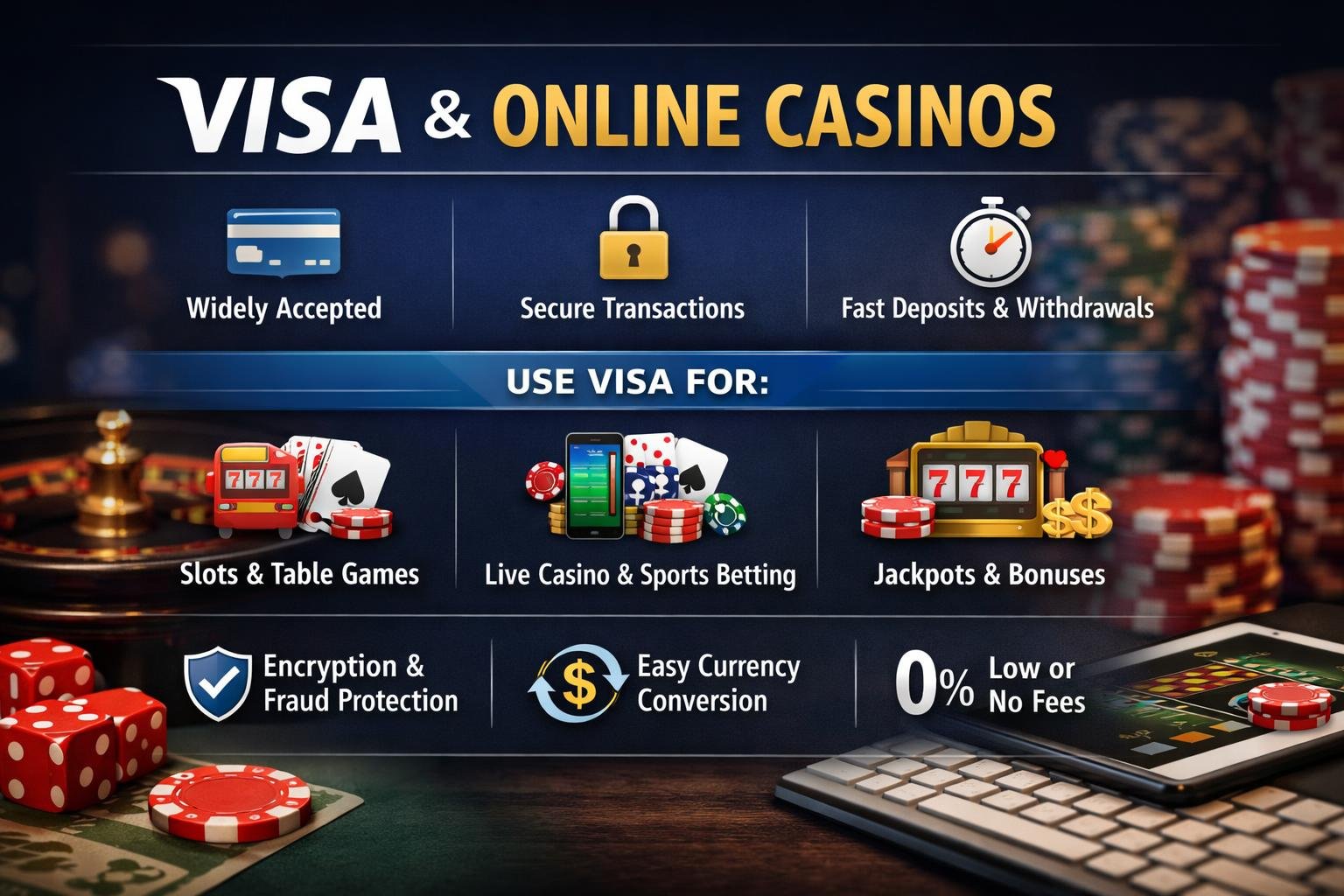
Visa is a global payment network that lets you move money from your bank account to online casinos with debit or credit cards. I’ll walk you through what Visa actually is, how it became the online casino standard, and why so many players (myself included) stick with it.
Payment Method Overview
Visa connects your bank to the casino’s cashier. When you deposit, Visa authorizes the transaction and moves your funds to the casino’s account—simple as that.
You’ve got three main Visa card types for casino payments. A Visa debit card pulls from your checking account. A credit card borrows from your credit line (though if you’re in the UK, remember that’s a no-go for gambling). Visa Electron is prepaid, so you can only spend what’s loaded.
This whole process uses standard online banking protocols, so your info stays safe. I just enter my card details—number, expiration, CVV, deposit amount—on the casino’s banking page.
Visa checks with my bank, then green-lights or blocks the payment based on available funds and security. Usually, it’s done in a minute or two.
Most casinos accept Visa because it processes transactions in 200+ countries and 160 currencies. That reach is tough to match, making Visa one of the most accessible casino payment methods out there.
History and Development
Visa started back in 1958 as BankAmericard, dreamed up by Bank of America in California. In 1976, they rebranded as Visa to go global.
Online payments came into the picture in the 1990s as internet shopping took off. Visa adapted quickly, letting casinos securely accept card payments online.
By the 2000s, they rolled out fraud protection like 3D Secure and Verified by Visa. These require you to enter a password or verification code during transactions, which makes both debit and credit card payments a lot safer for online gambling.
Visa now processes billions of digital transactions every year. They’re always upgrading for faster speeds and tighter security—it’s a moving target, but Visa keeps up.
Popularity Among Online Casino Players
Almost every licensed online casino I’ve reviewed takes Visa for deposits. That’s huge for players who want flexibility and quick access to multiple sites.
People stick with Visa because there’s no need to juggle extra accounts or apps. I can use the same card I keep in my wallet—no setup, no waiting.
The name alone inspires trust. Visa’s reputation and anti-fraud tech give me (and most players) confidence, especially when trying out new casinos.
It’s not just for casual players. High rollers love that Visa usually allows bigger deposits than most e-wallets or alternative methods. If you want to fund your account with a serious amount, Visa rarely lets you down.
Why Do Casinos Use This Payment Method?

Casinos love Visa because it opens the door to millions of players around the world and slashes payment failures and fraud headaches. The Visa network makes deposits instant and withdrawals reliable, which keeps both sides happy.
Key Benefits for Casinos Table
|
Benefit |
Impact on Casino Operations |
|---|---|
|
Global Reach |
Access to players in 200+ countries and territories |
|
High Success Rate |
Fewer declined transactions compared to other methods |
|
Instant Processing |
Players can fund accounts and start playing immediately |
|
Lower Chargeback Risk |
Built-in verification reduces fraudulent disputes |
|
No Third-Party Setup |
Players don't need separate accounts to make payments |
|
Brand Trust |
Visa name increases player confidence in the casino |
Seamless Integration with Gaming Platforms
In my experience, Visa plugs right into casino payment systems—no complicated setup, no headaches. Most payment processors already have Visa support baked in, so casinos can start accepting it right after getting their license.
Currency conversion? Visa handles that behind the scenes, which means casinos can welcome players from all over without building separate payment options for every country.
Visa works on every device I’ve tried. Like Amex, it flags high-value transactions for extra security. You can deposit from your desktop with a physical card, or link Visa to Apple Pay or Google Pay for mobile play. That flexibility keeps players from bouncing due to payment hassles.
Security and Fraud Prevention
Casinos trust Visa’s anti-fraud tools to stop sketchy transactions before they go through. The 3-D Secure step makes players verify their identity with their bank, which shuts down most unauthorized use.
Visa’s network watches transactions in real time with machine learning. If something looks off, it blocks the payment—no human needed. This keeps both casinos and legit players safe from fraud.
Every casino that takes Visa has to follow PCI DSS rules. That means secure data storage and regular security checks. It’s not just a checkbox—it’s what keeps your info safe and helps casinos avoid ugly data breaches.
Encrypted transactions are the norm. Your sensitive financial details never end up in the wrong hands. I wouldn’t trust a casino that didn’t use this level of protection.
Benefits for Players

Visa gives you direct access to your funds, tight security, and rapid processing. You don’t need extra accounts or apps, and most casinos let you claim bonuses when you deposit this way.
Ease of Use and Accessibility
I honestly think Visa is the easiest payment method out there. You just enter your card info at the cashier, and the money moves from your bank—no hoops to jump through.
Pretty much every licensed online casino takes Visa. I never have to double-check payment options before signing up, which saves time.
It works on desktop and mobile, and you can even use Apple Pay or Google Pay for quick mobile deposits. Most folks already have a Visa card, so there’s no learning curve.
Depositing with Visa feels like second nature. It plays nicely with your regular banking apps, so there’s nothing new to learn or install. I’ve seen players new to online casinos pick it up in seconds.
You can grab welcome bonuses and free spins using Visa. Most casinos don’t put restrictions on it for promos, so you’re not missing out. I always recommend checking bonus terms, but Visa almost always qualifies for the good stuff.
Speed of Deposits and Withdrawals Table
|
Transaction Type |
Processing Time |
Availability |
|---|---|---|
|
Deposits |
Instant |
24/7 |
|
Withdrawals |
1-5 business days |
During bank hours |
Deposits hit your casino account almost instantly. I’ve started playing within seconds of topping up—no exaggeration.
Withdrawals, though, do take longer. Most casinos process Visa withdrawal requests in 24-48 hours, but your bank might add another 1-3 business days. That’s just the nature of card payments.
Enhanced Security Features
Visa shields your payments with SSL encryption and Visa Secure (that’s 3-D Secure 2.0). You’ll get prompted to verify your identity before money moves, which blocks most fraud.
The network’s always watching for weird activity using multi-layer fraud detection. Your bank adds another review on top of that if something looks off.
All casinos that accept Visa must meet PCI DSS security standards. This means your card data gets stored and transmitted with serious encryption. If something does go wrong, you can dispute charges through your bank—an option you don’t always get with newer payment methods.
How Does This Payment Method Work?

Using Visa at online casinos is about as straightforward as it gets. Deposits land instantly, withdrawals take a bit longer, and you do it all with your existing bank card—no extra apps, no extra accounts, just the card you already trust.
Step-by-Step Guide to Deposits
Depositing with Visa? Honestly, it usually takes me less than a minute. I log into my casino account and head straight to the cashier or deposit area.
From there, I pick Visa from the payment options—no surprises there. Then I punch in the 16-digit card number, expiration date, and that little three-digit CVV on the back.
I type in the deposit amount. Most casinos now use 3-D Secure, so I get a text or a prompt in my banking app to approve the payment.
This extra step adds a layer of security, which I appreciate. Once I hit confirm, the funds show up in my casino balance right away—no waiting around.
Step-by-Step Guide to Withdrawals
Withdrawals with Visa work a lot like deposits, but they take longer—something that still bugs me after all these years. I go to the withdrawal section, pick Visa, and enter how much I want to cash out.
Sometimes the casino asks for ID or a utility bill before processing, especially if it's my first withdrawal. It’s a one-time security check, but don’t be surprised if it slows things down.
After I send the request, the casino team reviews it. Processing time really varies—sometimes just a few hours, sometimes up to two business days.
Once they approve it, the money heads to my Visa card. My bank usually takes another 1-5 business days to post the funds, depending on how efficient they feel like being.
Transaction Fees and Limits
Most online casinos won’t tack on extra fees for Visa deposits or withdrawals. But don’t forget—your bank might still slip in a small charge for gambling transactions or currency conversion, especially if you’re playing internationally.
Deposit limits always depend on the casino and your card. I usually see minimums in the $10-$20 range, while maximums can shoot up to $5,000 or even $10,000 per transaction. Some banks also cap your daily spending, so keep an eye on that.
Withdrawal limits tend to be higher. In my experience, most casinos let you pull out $500 to $5,000 at a time, but some set weekly or monthly caps. If you’re a VIP, you’ll often get bumped up limits—worth asking about if you play big.
Compatibility and Global Reach
Visa’s reach is almost unmatched in the online casino world. I’ve played everywhere from the US to Europe and rarely run into a site that doesn’t take Visa.
It works smoothly on mobile and desktop, and I’ve never had trouble with currency support as long as I stick to legal, licensed casinos.
Availability in Different Countries Table
Visa casino payments show up in nearly every regulated market I’ve tested. Most licensed online casinos accept Visa for deposits, but withdrawal options can get tricky depending on where you live and your local banking rules.
|
Region |
Visa Deposit Availability |
Visa Withdrawal Availability |
Notes |
|---|---|---|---|
|
United States |
Available at US online casinos |
Limited (varies by state) |
High decline rates due to bank blocks (MCC 7995); some states restrict transactions |
|
United Kingdom |
Widely accepted |
Available |
Full support at UK-licensed sites |
|
Canada |
Widely accepted |
Available |
Most provinces allow Visa transactions |
|
European Union |
Widely accepted |
Available |
Compliance with local gambling laws required |
|
Australia |
Limited |
Restricted |
Many banks block gambling transactions |
|
Asia-Pacific |
Varies by country |
Varies by country |
Depends on local regulations |
In some countries, banks or payment processors block gambling transactions altogether. I’ve run into this myself—sometimes your card just gets declined, and there’s not much you can do except try another method.
Supported Currencies Table
Visa handles all the major global currencies at online casinos. If you deposit in a different currency, Visa just converts it for you automatically.
|
Currency |
Support Level |
Typical Conversion Fee |
|---|---|---|
|
USD ($) |
Universal |
0-3% |
|
EUR (€) |
Universal |
0-3% |
|
GBP (£) |
Universal |
0-3% |
|
CAD ($) |
Wide |
1-3% |
|
AUD ($) |
Wide |
1-3% |
|
JPY (¥) |
Moderate |
1-3% |
|
NOK, SEK, DKK |
Moderate |
1-3% |
Conversion fees depend on your bank, not the casino. I always tell players to check with their card issuer before making big international deposits—those little fees add up faster than you’d think.
Mobile Compatibility and Usability
Visa just works on mobile—no extra apps, no fuss. I enter my card details right in the mobile browser, or sometimes I use Apple Pay or Google Pay if the casino supports it.
Deposits hit instantly on my phone, just like they do on desktop. Whether I’m using iOS or Android, I’ve never hit a snag with Visa on a legit casino site.
Visa Secure authentication pops up as a text or app notification, even on mobile. It’s an extra step, but it’s quick and keeps my money safe without slowing me down.
Comparison with Other Payment Methods
Visa’s got some clear strengths compared to other casino payment methods, but let’s be honest—every option comes with trade-offs. E-wallets pay out faster, prepaid cards help you stick to a budget, and crypto’s the king of privacy.
Advantages Over Other Options
Visa wins for sheer acceptance. If a casino takes cards, you can bet they take Visa—much more reliably than PayPal or Venmo, especially in the US.
Paysafe is great for one-way deposits, and Amex appeals to high rollers, but Amex just isn’t as widely accepted. E-vouchers and prepaid cards like PaysafeCard offer unique perks, but most can’t handle withdrawals like Visa prepaid cards can.
Setup is a breeze. No need to open new accounts or mess with extra logins like you do with Skrill, Neteller, or PayPal. I just use my existing debit or credit card and I’m good to go.
Visa prepaid cards like Play+ and VanillaDirect help me control my spend—you load what you want, and that’s it. Unlike most prepaid cards, Play+ actually lets you withdraw, which is a game-changer for budget-minded players.
Security’s another strong point. My card info stays encrypted, and I get fraud protection that you’ll never see with cash or PayNearMe. Mastercard casinos offer similar security, but Visa still edges them out on global reach.
Disadvantages Compared to Competitors
Let’s talk about the elephant in the room: withdrawal speed. E-wallets like PayPal, Skrill, and Neteller get you your winnings in 24-48 hours, sometimes even faster. Visa? You’re looking at 2-5 business days, which feels like forever if you’re waiting on a big win.
Banks sometimes block casino transactions, especially with credit cards. I’ve had cards declined for no good reason, and it’s a headache. Amex gives you higher limits but runs into the same roadblocks. ACH and eCheck payments dodge these issues since banks see them as regular transfers, not gambling.
Fees can sneak up on you. Some casinos charge 2-3% for credit card deposits, while debit cards are usually free. Bank wires and Apple Pay often cost less, and Play+ prepaid cards usually skip fees altogether at the right sites.
If privacy matters to you, Visa isn’t the best pick. Your card links straight to your identity and bank account. Bitcoin and prepaid options like PaysafeCard keep things much more anonymous.
Best Use Cases
I stick with Visa debit cards for my everyday deposits—fast, easy, and no extra accounts to manage. They’re perfect for sweepstakes casinos and any regular online casino that takes Visa.
When I want to keep my gambling budget separate, I’ll use a credit card like Visa or Amex. That way, my daily spending account stays untouched, and I rack up some rewards points on the side.
For strict budgeting, Play+ prepaid cards are my go-to. I load what I’m willing to lose, and if I win, I can pull the money right back to the same card. PaysafeCard and PayNearMe work too, but most can’t handle withdrawals.
If I’m moving more than $1,000, I usually switch to bank wire or ACH—no sense maxing out my card and risking a decline. For quick withdrawals, I always pick PayPal or another e-wallet over Visa.
Licensing and Regulatory Compliance
Casinos that accept Visa have to meet strict licensing rules and follow tight security protocols. These requirements keep players safe and make sure every transaction stays on the right side of the law.
Licensing Requirements
Licensed online casinos have to secure approval from recognized gambling authorities before they can process Visa payments. Every jurisdiction plays by its own set of rules, and trust me, they can vary wildly.
When I look for a legit site, I check if they’re licensed by heavyweights like the UK Gambling Commission, Malta Gaming Authority, or one of the state gaming boards in the US. These regulators actually dig into a casino’s finances, payment flows, and security protocols before giving out a license.
In my experience, if a casino skips the licensing step, Visa won’t touch them. That’s because Visa enforces strict rules around gambling payments, and they’re not shy about cutting off unlicensed operators.
Licensed casinos also need to obey local banking laws wherever they operate. For instance, the UK bans credit card gambling, but certain US states allow it—if you know where to look.
Anti-Money Laundering (AML) and Know Your Customer (KYC) Policies
If you’re using Visa at an online casino, get ready for KYC checks. The casinos will ask for your ID, proof of address, and age verification before they let you deposit or cash out.
I’ve noticed these checks often come in waves. You might get away with just basic info at first, but if you start moving larger amounts, the casino will want more details.
AML monitoring is always running in the background, scanning Visa transactions for anything weird. Things like quick deposit-and-withdraw cycles, big transfers, or payments from sketchy regions set off alarms. Casinos have to flag and report anything that looks fishy.
KYC isn’t just a box to tick—it keeps fraudsters and underage players out. Most sites want you verified within 72 hours after your first deposit, so don’t put it off.
Certifications and Third-Party Audits
Any casino that handles Visa payments must have PCI DSS certification. This means they encrypt and lock down your card data, which I always double-check before depositing.
Independent labs regularly audit casino payment systems. These audits make sure transactions are logged correctly and that the security actually holds up under pressure.
Multi-factor authentication is becoming the norm. Lots of casinos now make you enter a password and a code they text or email you—it's a pain, but it works.
Before I ever trust a site with my Visa, I look for up-to-date SSL certificates and recent audit results. These are the basics for responsible gambling and keeping players safe. If a casino can’t show proof, I move on.
Common Issues and How to Resolve Them
Most Visa payments at online casinos go off without a hitch, but I’ve seen plenty of cases where players hit snags—delays, errors, or outright failures. Nine times out of ten, it’s either not enough funds, your bank blocking the payment, or a typo in your details.
Transaction Delays
Deposits with Visa are almost always instant, at least in my experience. Withdrawals, though, can drag out—anywhere from 1 to 5 business days, depending on the casino.
Some sites move fast and process within 24 hours, but others can take up to three days before they even start the payout. Your bank might slow things down even more, especially for first-time or high-value withdrawals.
Holidays and weekends? Forget about it—banks won’t process anything until the next business day. If my withdrawal gets stuck, I log in and check the status: “pending” means the casino’s still working on it, while “completed” means the money’s on its way.
If you haven’t cleared all the verification steps, don’t expect your withdrawal to go anywhere. Casinos freeze payouts until they’ve checked your ID.
Deposit or Withdrawal Errors
Failed deposits usually mean one of two things: not enough cash in your account, or you’ve hit your card limit. I always double-check my balance and limits before trying again.
In the States, banks love to block gambling payments using the 7995 code. I’ve seen plenty of legit transactions get declined for no good reason—even when the casino’s fully licensed.
Quick fixes I use:
-
Check your card number, expiration, and CVV—typos happen to the best of us.
-
Make sure your billing address matches what your bank has on file.
-
Try a smaller deposit if you’re bumping up against your card’s daily limit.
-
Clear your browser’s cache and cookies—it sometimes helps.
-
Switch browsers or devices if nothing else works.
If I’m still getting nowhere, I switch to another Visa card or use an e-wallet. E-wallets, in particular, tend to sail through where cards get blocked.
Contacting Support
When DIY fixes fail, I go straight to casino support. Live chat is my go-to because it’s fast, and I can drop a screenshot right into the chat window.
Be specific—give them the date, time, amount, error message, and any confirmation numbers you have. The more details, the faster they’ll track down your transaction.
If it’s a Visa-specific hiccup, I also call my bank. Sometimes they’re the ones blocking the payment, and they can clear it or at least explain what’s going on.
Pros and Cons
Visa strikes a solid balance between convenience and security, but it’s not perfect. After years of testing, here’s what stands out—both good and bad—when you pay with Visa at online casinos.
Four Advantages Table
|
Advantage |
Description |
|---|---|
|
Wide Acceptance |
Visa works at almost every online casino I’ve played on. One card, tons of sites, no need to juggle accounts. |
|
Strong Security |
Visa’s fraud protection and encryption give me peace of mind. If someone tries to use my card, I can dispute it through my bank. |
|
Easy to Use |
No need to open new accounts or remember endless passwords. Just punch in your card details and you’re set. |
|
Bonus Eligibility |
Visa deposits almost always count for casino bonuses. I use Visa for match offers and to meet wagering requirements without hassle. |
Four Disadvantages Table
|
Disadvantage |
Description |
|---|---|
|
Processing Fees |
Some casinos tack on a 2-3% fee for Visa deposits. My bank might also charge for international transactions, so it’s worth checking. |
|
Withdrawal Restrictions |
Not every casino lets you cash out with Visa, and some take 3-5 days to process. Sometimes you’ll need a backup payout method. |
|
Declined Transactions |
Banks can block casino payments out of nowhere. I’ve had to call my card issuer more than once to get things moving. |
|
Spending Limits |
Daily caps on my card sometimes block bigger deposits. If you’re chasing a hefty bonus, you might hit a wall. |