












Open banking is where new financial rules meet online casino payments. Basically, it lets you tell your bank to send money straight to an online casino using a secure connection—no need to hand over your card numbers or passwords to the casino itself.
Think of it as a shortcut. You get a payment route that's quicker than a regular bank transfer and feels more open than using a card. For many folks, the built-in security is the real selling point. Open banking has changed the way people fund their online casino accounts. Simplicity and speed are what you’ll notice most as a player.

Depending on where you live and which company is in the middle, this method goes by a few names: Pay by Bank, instant bank transfer, account-to-account payment, or just open banking. Companies like Trustly and Zimpler have built their casino payment tools on this system, but the foundation is the same no matter what logo you see.
Here’s what actually happens: a regulated third party connects your bank to the casino through a secure payment gateway. You approve the payment using your bank’s own app, and the money moves almost instantly. The whole thing feels pretty seamless, which is a big reason so many people are trying it out.
I’ve tested open banking casino payments quite a bit, and honestly, it’s one of the friendliest options for players—especially in the UK and Northern Europe, where banks are already set up for it. It’s not everywhere yet, and it fits some people’s needs better than others. Let’s break down what you can expect.
Key Takeaways
-
Open banking deposits usually arrive right away, and you don’t have to enter card details or set up another account.
-
Withdrawals to your bank account are often quicker than using cards or regular bank transfers.
-
Whether you can use it depends a lot on your country and whether your bank supports open banking. It’s much easier to find good bank transfer casinos in places with strong digital banking.
What This Method Is And Why Players Use It
Open banking is basically a set of rules and tech that lets your bank safely share payment info with approved third parties. In plain English, you can fund your casino account by connecting straight to your bank. In countries with good regulations, it’s becoming the go-to for people who want fast, private deposits. You confirm the payment (usually with your fingerprint or face), and your money’s there almost right away.
This isn’t an e-wallet. It’s not a card either. It’s a direct bank-to-bank payment. Regulators in the UK (the FCA) and the EU (PSD2 rules) keep an eye on it, so there’s a safety net in place.
Key Facts At A Glance
|
Feature |
Detail |
|---|---|
|
Method type |
Account-to-account instant bank transfer |
|
Typical deposit speed |
Instant to a few minutes |
|
Typical withdrawal speed |
Minutes to 24 hours (varies by casino and bank) |
|
Withdrawals supported |
Yes, at casinos that enable the payout flow |
|
Typical fees |
Usually free for players; some casinos may charge small withdrawal fees |
|
Regulatory framework |
PSD2 (EU), FCA-supervised (UK); local equivalents in other markets |
|
Bonus eligibility |
Generally eligible; varies by casino terms |
How Open Banking Differs From Cards, E-Wallets, And Bank Transfers
Here’s the main thing: the payment route is different. When you use a card, your details bounce through several companies before reaching the casino. With an e-wallet like Skrill or Neteller, you load up a separate account that sits between you and the casino. Traditional bank transfers? You have to send the money yourself and wait a few days.
Open banking skips most of those steps. Casinos add it to give you a smoother choice if you don’t want to use cards. The casino starts the payment, a licensed open banking company sends it to your bank, and your bank takes care of the rest. Your card number and passwords never go to the casino.
Unlike prepaid cards, open banking also lets you withdraw your winnings, which prepaid cards usually don’t. That’s a handy perk.
Who It Suits Best
Open banking is a great fit for players who:
-
Want instant deposits without making a separate e-wallet account
-
Like withdrawals going straight to their bank account
-
Don’t feel comfortable entering card details on gambling sites. It’s also super useful for sports betting, where you might need to move fast to grab live odds.
-
Already use mobile banking with fingerprint or face unlock
It’s probably not for you if your bank doesn’t support open banking, if you want to keep gambling off your bank statement, or if you prefer using prepaid cards to control your spending.
How Deposits And Withdrawals Work In Practice
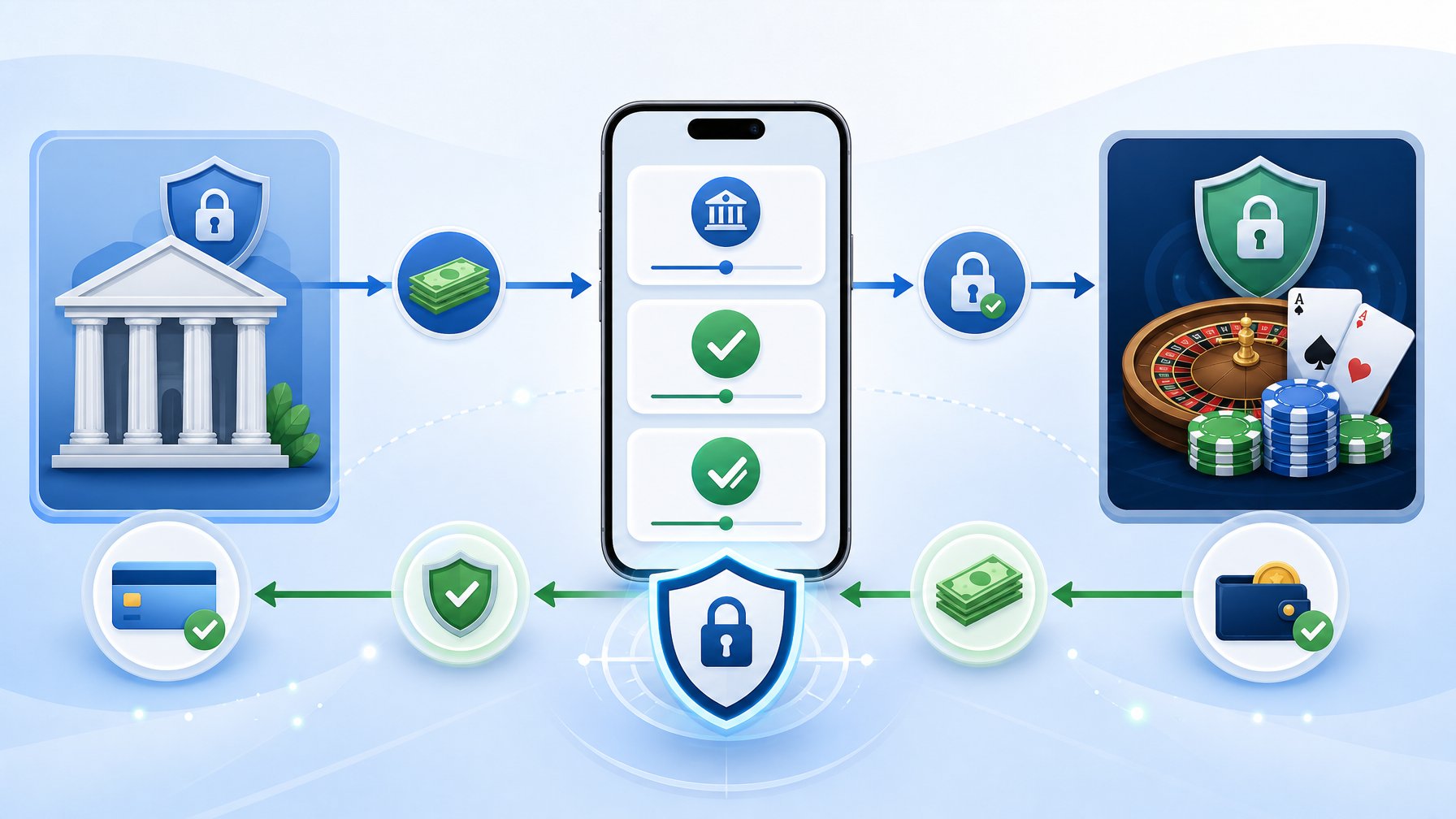
Depositing and withdrawing with open banking is pretty simple once you’ve done it. No need to set up new accounts, fund a wallet, or mess with reference numbers. Everything goes through your regular bank account and its security checks.
The system checks your bank account automatically—no need to share your login with the casino. This step is important for meeting gambling rules and keeping your info safe.
What Happens In The Casino Cashier
When you’re ready to deposit, pick open banking (or whatever brand name the casino uses, like Pay by Bank or Trustly) in the cashier. Enter how much you want to deposit, then choose your bank from the list.
Next, you’ll jump over to your bank’s secure site or app. Confirm the payment and prove it’s you—usually with a fingerprint, face scan, or a code sent to your phone. The tech behind the scenes makes sure the casino gets notified right away, so your account balance updates almost instantly.
From what I’ve seen, the whole thing usually takes less than two minutes from start to finish.
Bank Authentication And Approval Flow
Your bank, not the casino or payment provider, handles all the security checks. Depending on your bank, you might use:
-
Face ID or fingerprint in your banking app
-
A one-time code texted to your phone
-
Your usual online banking password plus a second step
This is called Strong Customer Authentication (SCA)—the law says banks have to do it. It works a lot like the security checks you see when paying with cards, but here, your bank controls the whole process. Two-factor authentication is built in by default. This makes it really tough for anyone to move your money without your say-so. Banks use smart fraud detection tools to watch every transaction as it happens.
Using The Same Verified Account For Cashouts
Here’s a big plus: the bank account you use to deposit is usually the same one you get your winnings sent to. Since the open banking provider already checked that your casino account matches your bank account, casinos can send withdrawals back without making you jump through more hoops.
Withdrawals are often faster than with cards, where refunds can get held up by the card company. Some casinos can send your winnings back in minutes if they use real-time payouts. Others might process withdrawals in batches, so you could wait a bit longer. Either way, it cuts down on manual checks for the casino staff.
Speed, Fees, Limits, And Bonus Eligibility
Speed is probably the number one reason people pick open banking for casino payments. Since it skips card networks and old-school clearing houses, you get your money faster—both when you deposit and when you cash out.
Typical Deposit And Withdrawal Timelines
|
Transaction type |
Typical speed |
Notes |
|---|---|---|
|
Deposit |
Instant to 2 minutes |
Subject to bank authentication |
|
Withdrawal |
Minutes to 24 hours |
Faster than cards; casino processing time varies |
|
Withdrawal (non-instant casino) |
Up to 3 business days |
Depends on casino's payout batch schedule |
Deposits usually show up even faster than card payments because there’s no card processor in the middle. Withdrawal speeds depend on how the casino handles payouts. Some, like those using Trustly, can send your winnings in minutes. Others might pay out once or twice a day, so there’s a bit of a wait.
Casinos use smart systems to make sure their records match the bank’s almost immediately. Sometimes, the only holdup is the casino double-checking their books before releasing your money.
Where Fees Usually Appear
For most players, open banking deposits don’t cost anything. Casinos almost never tack on a deposit fee for this method, since it’s cheaper for them than handling card payments.
Some casinos do charge a small withdrawal fee, especially if you’re taking out a lower amount. If your bank account uses a different currency than the casino, you might also see some exchange rate margins.
Apple Pay and Google Pay sometimes use open banking behind the scenes in certain markets, even though they’re technically different products. Skrill and Neteller work as separate e-wallets and don’t use open banking at all.
Some folks like using ETH because it’s decentralized, but direct bank payments usually mean better regulatory oversight. ETH and other crypto withdrawals run on totally different systems, so you’ll want to weigh the speed of ETH against the security of bank-direct payments.
Limits, Supported Currencies, And Welcome Offer Rules
Deposit and withdrawal limits jump around depending on the casino and which open banking provider they use. Usually, you’ll see minimum deposits between £5 and £20.
Maximum single transactions can go up into the thousands, but the casino decides that—not the banking system itself.
Supported currencies depend on the banks and providers the casino works with. GBP, EUR, and SEK pop up the most at casinos using well-known open banking platforms. USD is becoming more common, but it’s still a bit patchy.
Bonus eligibility tends to be pretty good for open banking. Unlike some e-wallets (like Skrill and Neteller, which casinos often exclude from welcome bonuses), open banking deposits usually count just like card deposits for bonus purposes. Still, always double-check the casino’s terms, since every operator has their own quirks.
Safety, Verification, And Regulatory Context
Open banking is one of the most tightly regulated ways to pay in consumer finance. The rules about how providers can access your bank data, confirm payments, and handle your consent are all set out in law across the EU and UK.
Operators licensed by the UK Gambling Commission use these strict protocols to keep players safe. That means both you and the casino have regional laws on your side if something goes wrong.
For casino players, this adds several layers of protection you just don’t get with some other payment types.
PSD2, SCA, And Consent-Based Payments
PSD2 (the EU’s Payment Services Directive 2) and its UK twin created the legal backbone for open banking. Any third-party provider wanting access to your bank data or to start payments needs to be authorized by a financial regulator.
In the UK, that’s the FCA. In EU countries, national regulators take care of oversight.
The consent model is a huge part of the safety net here. You have to say yes to every payment, or give standing consent for repeat payments, and you can pull that consent anytime through your bank’s app.
Once you revoke consent, nothing else moves—your data stops flowing immediately.
SCA (Strong Customer Authentication) is a must for every open banking transaction. Basically, you’ll need at least two out of three things: something you know, something you have, or something you are. Usually, that’s a fingerprint or face scan plus your device.
KYC, AML, And Identity Checks
Open banking really speeds up KYC (Know Your Customer) checks at casinos. Since the payment comes from your own verified bank account, the casino can check your identity through the transaction instead of asking you to upload a pile of documents.
This makes life easier for players by cutting down on the hassle of verifying your account. Casinos also benefit, since it helps them meet their anti-money laundering (AML) rules and spot financial crime more easily.
Every transaction links directly to your real, verified bank account, so there’s a clear paper trail. That makes it much simpler to spot fraud, since payments come straight from accounts tied to actual people.
Casinos still have to run their own ID checks no matter how you pay. Open banking doesn’t replace the casino’s KYC process, but it does make it faster and less painful. By confirming who you are through your bank data, operators can skip some of the usual document headaches.
What To Watch Out For Before You Deposit
Here are a few things to keep in mind before you jump in:
-
Bank visibility: Open banking payments will show up on your bank statement as gambling transactions. If you share your account or your bank blocks gambling payments, this could be a problem.
-
Bank participation: Not every bank is on board with open banking yet. Some challenger banks and smaller institutions might not appear on the provider’s list.
-
Casino licensing: Open banking keeps things secure on the banking side, but the casino still needs to be licensed by a recognized regulator like the UK Gambling Commission or Malta Gaming Authority. If a casino isn’t licensed, steer clear—no payment method can fix that risk.
-
No chargebacks: Once you authorize an open banking payment, you can’t reverse it like you can with a card. If you have a dispute, you’ll need to go through the casino’s complaints process or the gambling regulator, not your bank.
-
Responsible gambling tools: Open banking data helps casinos keep an eye on spending and set responsible gaming limits. When your financial data is clear and verifiable, it’s easier for casinos to spot risky behavior and help keep things safe.
Regional Availability And Pay N Play Variations

Open banking isn’t equally available everywhere. How well it works depends on local rules, which banks are in, and whether casinos have set up the right connections behind the scenes.
It’s worth knowing where open banking is strong so you don’t get your hopes up in the wrong market.
Where Open Banking Is Most Established
The UK leads the way for open banking in online gambling. Since 2018, all the big banks have to offer open banking APIs, and the FCA keeps a public list of approved providers.
If you’re in the UK, you’ll probably spot open banking at most licensed casinos.
Sweden and Finland are right up there too. SEPA Instant credit transfers make euro payments fast all over much of the EU. For example, Dutch players using ING can often get lightning-quick settlements thanks to these systems.
In the US, things are still developing. Open banking rules are coming together at both state and federal levels, but online gambling payments are hit-or-miss. It really depends on your state’s laws and which payment options the casino supports.
Pay N Play And Faster Onboarding
Pay N Play is a special product built on open banking rails, mainly by Trustly for the Nordic and EU markets. It lets you deposit and verify your identity in one go—just a single bank authentication step and you’re ready to play.
With Pay N Play casinos, you can skip the usual long sign-up process. Your deposit doubles as your ID check, so you’re in the game almost instantly.
This approach took off in Sweden and Finland, where it’s now the standard way to sign up at many licensed casinos.
In the UK, Pay N Play is rare, and in the US, it’s basically unavailable because local rules demand more formal registration steps.
Why Availability Depends On Banks And Local Rules
Whether you can use open banking at a casino comes down to three things: the casino needs to work with an open banking provider, that provider needs a connection to your bank, and your bank has to participate in the open banking scheme.
If any of those pieces are missing, open banking just won’t show up as an option or the payment won’t go through. Third-party providers handle the technical side, so the choices your casino makes really matter here.
In newer open banking markets, even well-stocked casinos might not offer as many options yet.
How It Compares With Other Common Options
No payment method is perfect. Open banking is quick and secure compared to most alternatives, but sometimes other options fit better depending on your needs.
When It Beats Cards And Standard Bank Transfers
Open banking usually wins for withdrawal speed compared to debit and credit cards. Card withdrawals can drag on for three to five business days, depending on your card issuer and the casino’s process.
Since open banking uses push payments, casinos see way fewer chargebacks than with cards. Payouts can land in your account within minutes if the casino supports real-time processing.
High approval rates are another plus. Banks rarely block account-to-account transfers, so more payments go through compared to cards.
Standard bank transfers are slower for deposits—think one to three business days—while open banking is nearly instant. You’re sending money straight to the casino’s account, so there’s less risk of funds getting lost between middlemen.
When E-Wallets Or Mobile Wallets May Be Better
E-wallets like Skrill and Neteller put a layer between your bank and the casino, which is handy if you want to keep gambling separate from your main account. Open banking doesn’t offer that buffer.
If you already use Apple Pay or Google Pay, making a deposit can be as easy as a single tap. These wallets also work at more casinos around the world compared to open banking right now.
Crypto withdrawals (like ETH) can be super fast and sometimes cheaper, but you’ll have to deal with price swings and extra steps to convert your funds.
Open banking’s tech is strong, but it’s not everywhere yet. E-wallets are more widely accepted outside the UK and Nordics. Still, in regulated markets, casinos often lean toward bank-direct payments for their added security and reliability.
Pros And Cons Summary
Advantages
|
Advantage |
Why it matters |
|---|---|
|
Instant deposits with no card details shared |
Your funds show up fast, and the casino never sees your card number. It’s a bit like sending money straight from your bank—no middleman holding your info. |
|
Fast withdrawals to a verified bank account |
You can often cash out in hours, not days. That means less waiting and more peace of mind. |
|
Strong regulatory protection under PSD2 and FCA rules |
Open banking providers must be licensed, and you always have to give consent. This adds an extra layer of safety you can count on. |
|
Generally eligible for casino welcome bonuses |
Most casinos let you claim bonuses with open banking, unlike some e-wallets that are often excluded. That’s a nice perk if you’re chasing those welcome offers. |
Disadvantages
|
Disadvantage |
Why it matters |
|---|---|
|
Transactions visible on your bank statement |
Your gambling activity shows up right alongside your other spending. There’s no way to keep it private from your bank. |
|
No chargeback protection |
Once you approve a payment, your bank can’t reverse it. So if there’s an issue, you’ll need to work it out with the casino. |
|
Bank and country availability is uneven |
Not every bank supports open banking, and it’s less common outside the UK, Nordics, and parts of the EU. You may need to check if your bank is on the list. |
|
Withdrawal speed depends on casino payout setup |
Some casinos pay out instantly, but others process withdrawals in batches. You might have to wait longer at certain sites. |
Open banking isn’t for everyone, and that’s completely fine. If you’re curious about other ways to move money, take a look at our full range of casino payment method guides on FreeCasino.co. There’s a good chance you’ll find something that fits what you need.